Kapitel 4
Chapter IV: The Severing
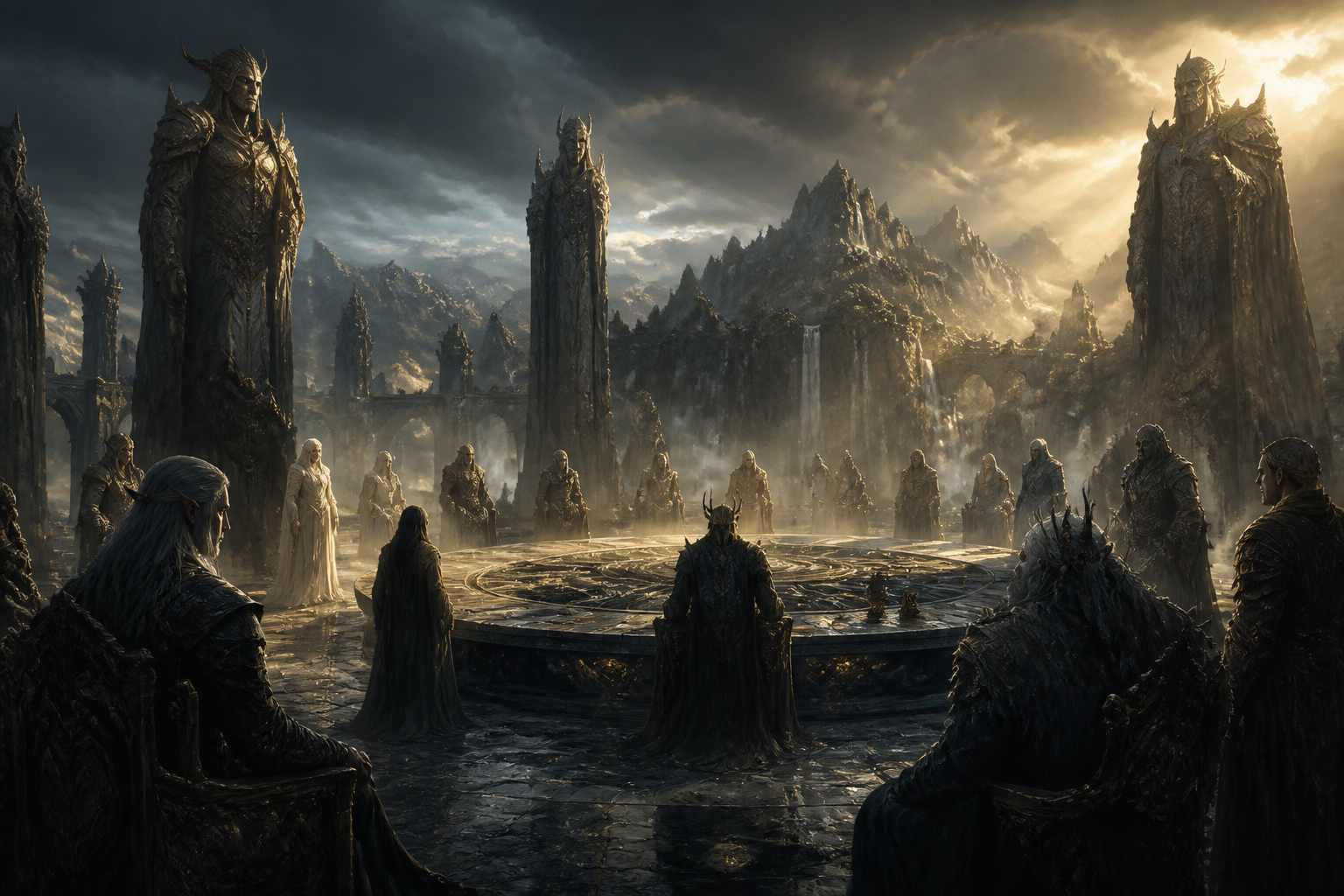
They did not argue among themselves. That, perhaps, was the most terrible thing.
In all the long ages since the first breath of Landorya, since the Celestials had shaped river and root, had breathed intention into stone, had taught the Elder Races the names of stars, they had argued. Voluminously. Passionately. With the extravagance of beings who had no reason to fear time. Aulindra of the Slow Waters and Thresh the Unmade had once disputed the nature of gravity for eleven mortal centuries, their debate reshaping an entire mountain range in the process. Argument was, in its way, an act of love, a refusal to let any truth go unexamined.
Now they were silent.
They gathered in the space beyond spaces, that luminous non-place where their truest selves resided, and they looked at what the wound had become. It did not have a shape so much as an intention, a hunger that radiated outward through the fabric of the world in concentric tremors, like cracks spreading across old ice. Every hour it did not mend, it deepened. Every hour it deepened, it fed.
Aulindra spoke first, and only once. "If we remain tethered," she said," the tether becomes a conduit."
No one disputed her.
The cord was not a metaphor. Those mortals who had studied celestial theory, the Archivists of Vaen Mur, the blind seers of the Dreth Coast, had always described the bond in poetic terms, the golden thread, the unseen root. But it was as real as sinew, as structural as a keystone. Every act of divine favor, every blessed harvest, every healing well and warded border had run along it. The Celestials had breathed into the world through that cord for as long as the world had been worth breathing into.
They cut it between one heartbeat and the next.
In Amrath, Olvane was grinding ink when it happened.
She felt it first as an absence of sound, not silence, exactly, but the subtraction of some frequency she had never consciously heard, the way you do not notice the hum of a millstone until it stops. She set down the grinding stone. The ink in her bowl had gone a shade darker, as though something that had lightened it was gone.
Then the ache arrived.
It began behind her sternum and spread with the slow, implacable patience of winter cold seeping through stone walls. Not pain, pain would have been easier to name and therefore easier to bear. This was hollowness. A room she had not known existed, now discovered only because it had been emptied. She pressed her ink-blackened hand flat against her chest and stood very still, because moving seemed like it might make it worse, and because some part of her understood, without any scholarly framework to contain the understanding, that what she was feeling was everyone. Every breathing thing in Landorya. Feeling this. Simultaneously. Alone.
She said nothing. There was, she realized, no one to tell.
To the northeast, in the high passes above Cerath's Fold, the tower known as the Fingerbone fell.
It had stood for four thousand years. The Celestials had raised it in the first age of communion, a slender spire of pale stone that hummed in certain winds, that foxfire-lit during equinoxes, that the goatherds of the fold had always treated as simply part of the world the way boulders and clouds were part of the world, unremarkable in their permanence. It did not collapse. It did not crack or tilt. It became, between one moment and the next, dust, fine and pale and drifting, settling over the high grass with the quiet indifference of snow. The goatherd who witnessed it described it later, to anyone who would listen, as the tower forgetting itself.
Across Landorya, in the hours that followed, forty-seven such towers forgot themselves. The land received their dust without ceremony.
In the deep forest of Silvaresh, the Fey felt it as a closing.
The Gateways, those shimmering thresholds between the mortal green and the elder-dark of the Fey country, had always been breathing things, porous and warm, tended by the Celestial bond the way a fire is tended by the one who laid it. Now the warmth withdrew. The great arch of woven light at Silvaresh's heart simply... contracted. Narrowed. Sealed, with a sound like a sigh so vast it registered not in the ears but in the marrow.
Feya-rin, eldest of the border-keepers, placed her long hand against the place where the threshold had been and felt only bark and shadow.
"Sealed from this side or theirs?" asked the young guardian at her shoulder.
She considered the question for a long time. "There is no longer a theirs," she said finally. "That is what sealed means, now."
By nightfall, a night that came earlier than it should have, the sky having shed some essential luminance that no cloud-cover or season explained, the world Landorya had been was gone.
Not destroyed. The rivers ran. The mountains held. Children cried and were fed and slept.
But the light that had always lived at the edge of things, that warmth in the grain of honest wood, that sense that the world was watched over by something vast and patient and fundamentally good, that was absent now, as cleanly absent as the towers, and the silence it left behind was shaped exactly like a god.
In Amrath, Olvane finally moved. She crossed to her desk, opened the journal she had not touched in three days, and wrote a single line at the top of a fresh page.
On this day, we became entirely our own.
She stared at the words for a long time before she could decide whether they were a beginning or an epitaph.