Kapitel 6
Chapter VI: The Long Silence
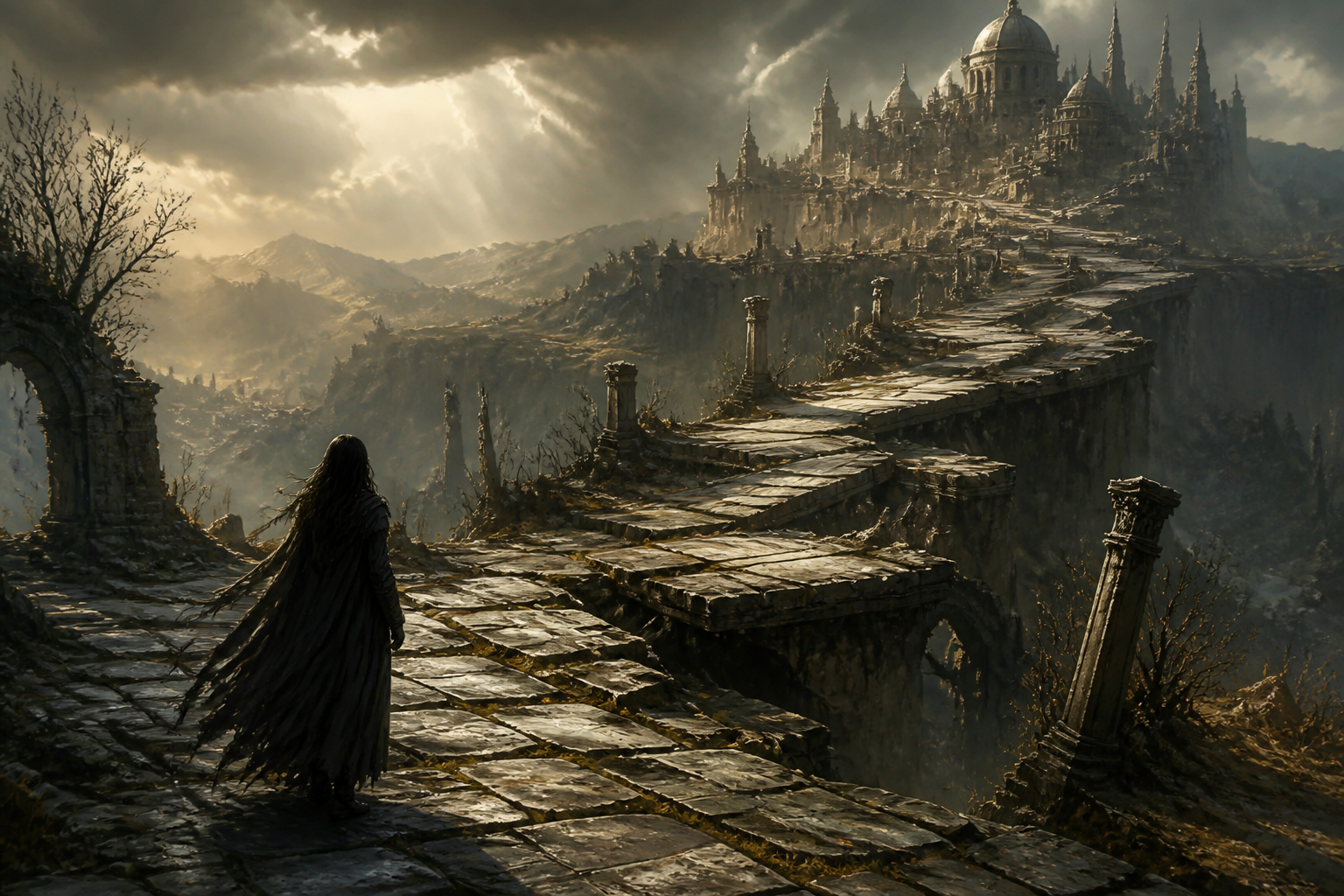
The roads out of Amrath were not roads anymore.
Caelindra Voss walked what had been the Western Processional, a highway of pale stone wide enough for twelve horses abreast, where merchants had once cursed the traffic and children had sold river-figs from reed baskets, and found it buckled into a series of tilted shelves, as though the earth beneath had shrugged and simply forgotten to settle. Grass grew in the cracks. Not the slow, tentative grass of neglect, but thick, urgent grass, the kind that had been waiting centuries for permission.
She did not look back at the city. She had decided this before she left, and she intended to be the kind of person who kept that decision.
Behind her, she knew without looking, others were doing the same. The great dispersal had no announcement, no decree, no single moment of dissolution. It happened the way grief happens, gradually, and then all at once, and then in ways that kept happening long after you believed yourself finished with them. Families moved north toward the Thornwall passes that still existed. Scholars moved east, toward the archive-cities that may or may not have survived. Soldiers moved nowhere in particular, which is a direction that looks like many others from a distance.
Caelindra moved west, because west was where she had been born and because that was the only logic she had left that did not require anything of her.
In the Greyveil highlands, three hundred leagues away, the Dragon Szarathos lay across the summit of Mount Drevorn and did not move for eleven days.
Those who had once made pilgrimage to his fire-scarred plateau, petitioners, scholars, the desperately foolish, came no further now than the foot of the mountain, and even that took courage most of them no longer possessed. They could see him from the valley: a vast, dark shape against the clouds, wings furled, head resting on stone. Occasionally steam rose from his nostrils. Occasionally it did not.
They are gone, he thought, on the fourth day, turning the fact over again the way one turns a wound to see if it has changed. The Celestials are gone and the world remains and the world is wrong-shaped now, a vessel made for something that is no longer in it.
He had known the Celestials as a young dragon knows fire, not merely as warmth but as the entire definition of warmth itself. Their departure was not loss. It was a category of experience for which no word had been coined, because no one had needed the word before now.
On the twelfth day, he rose, and flew north, and did not come south again.
The Fey sealed the Mirethwood on the same afternoon, though no one in the outside world knew this until much later, when a wandering cartographer pressed her palm to what had been the forest's edge and felt nothing, no shimmer, no resistance, no awareness pressing back. Just bark. Just air. Just the ordinary sadness of trees that remembered nothing of her.
Caelindra had been a Keeper of the Third Register. Her function had been the preservation of what was known, and it was a function she carried with her the way she carried her satchel, always, even when it was heavy, especially when it was heavy.
She stopped on the seventh night in the shell of a waystation, its roof open to a sky that had rearranged two of its familiar constellations, and spread her papers on the dirt floor and lit a single candle and worked.
She wrote what she remembered of the Accord of Fires, all fourteen sub-clauses, from memory. She wrote the names of the Elemental Envoys who had stood at the Conclave of Meres. She wrote the year of the Celestials' first speaking, as recorded in the Amber Codex, and then she wrote what the Amber Codex had said about endings: that knowledge carried in the body of a single scholar is not preserved but merely postponed in its loss.
She paused on that line a long time.
In the morning she sealed the papers in oilcloth and found a loose stone in the waystation's eastern wall and placed the packet behind it and replaced the stone and pressed her palm flat against it and said nothing, because there was nothing appropriate to say. The Elementals, who might once have witnessed such a gesture, had retreated into stone and current and thermal deep, and were no longer watching. The Fey were behind their bark and silence. The Dragons were elsewhere, mourning in the private, enormous way that creatures of great age and greater loss are permitted.
She was witnessed only by the grass.
She stood. She lifted her satchel. She walked west.
Across the wounded continent, in ruins and cellars and cliff-faces and the hollowed trunks of trees too old to have names, others were doing what Caelindra was doing. Sealing what they knew into the world's body. Trusting, and this was the particular faith of the broken, the stubborn, the irrationally hopeful, that the world would hold it until someone came looking.
Most of it would lie undisturbed for ages.
Some of it would not.
The Long Silence had begun: not with any sound, but with the careful, desperate hush of people pressing knowledge into stone and walking away, leaving behind them only the soft percussion of new grass growing through old roads, and the distant, settling groan of mountains that had not asked permission to exist, and the slow work of a world learning to remember itself without anyone to tell it how.