Kapitel 7
Chapter VII, The Five Pillars Standing (The Legacy Forged)
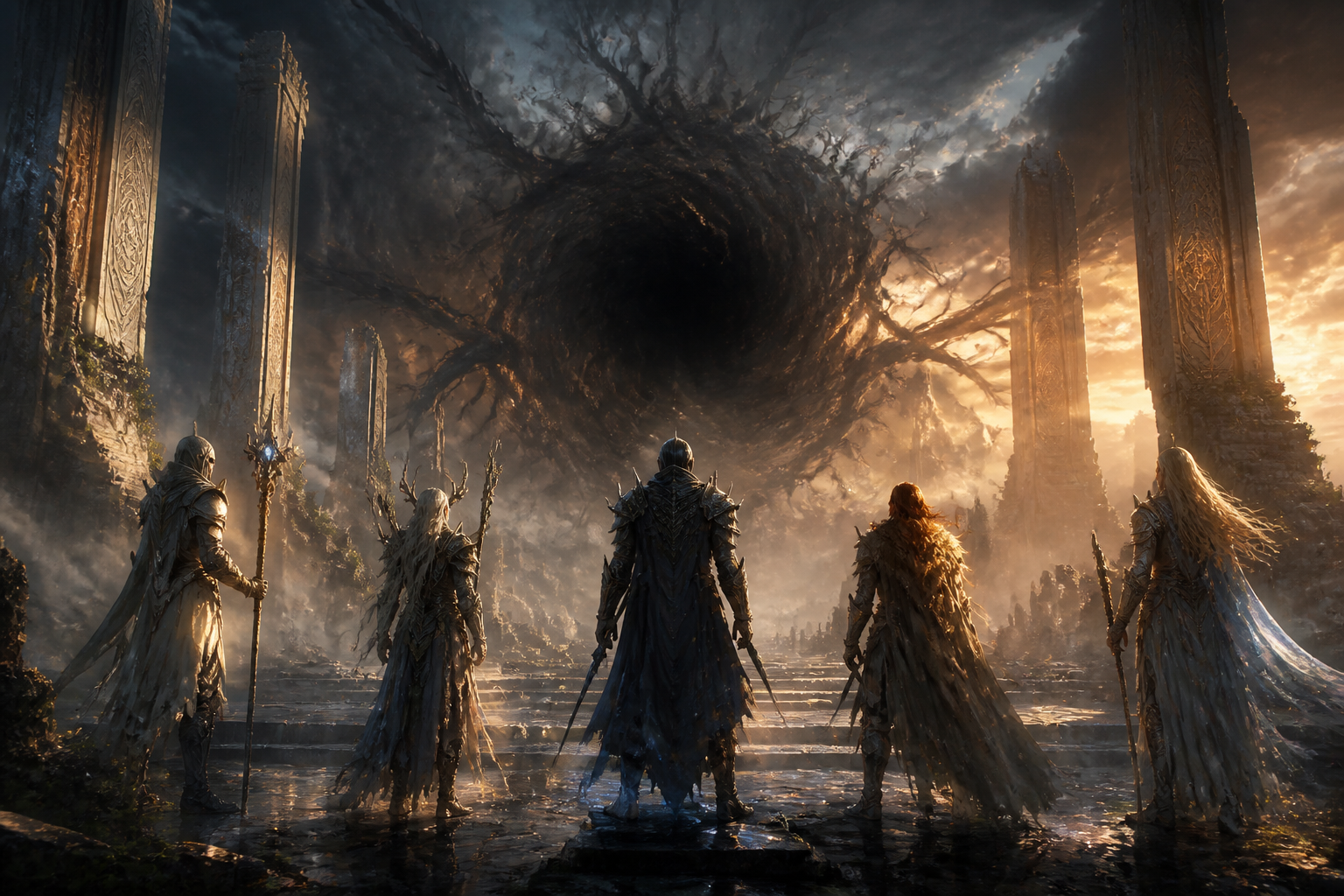
CHAPTER VII, THE FIVE PILLARS STANDING (The Legacy Forged)
They sealed the Null at dawn, or what passed for dawn in a sky still bruised from the Reckoning, the light arriving sideways and unsure of itself, as though the sun too had been shaken loose and was only now finding its footing.
It did not die. None of them had expected it to. The Null was not a thing that could be killed so much as a thing that had to be convinced, over many hours and at extraordinary cost, that it had nowhere left to go. What the five of them built around it, the five of them and the thousands who stood behind them, pouring what remained of their craft and their will into the structure, was not a cage so much as an argument. A permanent, aetheric rebuttal. A shape that said: not here, not ever again, and here is why, written in a language older than language.
Solenne of the Aetherans was the last to withdraw her hands. The others had stepped back one by one as their contributions locked into place, Varrik's stone lattice anchoring the base, the Pyrakian fire-lines running through it like veins, the Oceanan tidal rhythms setting the whole structure breathing, the Zephyrian wind-roads threading it all into coherence, and Solenne had remained, palms flat against the invisible surface of what they had made, feeling for any seam, any doubt, any place where the Null had found a question to press its weight against. She found none. She stepped back. She did not feel victorious. She felt the way a surgeon feels when the patient lives: grateful, exhausted, and already thinking about what she had not yet understood.
"It will hold," she said.
"It will hold," Varrik agreed, his voice carrying the particular flatness of a man who had just spent three days in communion with bedrock and was not yet entirely back. His hands were still-stone from the wrists down, not a wound, exactly, but a transformation the Granite Codex would later describe with a precision that only the Talamhari could have mustered, in those final passages carved not from grief but from necessity. He had not complained. He had simply carved with what remained of his hands until the hands became the carving.
The Zephyrian delegation had already begun transcribing. They could not help it; it was how they processed the world. Meridian, their eldest speaker, dictated to two younger scribes simultaneously, her voice low and continuous as wind through a canyon, encoding the terms of the coalition into what would become the Aetheric Charter, every condition of the alliance, every debt acknowledged, every secret surrendered, set down in high Zephyrian in a script so precise that later scholars would mistake it for natural law. This is simply how magic works, those scholars would say, centuries hence, examining the Charter's principles as though they had discovered them rather than inherited them. They would not know they were reading a negotiated peace. They would not know the price.
The Pyrakians knew the price. They paid it without ceremony, which was their way, a delegation of master-shapers arriving at the Zephyrian encampment on the third morning after the sealing, carrying sealed tablets of metallurgical knowledge so advanced that the receiving scribes went pale when the first was opened. Flame-tempering techniques that had taken six generations to develop. Alloy compositions that the Pyrakians had killed to protect, in another age. They were handed over in silence, and the silence was not cold, it was simply the particular quiet of a people who understood that forgiveness was an act, not a feeling, and that they were, at last, in the business of performing it.
At the coastlines, the Oceanans were already working. The Reckoning had wounded the shore in ways that would take years to fully map, tidal rhythms broken, deep channels disturbed, the ancient pattern of the sea's conversation with the land interrupted at its root. Elder Caraliss moved along the waterline with a group of tide-readers, performing the first of what would become the consecration rites: not spells, exactly, but structured rememberings. A way of saying to the water, we recall what you were, and we will hold that memory open until you can return to it. Her feet were bare in the wet sand. Her voice was barely above a murmur. The waves, after a time, began to answer in something closer to their old rhythm. Not healed. But listening.
Solenne spent those same days in a room no one else entered, building the memory-structures. This was the Aetheric work that could not be translated, not because it was secret, exactly, but because the medium was itself the message, and the medium was her bloodline. What she constructed were not records but inheritances: aetheric architectures that would persist across generations, readable only by those who carried the Aetheric resonance in their very cells. She was, in some sense, writing to people who did not yet exist. She chose her words carefully. She included the failures. She included the arguments, the fear, the long terrible night when she had not known if any of it would hold. She included Varrik's still-stone hands, and Caraliss's bare feet in the cold sand, and the Pyrakian delegates arriving with their tablets and their silence. She sealed it all inside the structure and she locked it with something that was not quite a key, more like a question, which was, she decided, the appropriate mechanism.
She did not title it. She simply left it where her heirs would, eventually, know to look.
They did not hold a ceremony. There was talk of one, in the early days, some formal acknowledgment of what had been built, what had been survived, but it never quite cohered, and after a while no one pressed for it. The five civilizations began, each in their own time, the slow work of returning to themselves: not as they had been, which was impossible, but as what the Reckoning had made of them.
The Talamhari would endure longest in their original form, the Granite Codex outlasting its carvers by millennia. The Zephyrians would transform most completely, their people scattering into wind-roads that carried Aetheric Charter principles to every corner of Landorya like seeds on a storm. The Pyrakians would give their metallurgical inheritance to civilizations that would never know its source, warming themselves at fires whose ancestry ran back to a debt paid in silence. The Oceanans' tidal rites would become, in time, a religion, misattributed, reshaped, but at its heart still Caraliss's voice at the waterline, still that patient act of holding a memory open. And the Aetherans would recede into bloodlines, their deepest knowledge becoming the kind of knowing that feels like instinct, like the place in the chest where certainty lives before it rises into words.
None of them would be remembered correctly. This was not a surprise; it was, in some sense, the nature of foundations. You do not see the skeleton. You see the body that moves because of it.
But the skeleton remains.
Every rune struck in Landorya carries, in the angle of its chisel-mark, the memory of Talamhari hands on granite. Every wind-road flown moves through corridors shaped, at their first shaping, by Zephyrian fingers. Every furnace lit draws on knowledge passed forward in a silence that was itself a kind of apology. Every tide read is, at its root, a form of the consecration rites, an act of holding the shape of what the water was, and trusting it will find its way back. Every aetheric connection felt between two people, that wordless recognition, that sense of being known, is an echo of five civilizations standing at a Rift and discovering that showing up, imperfect and afraid and owing each other the effort, was enough to hold the world together.
The Null is still there, beneath everything. Bound. Patient. Waiting for the argument to weaken.
The argument has not weakened.
It was built too well, by people who understood that the work of holding was not a single act but a continuous one, a door kept open not by force but by the accumulated weight of every hand that had ever turned back to hold it. They built a structure that knew this. They built a structure that required it.
Every time a hand reaches back, the structure holds.
Every time, it holds.
And in the deepest aetheric record, in the place only the bloodline can read, the last line Solenne wrote is not a conclusion. It is an instruction, addressed to no one and to everyone who will ever find themselves standing at a new Rift, looking across at a face they do not yet trust, holding something they cannot hold alone:
You already know what to do. You have always known.
Do it again.
Here ends the account of the Ancient Five and the Reckoning of the Rift. Here begins everything else.