Kapitel 2
Chapter 2: What the Deep Glacier Remembers
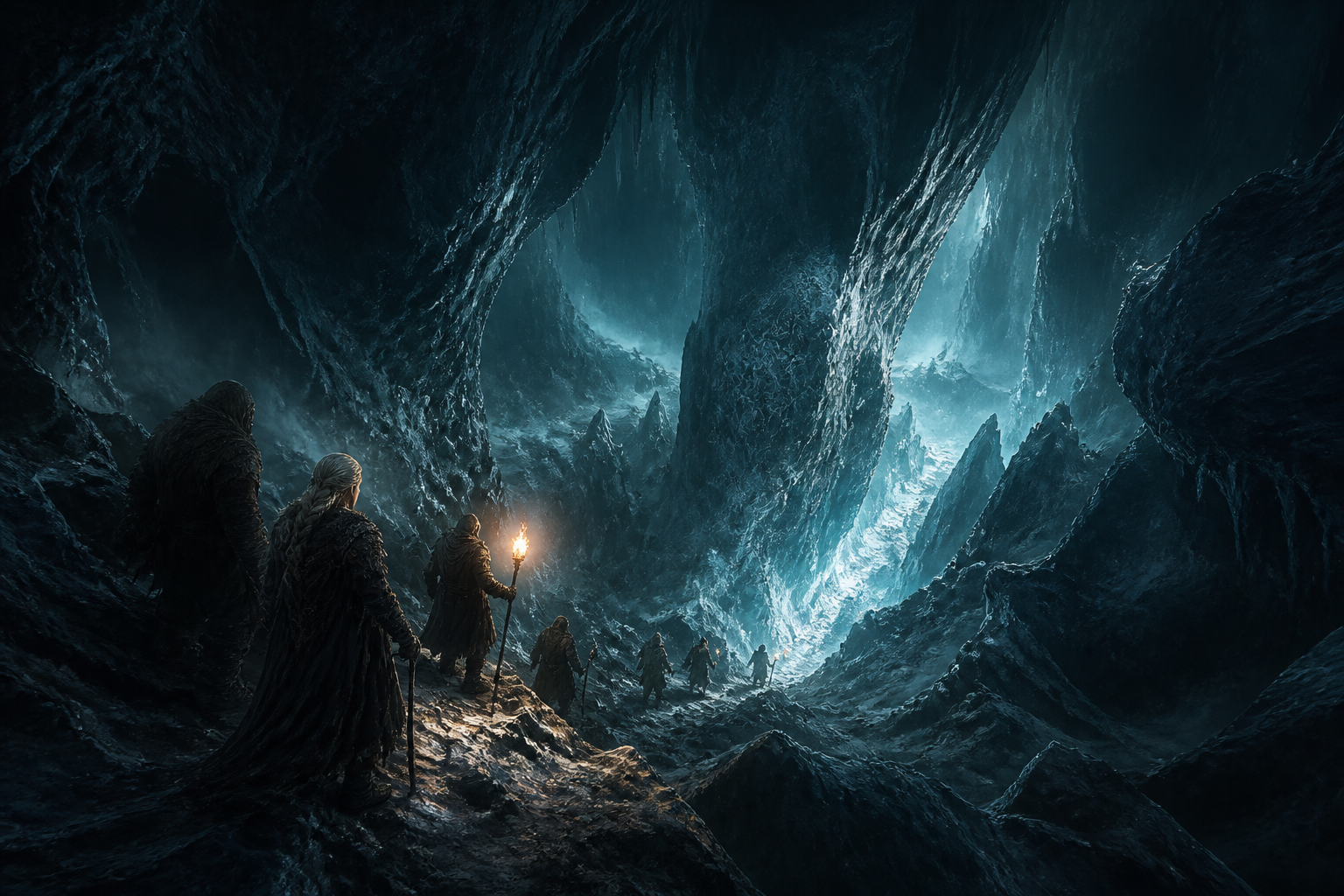
The descent took four hours.
Not because the passage was long, Solvei had mapped shorter routes in her first decade as a Sealwright, but because whatever had blackened the upper ice had also warped the geometry of the shafts below it. Twice, tunnels she had memorized in muscle and marrow simply ended, walls closed like healed wounds, and the party was forced to chip new lines through the dark. Halvard did most of the cutting. He was built for it: broad across the shoulders, with forearms roped in old scar tissue from forty years of deep-ice work, and a temperament that expressed discomfort entirely through silence and increased force. He swung his pick without complaint and without conversation, and the chips flew, and nobody spoke because nobody knew what to say.
Bryndis walked in the middle of the line. She had not spoken since Solvei finished her account in the longhouse before dawn. She had listened with her eyes closed and her hands flat on the table, and when Solvei described the pulsing dark at the crack's center, the shaman's fingers had pressed harder against the wood, as though steadying something internal. Then she had stood, gathered her rattle-staff and her bone-stitched traveling coat, and said only: "Bring rope. More than you think you need."
They had brought three times the usual measure. Solvei was beginning to think it would not be enough.
The cavern announced itself as a change in the air before any of them saw it, a sudden loosening, a breath exhaled from somewhere enormous. The torchlight bent sideways. Halvard stopped mid-swing, and the silence after his pick went still was a different kind of silence: vast, domed, attended.
They stepped through the fissure one at a time.
Solvei had stood in the great Hollow of Keldenmere. She had crossed the Abyssal Shelf west of the Thornspine ridge, where the ice was four hundred meters thick above you and the dark below had no bottom anyone had confirmed. She was not easily humbled by deep places.
This place humbled her.
The cavern was cathedral-vast, its ceiling lost to shadow that no torch reached, its floor a plain of ancient ice so old it had gone the blue-black of deep ocean. It should have been cold in the way deep glacier always was, the cold of compressed millennia, the cold that had no memory of warmth. Instead the temperature fluctuated in slow, rhythmic waves, each one carrying something that was not quite sound and not quite feeling but landed in the chest like both. In. Out. In. Out.
Heartbeat, Solvei thought, before she could stop herself. Then she looked at the center of the cavern, and thought stopped altogether.
The stones stood in a ring perhaps thirty meters across, or had once stood, now many were toppled, cracked along lines that glowed with a darkness too deep to be shadow. They were not carved so much as inscribed at the level of substance, the runes sunk into the rock itself as though the language had grown there, older than any tool. Some of the standing stones still held their arrangement, and Solvei could trace in them the ghost of an array so complex it made her own sealing-work feel like a child's first frost-marks. She counted interlocking radii, phase anchors, resonance bridges, architecture she understood piece by piece but could not hold entire, the way you might recognize individual words in a language you did not speak.
From the cracks in the fallen stones, the darkness seeped. That was the only word for it. It did not pour, did not flow. It seeped, the way cold seeps through a door, patient and indifferent, and where it touched the cavern ice, the blue-black surface filmed over with something worse: not ice, not water, but a kind of forgetting made visible.
Bryndis walked past Solvei without a word. She walked all the way to the edge of the array, stopping just short of the nearest fallen stone, and stood looking at it for a long time. Her rattle-staff was in her hand but she was not shaking it. She was gripping it the way you grip something when your hands need to be occupied so the rest of you can think.
"Bryndis." Halvard's voice was rough, low. "Tell me you know what this is."
"I know what the stories say it is." She did not turn. "I was hoping the stories were wrong."
Solvei came to stand beside her. Up close, she could feel the pulse of the seeping dark against her skin, not cold, not warm, but absent, a rhythmic erasure of sensation. It turned her stomach in a way she did not intend to show. "The Ur-Array," she said. It was not a question; she had seen the shape of the answer in Bryndis's face in the longhouse.
"The Ur-Array." Bryndis said it the way you say the name of a dead parent. Quietly, with the knowledge of weight. "Glacius is said to have laid these stones at the moment of the Iskveld's making, not to seal something, not to ward something. To be something. The foundation beneath all Frostborn working. Every seal you have ever cut, Solvei. Every binding I have ever sung. Every coldforging Halvard's hands have ever shaped." She finally turned. Her face in the torchlight was older than Solvei had seen it before, stripped of the briskness she usually wore like armor. "They draw from this. They have always drawn from this, the way roots draw from bedrock. We simply did not know the bedrock had a name."
Halvard made a sound in his throat. "And it's cracking."
"It is collapsing." Bryndis looked back at the seeping stones, and her voice went flat with precision, the voice she used for truths that had no kindness in them. "This is not a catastrophe that can be repaired. You cannot re-cut runes of this age. You cannot re-seal what Glacius himself laid down." She paused, and the pulse of the darkness moved through them all, slow as a failing heart. "If the Ur-Array unmakes itself entirely, and it is already well begun, then what we are comes undone with it. Not our power. Not our craft. Ourselves. What it means to be Frostborn. What the cold is to us, and us to it."
The torchlight guttered. Somewhere in the dark above, ice cracked, a small sound, very far away.
Solvei stared at the nearest fallen stone, at the darkness seeping from its fractured rune, at the slow and patient pulse that had understood the language of warning and moved below it. She thought of her palm pressed flat to ice until pain was the only clear thing.
She reached down and pressed her bare hand to the Ur-Array's stone now, and held it, and did not flinch.
The cold that answered was not cold at all. It was memory, vast, incomprehensible, and very close to gone.
"Then we find what's causing the collapse," she said. "Before there is nothing left to remember what we were."
Halvard looked at her. Bryndis looked at her. Neither of them disagreed, which was, in its way, the most frightening thing that had happened yet.