Kapitel 5
Chapter 5: The War Chief's Mantle
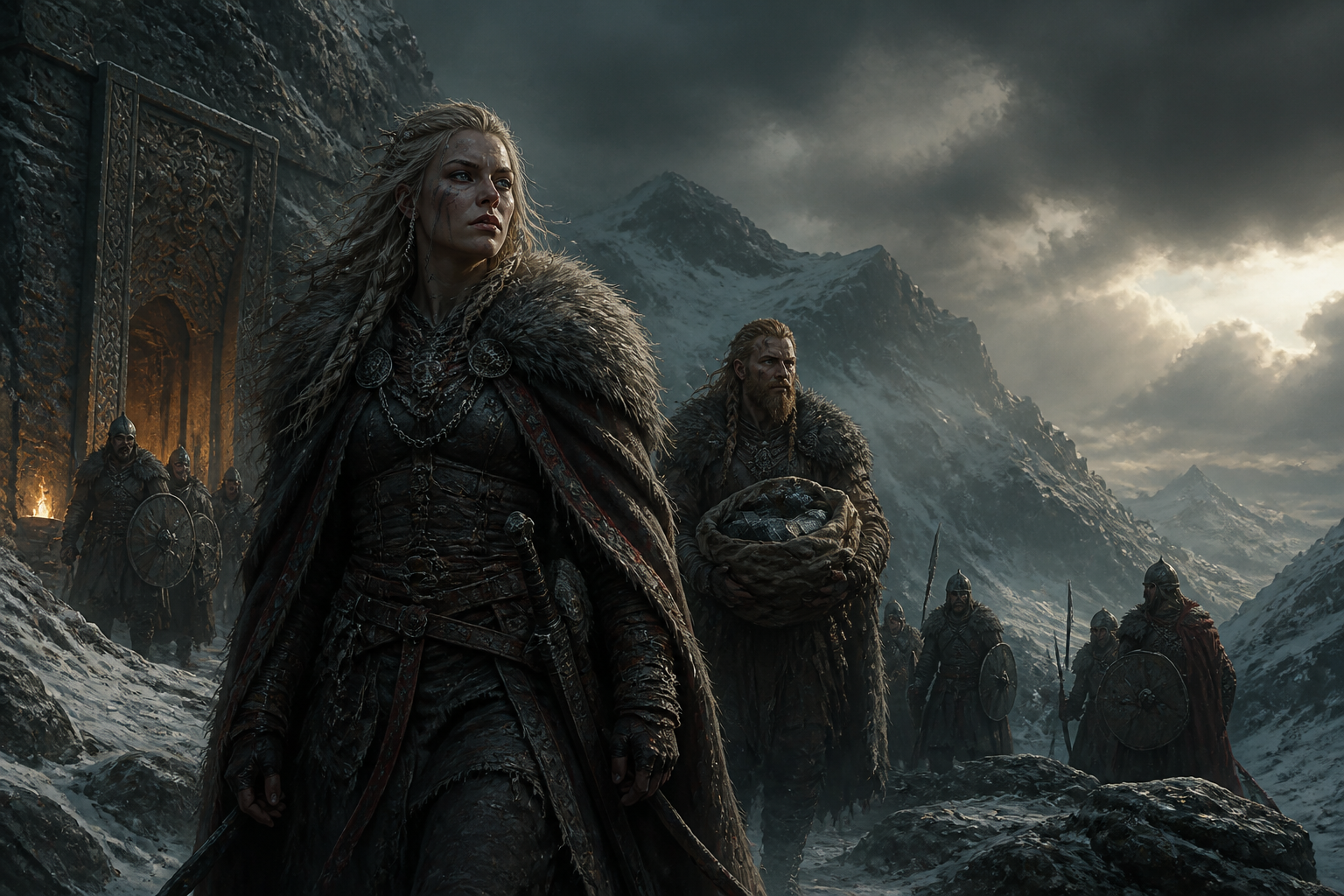
They came up from the mountain bearing gifts no one had asked for and news no one wanted.
Solvei emerged from the Underhall's eastern gate into a sky the colour of old pewter, the wind off the Hjalspine cutting through her furs as though they were gauze. Behind her, Halvard carried the star-iron in a leather satchel lined with salt-cloth, three ingots, each one dense as a secret, dark as the space between stars, warm to the touch in a way that had nothing to do with temperature. And behind Halvard came Caelindra.
The scholar had the look of someone who had spent too many years in library alcoves and not enough in weather: slight, pale, her Eldorian travelling robes already losing an argument with the wind. But her eyes moved over everything, the carved lintel above the gate, the frost-script on the boundary stones, the arrangement of the encampment's cook fires, with an attention so precise it bordered on hunger. She had studied runic array collapse, she had told them in the tunnels, with the slightly apologetic air of a person admitting to a peculiar hobby. She had never seen a live one.
She'll see one soon enough, Solvei had thought, and had not said.
The Council of Chiefs had already assembled. Word traveled fast in the mountain clans, faster still when it smelled of succession.
The Proving ground was a wide shelf of rock above the encampment, swept clean of snow by generations of ritual and wind. Seven Chiefs stood at its edges, their banner-bearers behind them, their expressions a collective exercise in studied neutrality. Solvei knew most of their faces. She knew which ones had wanted her father gone and which ones had simply wanted him replaced by someone quieter.
Errik Vane, Chief of the Windrunners, stood apart from the others the way a wolf stands apart from dogs: not hostility, precisely, but a clear taxonomy. He was broad through the shoulders, younger than his reputation suggested, and he watched Solvei cross the proving ground with eyes the colour of glacier melt, pale, cold, entirely without warmth.
"Iceborn comes to claim the mantle," said Chief Aldra of the Stonemarrow, who was conducting the Proving by dint of her age and the particular exhaustion of someone who had conducted too many of them. "Let the Proving speak what words cannot."
The first trial was endurance. Solvei knelt at the stone's centre and pressed both palms flat against the exposed bedrock. The cold came up through her hands like a blade being inserted slowly. The Proving tradition held that a War Chief candidate must hold contact until the mountain accepted them, a formality, most said, a test of pain tolerance and stubbornness. Solvei breathed through it. She thought of her father's hands on the same stone. She thought of the glacier, already doing what it had come to do.
She held for seven minutes. Vane had held for nine, she'd been told, at his own Proving.
She held for ten.
The second trial was judgment. Aldra presented three disputes drawn from recent clan records, a border death, a resource claim, a broken betrothal oath with military implications. Solvei answered each in turn. She was not always merciful. She was not always strict. But she was consistent, and when she was done, two of the seven Chiefs were nodding before they'd realised they'd begun.
The third trial was Runecraft, and this was where Errik Vane leaned forward.
They gave her a test array, standard boundary inscription, deliberately corrupted at two nodes, set to cascade failure within four minutes. The task was to stabilise it. A brute-force approach would exhaust the array's remaining integrity and collapse it faster. Everyone knew this. Brute force had collapsed four candidates' Provings in living memory. Most War Chief candidates spent the first minute working quickly and the remaining three hoping.
Solvei spent forty seconds reading the array.
Then she drew a containment glyph, not to fix the break, but to quarantine it, folding the corrupted node's influence back on itself and redirecting the array's remaining energy through the stable pathways like water rerouted around a sinkhole. It was the kind of solution that required knowing what not to touch. It was the kind of solution that could only look simple if you understood exactly how complicated the alternative was.
The array held. The cascade stopped. The timer, measured by a slow-burning salt candle, had barely reached two minutes.
Silence.
Then Vane said, without particular warmth but with audible exactness: "That was not the expected solution."
"No," Solvei said, still crouched over the stone. "The expected solution would have failed."
He looked at her for a long moment. The wind moved between them. Something was being weighed.
"She is fit," Vane said finally, and the words cost him nothing he would show, but they cost him something.
The vote was fractured. Four to three, the margin a hairline crack in the unity of the clans. But a binding vote was a binding vote, and Aldra declared it before Vane could let his silence harden into objection.
Solvei stood in the grey afternoon light with the War Chief's iron torc cold against her collarbone and felt not triumph but the particular weight of a door closing behind her. Every other direction was open. None of them were easy.
She turned to Halvard first.
"Warden of the tunnels," she said. "You know them better than you know daylight. I need eyes down there I can trust."
Halvard took that the way he took most things, without ceremony, with a single nod, and with the expression of a man who had already known what was coming.
She turned to Caelindra, who had watched the Proving from the edge of the rock shelf with her notebook open and her stylus moving.
"The oldest fragments of the array inscription. The Dwarven archivists have them in three separate vaults and won't agree on their order. I need a translation I can use, not one I have to arbitrate."
Caelindra closed the notebook. "I'll need access to all three vaults simultaneously."
"I'll write the orders tonight."
"And I'll need silence. Scholars translate badly when people breathe at them."
"I'll have them breathe elsewhere."
Then Solvei looked north, actually north this time, over the peaks, into the white distance where the Deepglacier clan's territory sat like a word someone had swallowed.
"No contact in thirty-one days," she said, to the assembled Chiefs, who had not left. "No messenger returned. No smoke signal. No word." She let that settle. "That is not a clan in disagreement. That is a clan in crisis, or a clan already lost, and I will know which before the next moon."
"You're speaking of martial investigation," Vane said.
"I am," Solvei said. "You're welcome to object."
He didn't.
The glacier was not waiting. And neither, at last, was she.