Kapitel 6
Chapter VI: The Shattering of Old Names
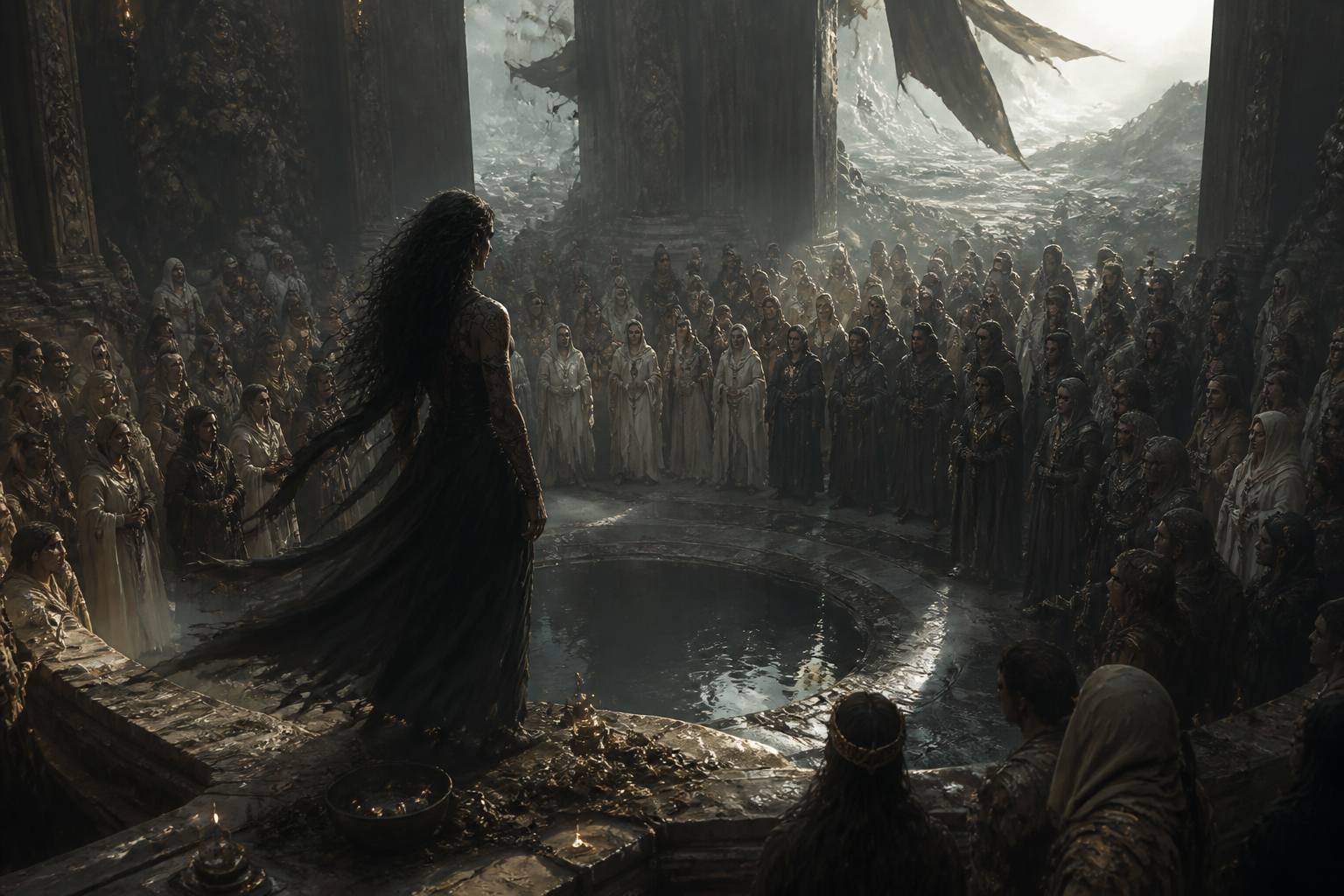
The morning came in sideways, pale and reluctant, the way light enters a room where something irrevocable has already happened. Sera stood on the raised rim of the basin and looked out at the gathered faces, scholars with ink-dark fingers, Wardens with their ceremonial ash-marks still fresh from the night's vigils, hedge-priests from the outer territories who had walked four days to be here and now stood at the back holding their hats like small confused animals. She had not prepared remarks. She had only the truth, which was worse.
"The being you have called the Nameless Hierophant," she said, and her voice carried better than she expected across the hollow," is a vessel. A willing one. What speaks through them is Nous, not the abstraction, not the scholarly metaphor. The Celestial principle itself. Present. Embodied. Diminishing."
The silence lasted perhaps three full breaths.
Then the hollow became a room on fire.
It began with the Archivist-Canon of the Pellucid Seat, a small man with enormous authority, who simply said," That is heresy calibrated to destabilise our entire epistemological framework," in the tone of someone identifying a beetle in their soup. Beside him, Warden-Prefect Aldous slammed a gauntleted fist against the basin wall and shouted that if a Celestial intelligence had been walking among them for weeks, every conversation it had witnessed was a matter of state security. Across the hollow, a cluster of the outer hedge-priests dropped to their knees and began a prayer of thanksgiving, weeping openly, which only enraged the Wardens further. Two scholars from the Lucent Academy began arguing with each other before anyone had even argued with Sera, one insisting the vessel must be preserved and studied, the other insisting that study was itself a form of imprisonment and therefore a moral obscenity.
Sera stood in the centre of it and let it break over her. This, too, she thought. This is also what choosing looks like from the outside.
She found Aldric at her elbow, not touching her arm but close enough that she could feel the warmth of him. "You knew this would happen," he said.
"I knew I couldn't prevent it by staying quiet."
"That isn't the same as knowing this would happen."
"No," she admitted. "It isn't."
From the far edge of the hollow, a figure moved through the crowd, not pushing, not hurrying, simply present in such a way that the crowd parted. The Hierophant walked as they always walked: unhurried, socketed in some calm that was not peace exactly but rather the absence of any need to perform peace. Their skin had taken on a translucency overnight, the teal luminescence Sera had first noticed in their eyes now distributed faintly across the whole of them, as though they were a lantern burning near its last of oil.
The arguing did not stop when the Hierophant reached the basin's edge. If anything, it intensified, three factions turning to address the vessel simultaneously, the Archivist-Canon stepping forward with a prepared declaration about custodial authority, Aldous raising his hand in the formal gesture of a state warrant.
The Hierophant looked at none of them.
They sat down, cross-legged, on the stone floor of the basin, placed both hands open on their knees, and closed their eyes.
The Resonance began as a pressure change, the way the air thickens before a lightning strike, everyone in the hollow felt it in the chest before they understood it in the mind. Then it arrived: not sound, not light, but something underneath both, a transmission without a medium. Sera felt it pass through the back of her skull like a hand smoothing a crumpled page. Ideas she had wrestled with for years simply opened. Not answered, opened, like doors she had been pressing against from the wrong side.
She looked around. The Archivist-Canon had sat down on the ground, his declaration still in his hand, his mouth no longer moving. Aldous had removed his gauntlet. One of the hedge-priests was laughing, not joyfully, but in the helpless way of someone who has just understood a joke that restructures everything that came before it. The scholar who had argued for preservation was holding the hand of the scholar who had argued against it, neither of them appearing to notice.
The Resonance did not choose its recipients. It simply, gave. Every person in the hollow received the same undiluted transmission, the full philosophical architecture, the questions and the frameworks and the luminous uncertainty at the core of all of it. No scroll could contain it. No institution could curate it. No single voice could claim to have been its exclusive interpreter. It was already inside all of them now, already beginning to mean different things to different minds, already irrevocably common.
It lasted the length of a long breath.
When it was over, the Hierophant opened their eyes, looked once at Sera with an expression she could only describe as recognition, not of her face, but of something she had done, and then lay down on the stone as simply as a person lies down to sleep.
No one spoke. The hollow held them all, fractious and strange and newly populated by the same enormous idea, and the sky above it shifted from grey to the first pale amber of actual morning.
The Hierophant died somewhere in that transition. There was no moment anyone could point to afterward, only that at some point the teal light had moved from inside the vessel to somewhere faintly above it, diffused among the cold air of the hollow like heat from a cooling stone. The scent arrived just after: clean and mineral and impossibly distant, the way Sera imagined starlight would smell if starlight had a smell, which she now suspected it did.
She knelt. Not in prayer, she had no cult, no form, but because kneeling seemed like the honest response to being in the presence of something that had chosen to become small enough to be known, and had done so anyway, and was now gone.
Around her, the factions did not dissolve. They would argue for weeks, months, longer, in lecture halls and border fortresses and small rooms where hedge-priests met by tallow-light to make sense of what they had been given. The Archivist-Canon would write three competing papers. Aldous would file a report that his superiors would classify and then quietly study in private. The two Academy scholars would spend a year not speaking to each other before the idea in both of them forced a reconciliation neither had planned.
But that was later. That was the long work of the world reassembling itself around something new.
Now: the hollow, and the faint smell of stars, and the light that was already, slowly, everywhere.