Kapitel 7
Chapter VII: The Fractures That Let the Light In
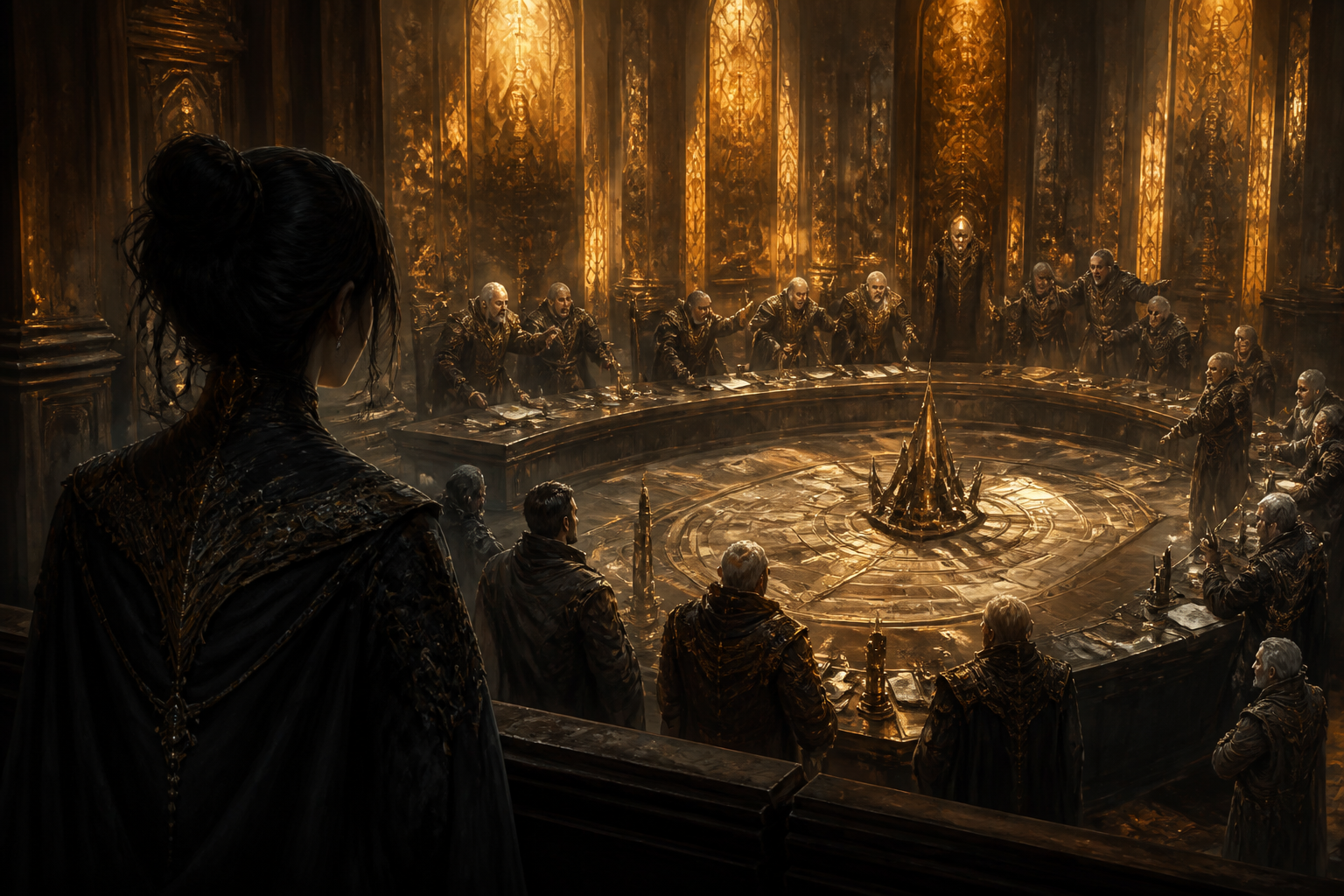
The Scholarly Council convened in the Amber Hall for the last time as a unified body on the forty-third day after what the official minutes would call, with breathtaking cowardice, the Sanctum Irregularity.
Sera stood at the back of the gallery and watched them tear each other apart with the precision of people who had spent their lives learning exactly where a mind was softest.
"Suppression is a form of authorship," said Elder Voss, and his voice carried the particular trembling authority of a man who had never before said anything he might regret. "We shape the record by what we exclude. That is not scholarship. That is architecture disguised as history."
"You are describing every archive that has ever existed," came the reply from the Archivist-Canon, her fingers laced so tightly her knuckles had gone the colour of new chalk. "The question is not whether we curate. The question is whether we curate honestly."
"Then let us be honest," said Voss.
The silence that followed was not agreement. It was the sound of people discovering simultaneously that honesty, as a principle, was far more comfortable than honesty, as a practice.
Sera slipped out before the vote. She already knew how it would end, not with resolution, but with the particular inconclusive fracture that precedes, over years, a reckoning. She had learned to recognise the shape of things that were not finished but could no longer be contained.
In the east courtyard of the Eldorian Chapter House, Sir Aldric was teaching a class he had not been asked to teach, to twelve young knights who had not been told to attend.
They came anyway. Word travels in institutions the way water travels in stone, not quickly, but inevitably.
"The oath you swore," Aldric said, and he did not stand at the front of the room as an instructor might. He sat among them, his sword on the table rather than at his side," binds you to the Order. But the Order binds itself to what, precisely? To a principle? To a hierarchy? To a version of the world that someone decided, at some point in the past, was worth protecting by force?"
A young woman, Cadet Fenris, barely seventeen, with the kind of directness in her eyes that reminded him uncomfortably of Sera, said: "All three, I thought."
"Yes," said Aldric. "And when those three things diverge?"
The silence this time was different. It was the silence of twelve people finding a question they had been carrying without knowing its name.
He did not answer it for them. He had learned, finally, that this was the one thing he could not do for anyone.
His report sat in a locked drawer three floors above the Council Chambers, classified under a seal that meant urgent, defer indefinitely. He knew three of his superiors had read it. He knew because their behaviour had shifted in small, unmistakeable ways, a new carefulness in how they spoke about canon, a slight hesitation before the word heresy, as though they were now aware of its weight in a way they had not been before.
Change, he had come to understand, did not announce itself. It metabolised.
In the Mystaran Conclave, the reclassification took eleven days and the erasure of four dissenting voices from the formal record. The phenomenon was labelled Spontaneous Nous-Resonance, Class IV, Non-Replicable, Source Indeterminate, and the file was sealed with the kind of thoroughness that implied everyone involved knew, privately, that it was insufficient.
Thessaly attended the sealing ceremony with her hands folded and her expression appropriately neutral.
That night, she walked into her own dreaming, the way she had learned to at twelve years old, the way that still felt like stepping through a door that existed only in peripheral vision, and she placed the copy of the full record in a room that had no location in waking geography. A room with shelves made of condensed memory and light that came from no visible source.
She stood in it for a moment, her hand resting on the sealed documents, and felt something she could not have named to anyone who had not been in the hollow that night.
Not vindication. Not grief, exactly.
Something more like: permission.
The desert received Sera the way it always had, without ceremony, without welcome, with only the indifferent honesty of heat and distance and silence so complete it pressed against the eardrums like a second presence.
She had not brought her Scholar's insignia. She had not, strictly speaking, brought herself as she had been.
She set up her writing table under a canopy of bleached canvas and she began.
Not a treatise. Not a report. The first honest account she could manage of a man who had called himself nothing, had claimed nothing, and had nonetheless changed the interior architecture of every mind that had come near him.
She wrote about the hollow. She wrote about the light. She wrote about the peculiar grief of ideas that outgrow the people who carry them, and about how that grief was not, she had decided, a tragedy.
She wrote about him without naming him, because he had not wanted a name, and she found, this surprised her, that it made the account more true, not less. The unnamed thing at the centre of it was not an absence. It was a space the reader would have to fill themselves.
She finished on a morning when the sky was the particular pale gold of a world that had not yet decided what the day would mean.
She read it through once.
Then she set the cover page down and left it blank, and felt, for the first time in longer than she could measure, that she had made something that did not belong to her.
That was the point.
That was entirely the point.
In Landorya, the Age of Restoration did not end with a decree or a battle or a name written into the heavens. It ended, or perhaps it merely changed, the way most true things do: in the quiet interval between one person setting down a question and another, somewhere else, picking it up.
The movement could not be unborn.
Neither, it turned out, could the world it had opened.