Kapitel 1
Chapter I: The Sigil in the Northern Sky
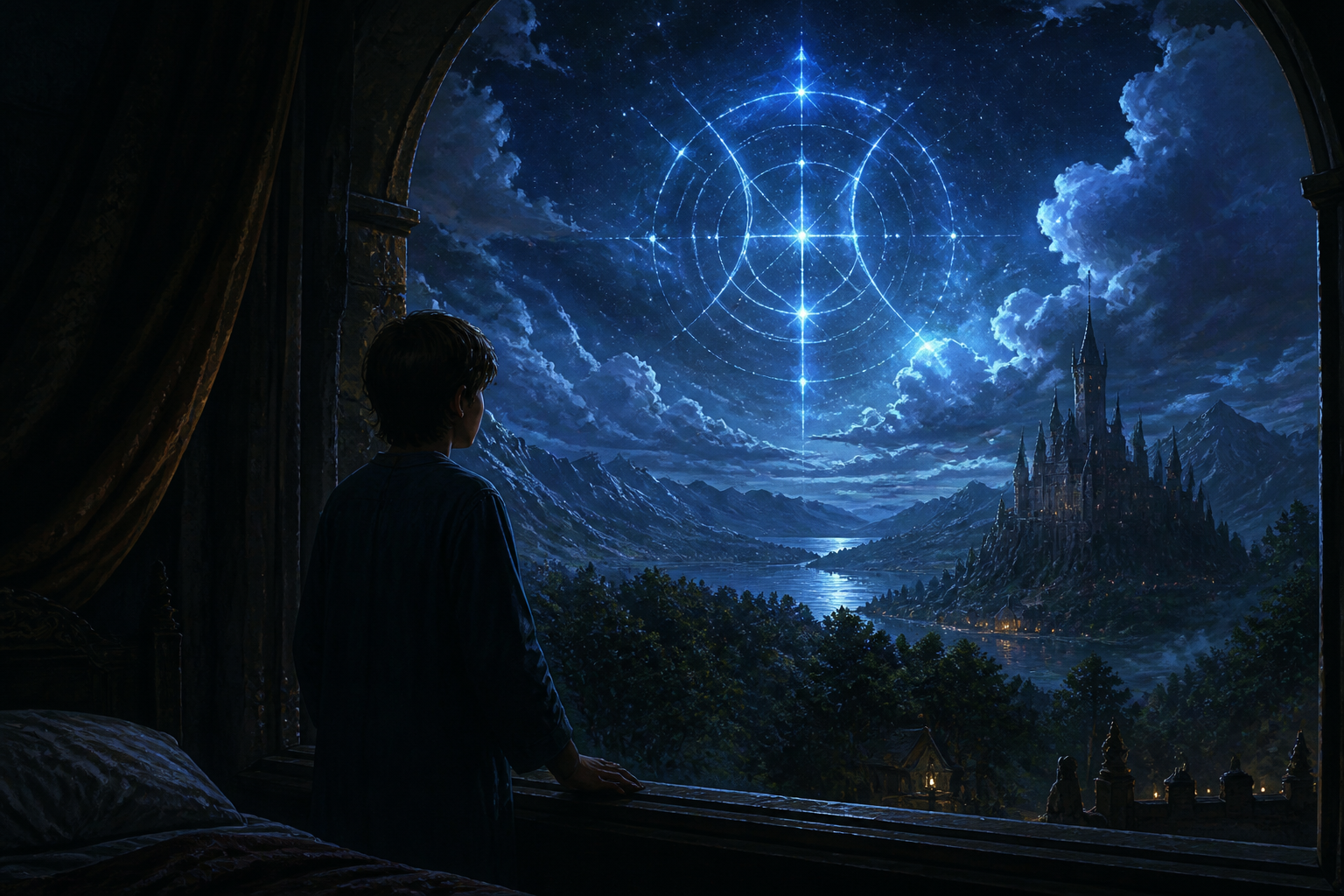
The sigil bloomed at the hour when night is most itself.
Robert was awake because he had heard his father's hounds go quiet, not the drowsy quiet of sleep, but the held-breath quiet of animals that have seen something they cannot name. He had slipped from his bed and crossed to the eastern window of his room, the one that looked out past the oak grove toward the long black spine of the Arvenmoor highlands, and he had stood there in his nightshirt while the cold of the stone floor moved up through his feet and settled in his chest.
He was eight years old. He knew what a Celestial Relic sigil looked like. His father had shown him in the Household Register, a leather volume the colour of dried blood that lived in the study beneath a glass case: diagrams of the four beacon-marks, each one a compact sun, each one meaning something different. Two marks meant a successful binding. Three meant a negotiation had opened. One mark, one, meant the Guardian had fallen.
The sky above the northern ridge wrote itself in light.
One mark.
It lasted perhaps six seconds. A spiral of cold gold fire, turning slowly the way a coin turns when it is nearly done spinning, and then it folded inward and was gone and the darkness was more complete than before and the hounds began to howl and somewhere down the corridor Mary cried out in her sleep, just once, as if someone had pressed a cold hand briefly against her cheek.
Robert did not move from the window for a long time. He looked at the place where the light had been. The stars behind it were unchanged, indifferent, arranged in their ancient casual patterns, and he thought, with a clarity that felt like a door closing in a very large house: They are not coming back. Not as a fear. Not as a question. The sigil had been his father's, he knew the frequency, had memorised it at Alaric's knee the way other boys memorised prayers, and it was gone, and the gone-ness of it was already becoming the new shape of the world.
He went to James's room first, because James was three and slept lightly and would need settling before Mary did. His brother lay starfished in the centre of his small bed, blankets kicked to the floor, one fist curled near his mouth. Robert retrieved the blankets, tucked them with the methodical care he had seen his mother use, folded edge at the chin, pressed down along the sides, gentle, and stood watching the child's chest rise and fall until his own breathing matched it. There. James did not wake.
Mary was sitting up when he reached her room, her dark hair loose around her shoulders, her eyes very bright in the way they got when she was frightened and trying not to be.
"I heard something," she said.
"The hounds," Robert said. "A deer came too close to the fence."
She considered this with the particular gravity of a six-year-old who suspects she is being managed. "Was it?"
"Go back to sleep, Mary."
"Where are Mama and Papa?"
The question sat between them in the cold dark. Robert pulled her blanket straight and smoothed the corner of her pillow with his palm. His mother had always done that too, the pillow corner, and the muscle memory of watching her do it was suddenly unbearable in a way he would not be able to name for years.
"They're working," he said. "You know how the Relic work goes long sometimes."
She lay back, slowly, watching his face for the truth of it. He kept his face the way his father kept his face during difficult things, open and still, like water before the wind touches it, and after a moment her eyes closed. He sat on the edge of her bed until her breathing deepened, then walked back to his own room without a candle, navigating the corridor by memory, by the particular creak of the third board from the linen cupboard, by the faint smell of his mother's dried lavender that still hung in the curtains even now.
He did not sleep again that night.
Instead he sat at the small desk beneath his window and he opened his own copy of the Household Register, a junior volume, not the sealed original, and he read the section on Celestial Relic guardianship for the fourth time in his life and the first time as the eldest surviving Starwind of Greenvale.
The Starwinds had held their guardianship for six generations. The silver banner in the entrance hall, quartered with the comet-and-crescent, was not ornamental: it was a deed of office, woven in thread that had been blessed at the Conclave of Varentis and could not be burned or cut. Robert had seen visitors look at it and stand straighter, involuntarily, the way one stands before something old and consequential. He had always felt a mild pride in that. Now the pride was still there but it had changed its texture, thicker, heavier, like wet cloth.
In the days that followed he did not announce what he knew. He let the estate manager, old Torven, carry the formal news when it came, borne by a Conclave rider on the fifth morning, a sealed letter addressed to The Starwind Household, which Robert accepted at the door while Mary played in the courtyard below and James sat on Robert's hip because he had decided that morning that walking was beneath him. Torven wept, briefly and silently, into the back of his hand. The rider looked at Robert, at this pale, composed boy with his brother balanced on his hip and his free hand holding the letter very still, and seemed unsettled in a way he could not account for.
"Is there a guardian?" the rider asked. "An adult of the estate?"
"There is," Robert said, and did not clarify.
He read the letter alone in the study. Then he folded it along its original lines and placed it in the Household Register case, beside the glass, where his father had kept the things that mattered and must not be lost.
The western wing of Starwind Manor had been fire-ruined since before Robert was born, before his parents were married, in fact. Some older quarrel with a force his father had only ever called the Ashbound, a word he spoke in a tone that foreclosed questions. Three rooms and the connecting gallery were open to the sky now, their walls standing but roofless, the floor inside laid over with a skin of moss and small yellow flowers that came up each spring regardless of the season. His mother had called it the wound with a voice that contained no self-pity, only the calm acknowledgment of facts. His father had called it the reminder: that beauty could be partly taken and still stand.
Robert walked through the wound on the evening of the fifth day, after James and Mary were asleep. The sky above the open rooms was the particular deep blue of late dusk, one star already lit in the east. The moss gave slightly beneath his feet. The walls around him were streaked black where the fire had climbed them, and between the streaks the old stone still held its pale grey colour, its carved window-frames still intact, some of the glass still in place, warped and bubbled by heat, but unbroken.
He stood in what had been the gallery and looked up at the star.
I will come back to this, he thought, meaning the manor, meaning the ruined rooms, meaning the banner in the hall, meaning the sealed letter and the six generations and the weight of it, all of it together, this beautiful, partly-burned thing that was his.
It was not a vow made in a ceremonial sense. He had no candle, no Register, no witness. It was simply a boy standing in the ashes of something that had been worth burning, deciding that the story was not finished. Deciding it with the absolute certainty available only to those who have not yet learned that certainty is dangerous.
Above him the star held its position, unchanged, indifferent, and faithful in its indifference, still there, as it had always been, as it would always be, waiting to be navigated by.
He went inside. He checked on James, who was sleeping. He checked on Mary, who was not.
"Tomorrow," she said, before he could speak," will you show me the Register? Papa was going to. He said soon."
"Yes," Robert said. "Tomorrow."
He smoothed the corner of her pillow. He went to bed.
In the morning, he began.