Kapitel 3
Chapter III: The Celestial Relic Quest
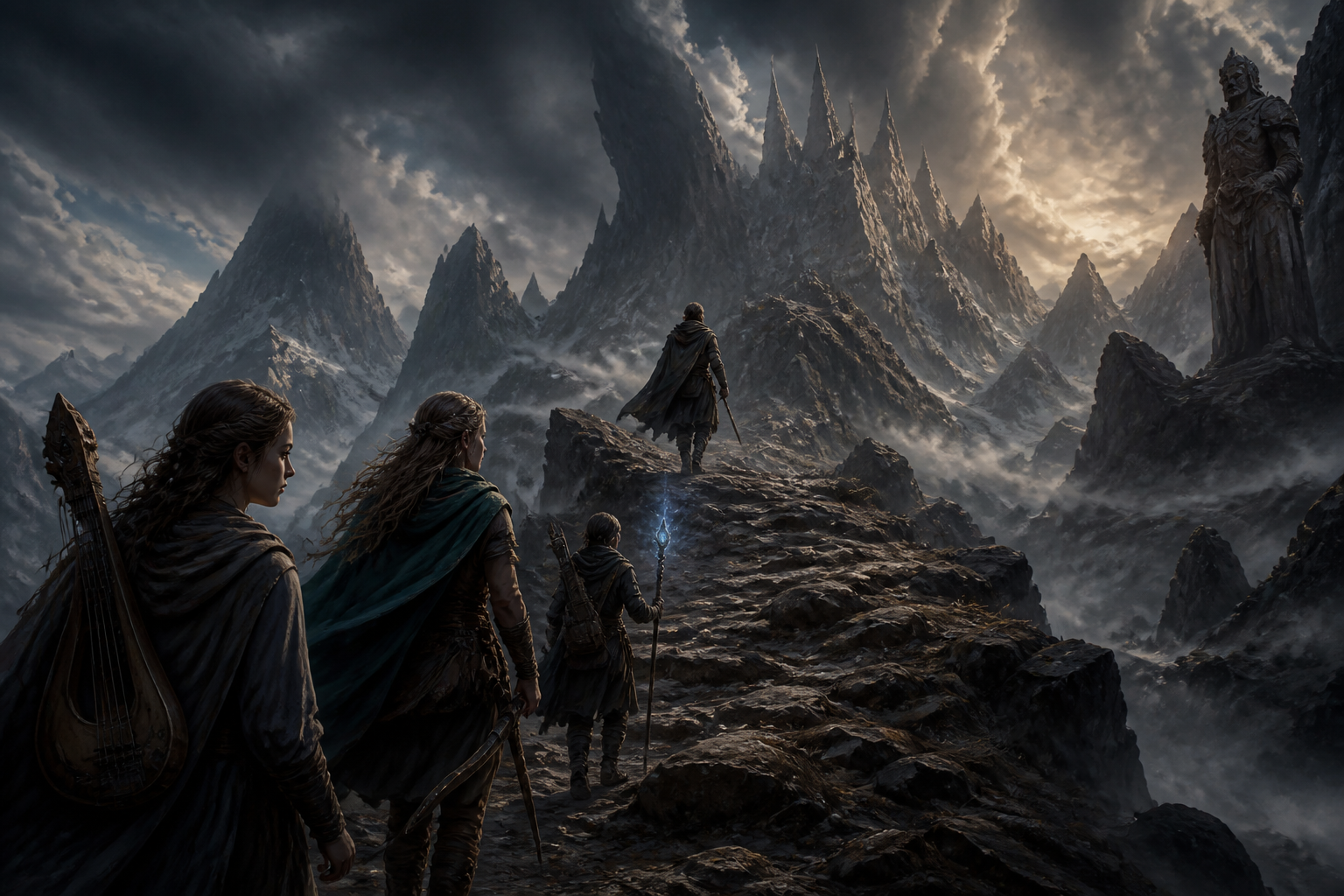
The Celestial Mountains did not welcome them. They rose from the Landoryan plain like a sentence that had been interrupted mid-thought, jagged, ancient, and cold in a way that had nothing to do with temperature. The air up here tasted of iron and old lightning, and the path, such as it was, seemed less a road than a dare.
Robert walked point. He always walked point. Mary had stopped arguing about it somewhere around the second mile, and James had never started.
"Third marker on the left," Mary said, not quite to either of them. She was reading again, that particular quality of stillness she carried when the rune-clusters spoke to her, head tilted, fingers moving at her side as if tracing letters only she could feel. She had been doing it since the mouth of the Vethara Pass, consulting the carved stones that older cartographers had dismissed as erosion. "It's a pressure plate. Four steps wide. Step on the rightmost edge or don't step at all."
Robert stepped on the rightmost edge.
The mountain did not kill him.
He exhaled. James, behind him, let out a low whistle. "Useful," he said," having a scholar."
"Don't call me that," Mary said, but there was no edge to it.
They moved like this for two days, Mary reading the mountain's old language, Robert absorbing each instruction as though it were a field order, James threading between them with a lightness that was not carelessness but its own kind of vigilance. The Celestial range had been designed, or at least arranged, to punish confidence. Its traps were not crude; they were architectural, embedded in the geometry of the pass itself, in the way certain archways framed the sky at angles that rewarded attention. Mary rewarded it. Robert trusted her. James, when the paths narrowed to ledges above nothing, hummed quietly under his breath, and the wind, always obliging for James, pressed flat against the rockface beside them as though leaning in to listen.
On the second night, the Dark Hounds came.
There was no preamble. One moment the camp was firelit and almost peaceful, and the next the darkness at its edge had teeth. Robert was on his feet before he was fully awake, sword out, training doing the work his body hadn't yet caught up to. There were four of them, massive, smokeblack, their eyes the colour of old wounds. They moved without sound. That was the worst of it. Creatures that large should have had weight to them, presence. Instead they slid between shadows like ink dropped in water.
Robert took the first one's charge on his shoulder and drove it back with the pommel. James sent a gust that scattered the embers of the fire in a wild arc, buying light and momentary confusion. The Hounds reoriented with nauseating speed.
Then Mary's light came.
It was not a choice. That was what she would say afterward, and she would be right, and it would not help. The burst came from somewhere below decision, below training, below everything, white and absolute, flooding out from her palms with a sound like a chord played too loud for the instrument. Two of the Hounds screamed, which was somehow worse than the silence, and the nearest one crumpled sideways, one eye ruined, the other rolling.
Robert was closest.
The light caught him full in the face. He dropped to one knee with a sound she would not forget, not a cry, something quieter, which was worse, his hand pressed over his eyes. For six seconds, which she counted, he was blind.
The Hounds fled. The camp settled. Robert's sight returned, stuttering, in the shape of afterimages.
"I'm fine," he said, before she could speak. He was already standing.
"Robert,"
"I said I'm fine, Mary." He did not say it harshly. That was, somehow, worse. He looked at her with eyes that were still watering, and the care in them was unbearable. "You saved us. That's the accounting that matters."
She did not believe him. She did not believe that any accounting would balance what she had felt, the power moving through her without permission, without form, without the restraint she had spent two years building. She believed, with the particular clarity of three in the morning, that she would carry the shape of his blinded face for the rest of her life.
James sat beside her after Robert slept. He did not say anything for a long time. Then: "It'll learn manners. The light. Give it time."
"What if it doesn't?"
He looked at the dark where the Hounds had gone. "Then you'll learn to live with having saved us badly." He paused. "Still saved us, though."
She pulled her knees to her chest and watched the mountains and did not sleep.
The Shimmering Falls appeared on the afternoon of the fourth day, and they were beautiful in the way that dangerous things often are, a great curtain of white water dropping a hundred feet into a gorge of black stone, misting the air into something that caught light and fractured it into brief, sourceless rainbows. The path crossed directly behind the falls along a ledge barely wide enough for single file.
They were halfway across when the tremor came.
It was not an earthquake. It was older than that, a resonance in the stone, the mountain sighing, and the falls responded by doubling in volume. The water hit the ledge in a wave that swept Mary's feet from under her. She caught the rockface by instinct, fingers finding a crack, but the current was on her immediately, cold and absolute, trying to peel her loose.
James moved without thought, which was the only way he ever moved well. He planted his feet, dropped his center, opened both hands, and pulled. Not the water but the air above it; he seized the column of wind rising from the gorge and bent it sideways, hard, slamming it into the falls themselves. The water didn't stop but it broke, deflected, the main body of it sheering away from Mary's section of ledge in a spray that soaked all three of them but carried no force.
Robert felt his sword hum.
It was not metaphorical. The blade vibrated in its scabbard with a high, clean note he had never heard from steel, and before he understood what was happening the air around his right arm was moving, not James's wind, something older, something that had apparently been waiting in him the way a name waits to be spoken, and it formed into a compressed arc that deflected the slab of loosened rock tumbling from the cliff above him before he had consciously chosen to raise his hand.
He stood very still for a moment.
"Was that you?" James called over the roar of water.
"I don't know," Robert said. Which was the most honest thing he'd said in years.
The Dark Citadel crouched against the northern face of the highest peak like something that had grown there rather than been built, black stone, no visible gate, walls that seemed to absorb light rather than merely block it. Mary read the rune-clusters carved around its base for twenty minutes before she found the breathing point in the wards, a seam no wider than a hand-span where the old magic thinned.
"There," she said. "James."
James grinned. He had been waiting to be pointed at something since they left Vethara.
He called the fire-sprites three at a time, setting them into the seam like keys into locks, coaxing each small flame into a chain-link with the next, patient work, delicate work, the kind that surprised people who assumed wind-workers were only good for bluster. The chain ignited at the fourth sprite. The wall did not explode; it unzipped, a clean vertical breach that split the stone from base to parapet with a sound like a bell struck too hard.
What waited inside was worse than soldiers. It was silence, and at the center of the silence, a plinth of pale stone.
The Relic rested on it, a shard of something that might once have been a mirror, no larger than Robert's palm, its surface showing not reflections but distance. Stars, or something like stars.
Robert crossed the chamber. He pressed his Air Magic into the wards around the plinth, his newborn, unnamed, barely-controlled Air Magic, and felt them begin to yield, and felt something else begin to yield in him as well. He pushed further. The chamber blurred. His knees buckled.
"Robert." Mary's voice, sharp.
"Keep going," he said.
"Robert, stop,"
"I said,"
"I know what you said." She was beside him now, her hand on his arm, and her voice had the particular quality it carried when she was not asking. "Delegate. Right now. To us."
He looked at her. He looked at James, who stood at the breach with fire-sprites still curling around his fingers, watching him with an expression that was not judgment but something quieter and more demanding than judgment.
He let go.
James caught the ward-work with wind and Mary caught Robert, and together they eased the plinth's defenses open like a lock that simply wanted gentler hands.
The Relic rose.
Its light filled the citadel and showed them, briefly, overwhelmingly, two faces they had been carrying for five years in the shape of absence: Alaric Starwind and Elara Starwind, alive, intact, suspended in a void that had no floor and no ceiling and no passage of time. Their mouths were forming words. Their eyes were open. The light failed before Robert could read what his father was trying to say.
The Relic went cold.
Mary turned it in her hands. The three of them stood in the ruined citadel, breathing hard, coated in mountain-dust and spray and old smoke.
"They're alive," James said at last. His voice was doing something he was pretending it wasn't doing.
"Imprisoned in a timeless void," Mary said carefully, because precision was the only thing she had to offer the moment. "Unreachable." She paused. "Without a key that doesn't exist yet."
Robert stared at the fragment of dead mirror in his sister's hands. He thought about gates he'd stepped through. He thought about absence shaped like presence. He thought about the word yet.
"Then we build it," he said.
He said it the same way he'd stepped through the gate at Vethara, not as if it were easy, but as if it had already been decided, and the rest was only motion.
They walked out of the citadel into the Landoryan wind.