Kapitel 4
Chapter IV: The Cost of the Flame
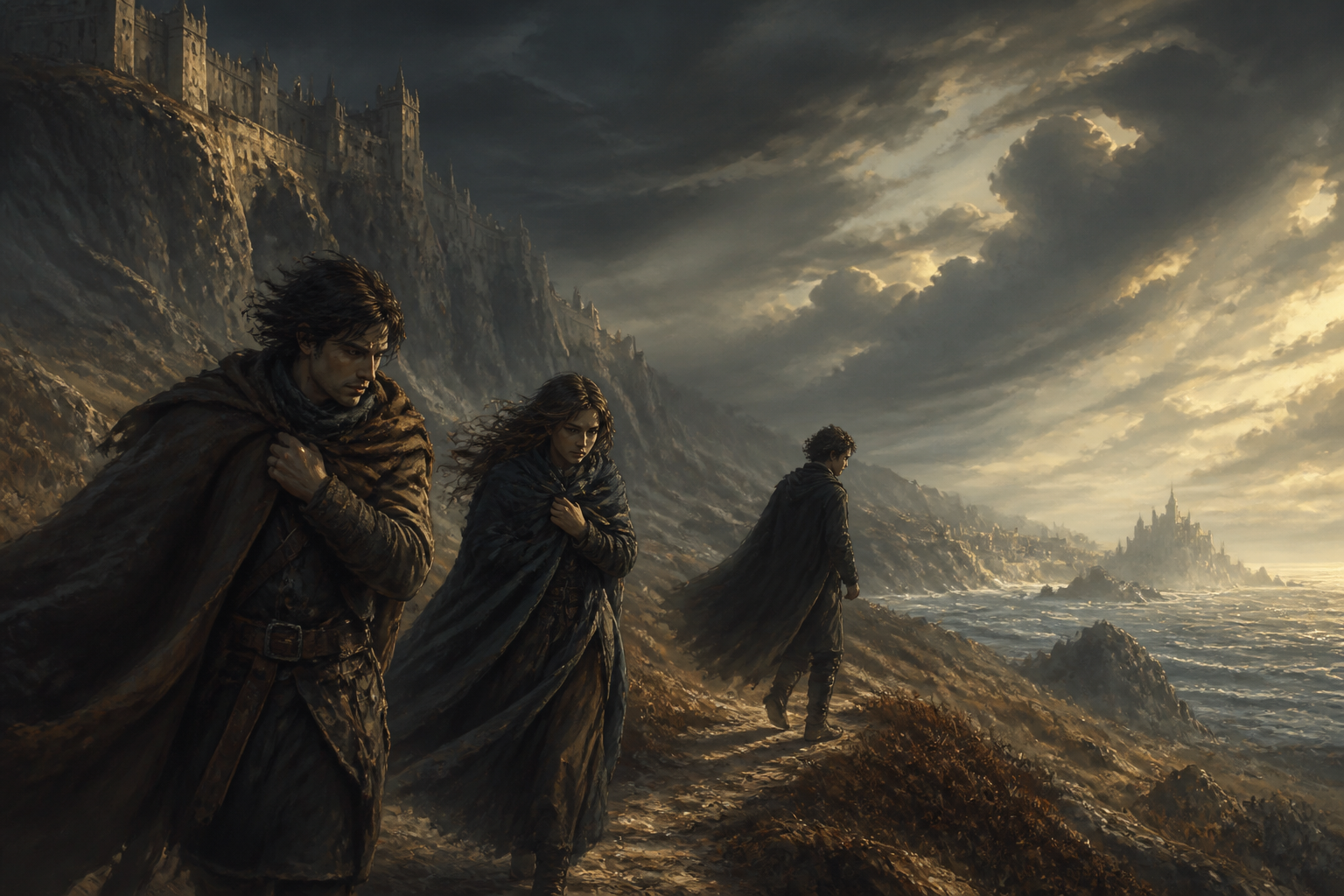
The Landoryan wind did not let them rest.
It followed them south from the citadel with the persistence of something alive, threading cold fingers through Robert's collar and pulling at the hem of Mary's travelling cloak until she finally held it shut with both hands. James walked three paces ahead of them both, the way he always did when he was thinking, fast and slightly tilted, as though leaning into a future the others hadn't caught up to yet. Robert watched his brother's back and said nothing. There was nothing yet that needed saying. The word yet was doing all the work.
They split at the Crossroads of Solen, where the old road forked like a broken promise.
James went north and east toward the Aurora Plains, drawn by word of a seer named Lysa who was said to speak in thunder and mean it. Mary turned toward the low hills where the Eldrin Library sat half-sunken into bedrock, patient as a held breath. Robert rode south with seventeen riders toward Ashenmoor, where Lokahi the Warrior Chief had sent word that the border was bleeding again, and that he wanted the boy who had walked through the gate at Vethara to come and explain what kind of boy he was.
Robert had arrived expecting negotiations. He had not expected to like Lokahi.
The Chief was a wide, unhurried man with hands like quarried stone and eyes that measured you without appearing to. He received Robert in a tent that smelled of pine resin and old iron, poured something deeply amber into two cups, and pushed one across the table without ceremony.
"My people say you stopped a river with your hands," Lokahi said.
"Your people exaggerate."
"They do." Lokahi picked up his cup. "That's why I need to hear it from you."
Robert told him the truth, not the story, but the truth, which was smaller and stranger and more exhausting than the story. Lokahi listened without interrupting. When Robert finished, the Chief nodded once, as though the answer had confirmed something he'd already decided.
"Then we fight together," Lokahi said. "Because I don't want a legend at my side. I want someone who knows the cost."
Robert would think about that sentence for a long time afterward. He would think about it especially on the third day of the Siege of Ashenmoor, when the eastern wall cracked and the enemy poured through the gap like smoke through a keyhole and Robert stood at the centre of it and called the wind.
He called it the way he always did, from the diaphragm, from the instinct, from the place below thought where the Air Magic lived. But the siege had been running for thirty-one hours and he had already raised three windwalls and twice lifted men physically from the path of cavalry, and what answered him this time was not the clean torrent he was used to. It was something thinner, and then something vast, and then it tore through him like a cord pulled past breaking.
He didn't feel himself fall.
He woke to candlelight and the smell of something herbal and serious.
Mary was beside him. She had ridden through the night when Lokahi's messenger reached the Library, arriving in the early dark of the second day with the Codex of Harmony tucked under one arm and a leather satchel of salves over the other shoulder. She had not slept. She looked, Robert thought distantly, the way she always looked when she was frightened, very calm, very precise, every motion deliberate.
"You burned your channels," she said, not looking up from his wrist.
"How bad?"
"Bad enough that I'm here."
Outside the tent, the Celestial Eclipse was reaching its peak, that rare alignment where Landorya's twin moons slid across the sun's face in sequence, and the sky went silver-dark for three exact minutes. Mary had timed her work around it. The Celestial Light that bled through the canvas at its height was faint and absolute, and she drew it down through her palms the way the Codex described, layering it into his damaged channels like thread through a needle. The salves went on at the joins, collarbone, wrists, the base of his skull, cold and green-smelling and very precise.
Robert lay still and let her.
He had never been healed before. Not like this. He had been treated, bandaged, rested, told to eat. But Mary's hands moved through him like she knew the map of him better than he did, and somewhere in the silver dark he felt the frayed places begin, slowly, to close. He thought about saying something. He thought about how much easier it was, in this family, to say then we build it than to say I needed you.
"Mary," he said.
"I know," she said.
They did not speak again for a long time, and the silence between them was of a different quality than it had been before, not empty, but full. Not the absence of words, but the presence of something that didn't need them.
James had not come to the siege. He had his own reckoning to manage.
Lysa the seer had given him the Elemental Talisman on the third morning of the Aurora Plains, pressing it into his palm without preamble in a voice like distant weather. For the one who runs toward the thing that frightens him, she had said. Not because it is wise. Because he cannot help it. The nomadic tribes had named him Storm-Ranger at dusk the same day, which James had accepted with genuine pride and, characteristically, taken as confirmation that his instincts were right.
They were not always right.
The Cavern of Echoes had been marked on Lysa's map with a symbol James had interpreted as significant. The correct translation was trap. He understood this about forty seconds after entering, when the passage sealed behind him and the voices started, his own voice, fractured and multiplied by the cave's geometry, each echo a version of his worst impulse feeding back on itself in an ascending spiral of noise.
Robert found him two hours later. He was still not fully recovered. He had stood up against Lokahi's explicit orders and against Mary's quieter but more effective disapproval, and he had followed the trail James had left with the particular grim efficiency of someone who had done this before.
He did not say anything when he pulled his brother free of the passage. He did not say anything as they walked back into open air and sat down on the cold scrub grass of the plain. He waited until James's breathing steadied, and then he said it.
"You knew it might be a trap."
"I thought,"
"You thought being brave enough would change what it was."
James turned. "That's not fair."
"No," Robert said. "It isn't. But fair isn't the question." He looked at his brother, really looked at him, the way Lokahi had looked at him in the tent, measuring without cruelty. "Bravery is walking into the thing that frightens you because you've decided the cost is worth it. Recklessness is walking in before you've done the accounting. James." He paused. "You nearly died in a cave because you mistranslated a symbol."
The silence that followed was not like the silence in Mary's tent. It was hot and jagged and honest.
"I know," James said at last. His voice was different, stripped of its forward tilt.
Robert put a hand briefly on his brother's shoulder. He left it there for one moment, and then they both stood, and the wind moved across the Aurora Plains from the west the way it always did at dusk in Landorya, low and cool and carrying the smell of something far away, something they hadn't reached yet.
Yet. The word was still working.
They walked back toward the camp where Mary was waiting, and the Talisman was warm in James's closed fist, and the flame between all three of them, fractured, costly, absolutely theirs, burned on.