Chapter 3
The Call to Adventure
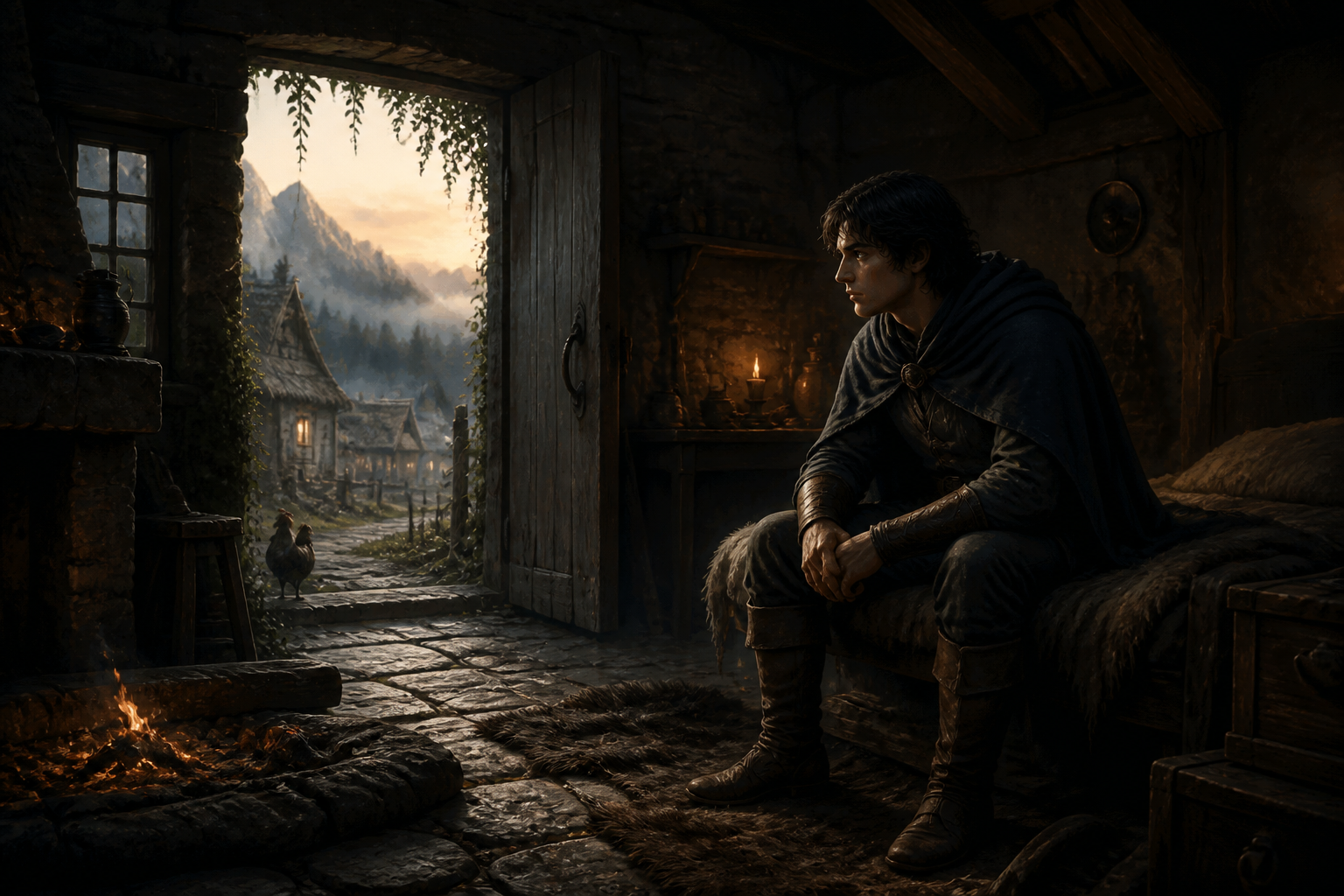
The hearth had burned low by the time Elandril made his decision.
He sat at the edge of his cot in the small stone house his grandfather had built, watching the last orange tongue of flame curl and die beneath a mound of grey ash. Outside, the village of Thornhaven breathed in the quiet rhythms of early morning, a rooster's distant declaration, the creak of a neighbor's shutter, sounds so ordinary, so achingly familiar, that his chest tightened at the thought of leaving them behind.
He did not want this.
He had told Miralith as much when she had come to him two nights ago, her silver eyes catching the moonlight like coins thrown into dark water. She had spoken of a destiny written in the arrangement of stars, of a wound opening somewhere deep in the bones of Landorya that would swallow everything he loved if left to fester. He had listened. He had nodded. And then he had gone home and stared at the ceiling until dawn and told himself she was wrong.
But the mark on his wrist had not let him sleep since. It had appeared the morning after her visit, three pale points arranged like a constellation just below the pulse point, faintly luminous in the dark. He had tried to scrub it away. He had tried to convince himself it was a bruise, a burn, a trick of anxious eyes. It pulsed now, gently, like a second heartbeat.
You already know, it seemed to say. You have always known.
He rose before the rest of the house stirred and went to the cedar chest beneath his parents' window. The lock had not been turned in years; the key was kept on a hook above the lintel, coated in the comfortable rust of disuse. The chest exhaled the smell of cedar oil and old iron as the lid lifted. There, beneath a folded burial cloth and his mother's wedding ribbon, lay the sword.
It was not a beautiful weapon by any measure. The blade was dark, almost grey, forged from a Landoryan ironwood-and-ore alloy the old smiths had called andurath, a word that translated roughly as that which endures. The crossguard was simple, worn smooth at the edges where generations of hands had gripped it in worry or in war. But when Elandril closed his fingers around the hilt, the weight of it settled into his palm with a familiarity that made his throat ache. It fit him the way a word fits a thought, as though it had always been waiting for this particular moment, this particular hand.
He heard his mother's footsteps before he saw her.
She stood in the doorway in her sleeping shawl, grey hair loose around her shoulders, and she looked at the sword in his hand and said nothing for a long moment. Her eyes moved from the blade to his wrist, to the three pale points of light, and her lips pressed together in an expression he had seen only once before, the day they had buried his grandfather.
"Then it has come," she said quietly. Not a question.
"I don't want it to have come." His voice was rougher than he intended.
She crossed the room and took his face in both hands, the way she had when he was small and frightened of storms. "Wanting and needing were never the same thing in this family." She kissed his forehead. "Come. Wake your brother. Eat something before you go."
Breakfast was bread and salt-cured lamb, eaten mostly in silence. His younger brother Dari kept his eyes down but reached across the table once and gripped Elandril's forearm, hard and brief, the way boys do when they refuse to cry.
At the door, Elandril shouldered the satchel Miralith had pressed into his hands, a small thing, soft leather the color of river moss, clasped with a bone toggle carved into the shape of a crescent. He had not yet opened it fully, but he could smell the sharp green of dried fenwick-root and the sweeter, deeper scent of something older, something that did not belong to any herb he knew. When he had briefly lifted the flap the previous evening, he had glimpsed the edge of a map, parchment so aged it seemed less like paper and more like dried skin, inked in a script he could not read but somehow, disturbingly, half-recognized.
He stepped out into the cold morning air.
Thornhaven was waking around him, smoke rising from chimneys, the baker's boy wheeling his cart through the mud, and all of it looked both entirely the same and irreversibly distant, as though a pane of glass had been lowered between him and everything he had ever belonged to.
His mother stood in the doorway until he reached the road. He turned once. She raised her hand.
He raised his.
Then he turned south, toward the dark treeline of the Mirewood, toward the wound in the world Miralith had described, and he walked, not with the confidence of a hero, but with the grim, quiet resolve of a man who has simply run out of reasons to stay still.
The mark on his wrist pulsed once, warm, like an approving heartbeat.
Landorya received him without ceremony.