Chapter 8
The Celestial Summit
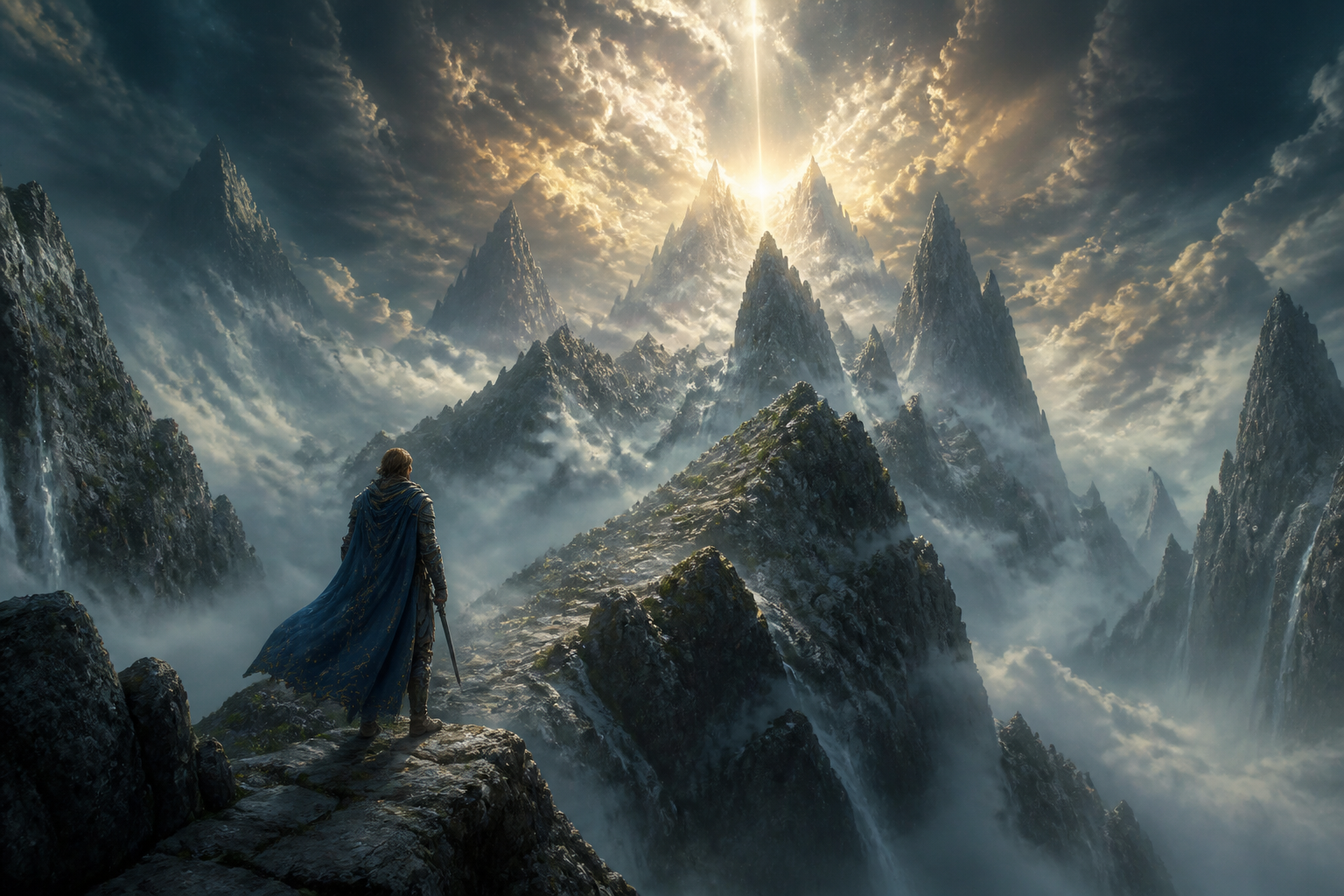
The path ceased to be a path somewhere around the third hour of climbing.
Elandril had known the Celestial Mountains by reputation, every child in Landorya did, whispered over firesides as a place where the gods had once pressed their fingers into the earth and pushed upward until stone split sky. But reputation, he understood now, was a pale and treacherous thing. The reality of the mountains was something that burrowed beneath the skin and stayed there.
He shifted the weight of his satchel, feeling the fragments stir against one another through the leather, five shards of the Amulet of Harmony, each one warm with its own particular pulse. Together they had carried him across half of Landorya: through the ash-plains of Dhorrak, along the sunken canals of Vel Serith, into the fever-dark of the Thornwood. And now here, where the wind came not from any direction but from everywhere at once, carrying with it a smell like burning copper and old rain.
The trail, if it had ever been one, vanished beneath a field of pale stone that reflected the sky. Not a mirror's reflection, but something older and more disquieting. The clouds above moved through the rock below him as though the mountain were dreaming of the heavens, and Elandril found he could not always be certain which surface he was standing on.
Don't look down, he told himself, which was precisely the wrong instruction to give a mind already fraying at its edges.
He looked down.
The stone rippled. Somewhere far below, or perhaps far above, a constellation he did not recognise blinked into existence and was gone.
"Keep moving," he said aloud. He had long since passed the point where speaking to himself felt strange. Solitude had a way of dissolving that particular dignity.
The fragments pulsed, harder now. They knew where they were going even when he didn't.
The air thinned as he climbed, and with it thinned the reliable grammar of the world. Time grew elastic. He passed the same broken spire of granite twice, he was certain of it, yet the angle of the faint, colourless light had shifted between each passing as though hours had elapsed. Once he rounded a ledge and walked directly into the memory of rain: a full, drenching downpour that left no moisture on his cloak but soaked him to the chest with cold before it dissolved. He stood gasping in dry air, heart hammering, and pressed on.
Landorya's scholars called this phenomenon the Veilshear, the tendency of places close to old celestial power to shed the skin of ordinary reality. Elandril had read about it in Vel Serith's library, calm and candlelit, turning pages with clean hands. He had found the concept intellectually fascinating.
He did not find it intellectually fascinating now.
What he found, eventually, was the summit.
It announced itself not with any dramatic revelation but with a sudden cessation, of wind, of the unsettling doubling of surfaces, of the low harmonic vibration that had lived in his back teeth since the midpoint of the climb. One step, and the world was a blurred and slipping thing. The next, and it was utterly, crystallinely still.
The summit was a flat disc of black stone perhaps thirty yards across, polished smooth as a lord's table, ringed by seven formations of rock that rose like the fingers of a cupped hand. Above, and here Elandril stopped breathing, the sky was impossible. It was night in full, though it had been grey midday at the base of the mountain, and the stars were arranged in an alignment he recognised from the oldest star-charts he had studied: the Concordance, a convergence that occurred once in a generation, when seven celestial bodies drew into a single arc across the sky's meridian. Tonight was the night. It had to be. He had timed everything, every detour, every delay, every frantic recalculation, toward this.
He knelt at the centre of the disc and opened the satchel.
The fragments came out one by one, each one a different texture and temperature in his palms: the cold, smooth curve of the first; the rough, volcanic edge of the second; the third, faintly luminescent, like a trapped moth; the fourth, dense and humming; and the fifth, the one recovered last, from the hands of the dying warden in Dhorrak, still faintly blood-warm, as though it remembered.
He arranged them in the configuration from the old inscription. His hands trembled. He was aware, acutely and suddenly, of how entirely alone he was, and how much was asked of one person kneeling on a cold stone at the top of the world.
What if it doesn't hold? The thought arrived without invitation. What if I've carried broken things across a broken land and they are still, in the end, only broken?
He pressed the final fragment into place.
The reaction was not violent. It was the opposite of violence, a slow, immaculate cohesion, as though the shards remembered their original form the way old friends remember each other's names. Light moved between them in thin rivers, silver and gold and a blue that had no earthly name, and the seams sealed themselves with a sound like a single, perfect note struck on a bell of vast size and great distance. The vibration passed through Elandril's hands, up through his arms, and settled somewhere behind his sternum.
The Amulet of Harmony lay complete in his palms.
Above him, the seven celestial bodies of the Concordance blazed in their brief, ancient alignment, and for one suspended moment, Elandril felt the whole of Landorya beneath him, its rivers and its ruins, its living and its long dead, held together in something that was almost, almost peace.
He closed his fingers around the amulet and bowed his head, not in prayer, but in the particular silence of a person who has done the thing they were made to do and does not yet know what comes next.