Chapter 3
Chapter III: The Grand Rite of Unbinding
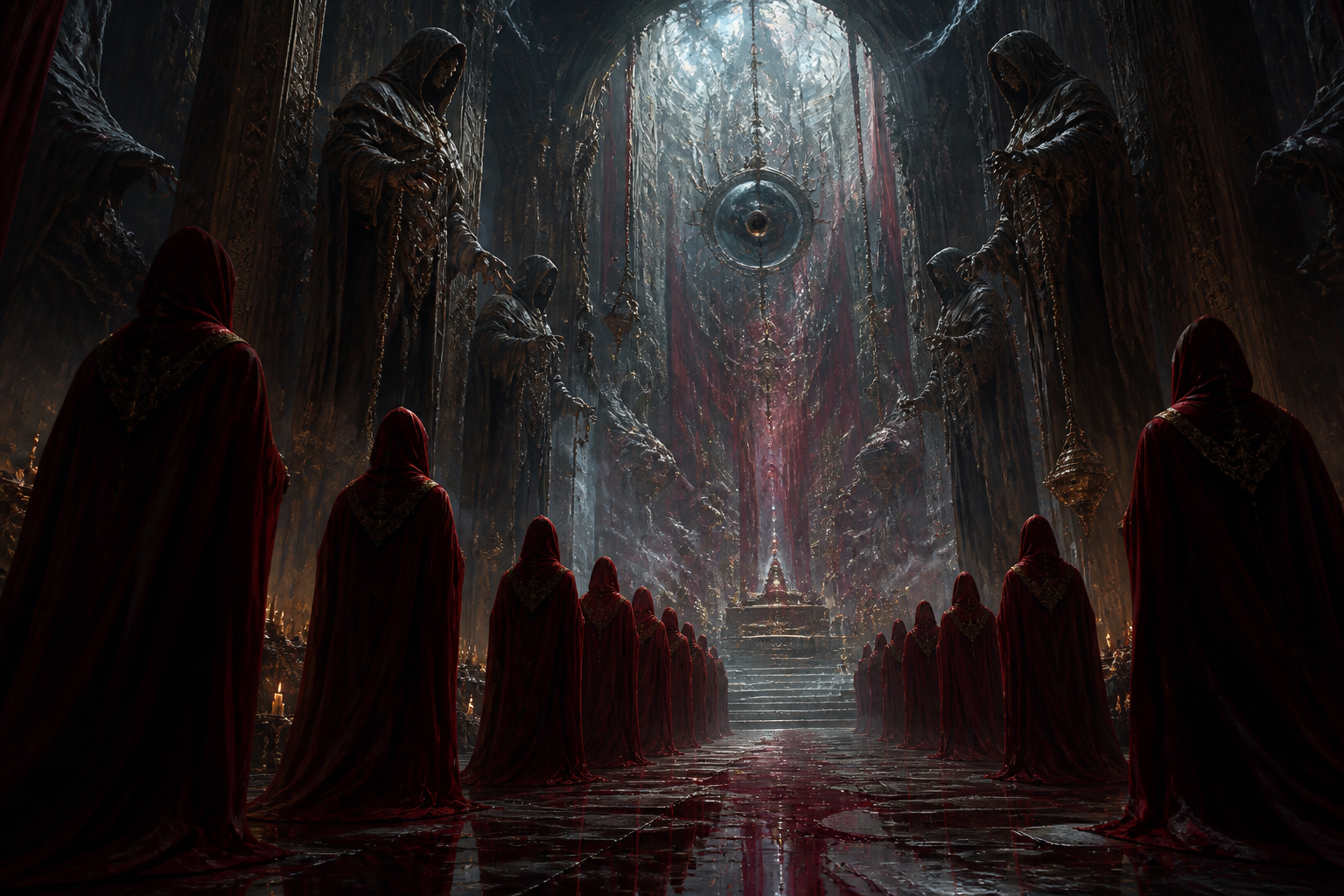
CHAPTER III: The Grand Rite of Unbinding
They came before dawn, when the stars still held dominion and the world had not yet remembered it was mortal.
Forty-three members of the Aetheric Compact crossed the threshold of the Sanctum Veranthos in single file, their robes the deep arterial crimson that no dye-master in Amrath could quite replicate, a colour achieved, it was whispered, by soaking the cloth in distilled aetheric residue until the fabric itself learned to hunger. They carried no torches. They needed none. The sanctum's walls exhaled a pale luminescence from the leywork carved into every stone, ten thousand glyphs laid down over six generations of Compact scholarship, all of it leading here, all of it leading to tonight.
Archon Seravel Doss walked at the column's head.
He was not a large man. He had never needed to be. His authority lived in the precision of his stillness, the way he turned his head by exactly the degrees required, the way his hands, even now, hung relaxed at his sides as though the greatest act of magical violence in recorded history were a matter of mild administrative interest. His apprentices had once called him the Glacier behind his back. He had chosen to take it as a compliment.
We are past the point of fearing what we are, he had told the Compact at their final council, three nights ago. The Weave was not spun by gods. It was spun by forces older than gods, and forces can be seized by those with the will and the knowledge to close their fist around them. He had paused, letting the silence sharpen. We have both.
They had voted. Forty-two to one. Archon Ysse had walked out without speaking. Seravel had let her go. There was no version of the future in which a single dissenter mattered.
Now he descended the central aisle of the sanctum's great nave, where the ritual floor had been prepared over the preceding week. The Convergence Pattern filled the entire chamber, a mandala forty feet across, inscribed in silver dust and ground aetheric crystal, its geometry so complex that three junior members had wept involuntarily upon first seeing it fully rendered. At its heart stood the Binding Seat: an iron chair engraved with the Compact's foundational theorems, bolted to the floor above the deepest leyline intersection in the known world.
Seravel sat.
Around him, the forty-two arranged themselves in concentric rings, each at a prescribed coordinate within the mandala. They did not speak. Language was a blunt instrument for what came next. They breathed together, finding the slow rhythm that the Compact called the unison pulse, and one by one they opened the interior doors they had spent lifetimes building, the disciplined channels through which a practitioner touched the Weave and drew from it, carefully, the way one draws water from a deep well with a rope of known length.
Tonight they would drop the rope entirely and jump.
The aether responded to their combined attention the way a sea responds to sudden wind, first a ripple, then a gathering swell, then something that ceased to resemble water at all. Seravel felt it come up through the iron chair, through his spine, into the architecture of his thoughts. He had touched raw aether before, in controlled fragments. This was different. This was the source behind the source, the fire that had lit every fire, and for one suspended, annihilating instant it was comprehensible, a vast grammar of existence spelling itself out in a language that bypassed hearing and landed directly behind the eyes.
He understood stars. He understood the articulation of stone into mountain. He understood, with calm and terrible clarity, why the Weave existed and what it was holding in place, and he opened his mouth to say something, to name it, to claim it, to complete the Rite, and the word he needed was precisely one syllable longer than a human throat could form.
The Weave did not break.
It corrected.
The feedback came without warning: not a sound but a pressure that preceded sound, the way lightning precedes thunder by the distance of your own safety. The mandala's silver dust rose six inches off the floor in a single unified sheet and then detonated outward. Seravel had time to register that the light was the colour of something that had no colour, that the forty-two were screaming in harmonics he had never catalogued, that the leylines beneath them were not merely overloaded but inverted, turned back on themselves like a river reversing to flood its own source.
Then the sanctum's floor split along seventeen simultaneous fault lines, and Veranthos folded inward at the centre, and the sky above the valley opened.
Across Landorya, people stopped.
A shepherd on the Ashen Moor fell to his knees and pressed his forehead to the cold grass, certain, for one gasping moment, that the world was being unmade. In Amrath, Grand Magistra Olvane was at her writing desk when the window blazed white and her inkwell shattered from a concussive tremor in the aether, a tremor with no physical source, no earthquake to name it by. In the Thornwood, ancient trees groaned in their roots. In the coastal city of Vel Sarrath, every flame in every lantern turned the wrong shade of blue and then died simultaneously, leaving ten thousand people standing in sudden dark, looking upward at a sky that pulsed like a wound.
The light lasted eleven seconds. Those who tried to count always lost track somewhere around eight, their minds sliding away from the number the way the eye slides from a too-bright point.
Then it was gone.
Nothing remained of the Sanctum Veranthos but a crater forty yards in diameter, its edges fused to black glass, and at its centre a tear in the visible air approximately the height and width of a standing man, a vertical seam through which the world on the other side was subtly, wrongly different, as though reality there had been rearranged by a hand that almost, but not quite, understood how the pieces fit.
No bodies were recovered. The Compact's library, its instruments, its six generations of accumulated theory, all of it was simply elsewhere, translated to some state that had no name in any language yet devised.
The tear pulsed once in the cold morning air, like a heartbeat, and remained.
In Amrath, Olvane stood at her shattered window with plaster dust on her shoulders and ink on her hands. She stared at the horizon, where the afterglow of that impossible light was only now fading from the clouds.
Not yet, she had told herself, three nights ago.
She did not reach for that word again. It no longer seemed to be there.