Chapter 5
Chapter V: The World Unmade
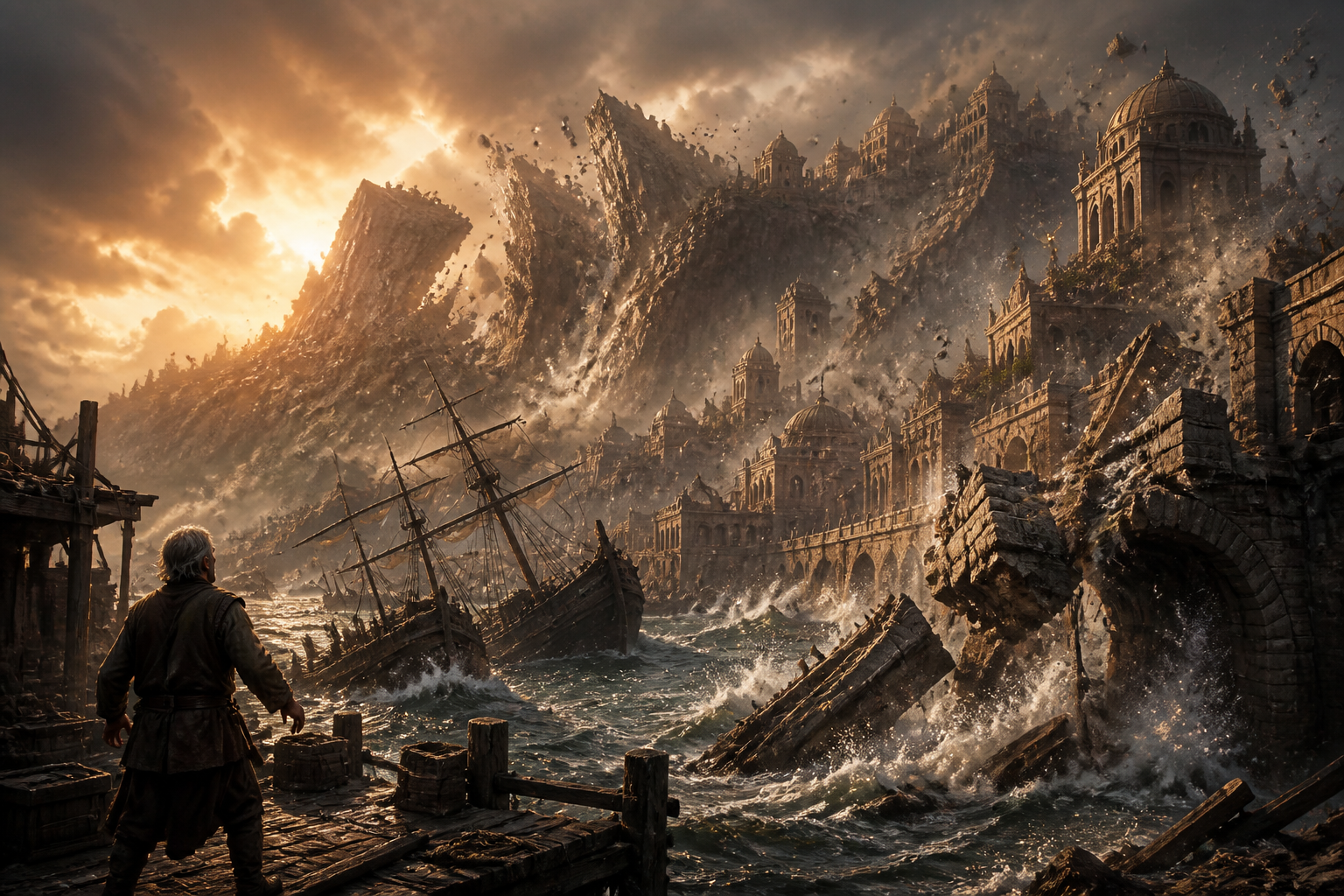
The first earthquake reached Vel Sarath at dawn.
It arrived not as a rumble but as a sound, a low, foundational groan, as though the bones of the world were being read aloud in some language older than stone. Mirek the dockmaster heard it from his wharf and stood very still, the way animals stand before lightning, and had just enough time to think this is wrong before the harbour wall split along its length like a piece of overripe fruit and the sea came in.
It came in fast. It came in dark and salt-cold and carrying the wreckage of three moored galleys before it, and it swallowed the lower city in the space of a long breath. The waters did not recede. Where Vel Sarath's famous market terraces had cascaded down to the waterline in their broad, sun-warm steps, steps that merchants from Thassovane and the Ironfields and all the far reaches of the empire had climbed for four hundred years, there was now only a grey churn, littered with floating timber and bolts of dye-soaked cloth bleeding colour into the flood like open wounds.
Mirek survived by climbing. He never stopped climbing for two days.
Elsewhere the world behaved differently, and no less terribly.
At the Aetheric Compact's Grand Conclave in Orrath Vel, the rupture had already come and gone, but what it left behind was still becoming clear. The tower complex, seven spires of pale ashenglass that had stood for two centuries as the visible proof of order, of mastery, of humanity's negotiated dominion over the Elemental Planes, was simply not there anymore. The foundations remained, and portions of the outer wall, and a fused black scar across the courtyard's marble where something had exited the physical world at tremendous speed. The thirty-one senior Compactors who had gathered for the emergency conclave were gone with the towers.
Three junior archivists had survived by being in the sub-level storerooms, sheltered beneath the weight of two centuries of documented knowledge. They emerged into the courtyard, breathed the air that tasted of ozone and blood and burned hair, and looked at one another.
One of them, a young woman from the hill provinces whose name was Sael, walked to the edge of the scar and crouched over it. She ran two fingers along its surface. It was warm. It was still warm, hours later, and the warmth was not residual, it pulsed, faintly, at irregular intervals, the way a sleeping creature breathes.
She stood and walked back to the others without speaking. She had intended to say something practical. Instead she said: "The Planes heard it."
No one asked what she meant. They all knew what she meant.
The mountains moved on the third day.
The Vethori Range, which had marked the northern boundary of the empire's heartland for as long as maps had been made, shuddered upward along its eastern extent, adding two hundred feet of raw rock to peaks that had once been manageable passes. The roads that threaded those passes, the Amber Road, the Silver Trace, the Pilgrim's Way, did not so much close as cease to be. Landslides buried the waystation at Kell's Crossing under sixty feet of granite and frozen soil. The garrison post at High Vethori, sixty soldiers and a cook named Davan who made exceptional flatbread, was simply incorporated into the new geography, sealed inside the mountain's sudden growth like an insect in amber.
South of the new heights, the Cassavar River lost its course. It wandered, then pooled, then spread across the broad agricultural plain that had fed the empire's centre for generations. By the end of the first week it had become a shallow inland sea, its edges still advancing, its waters pale brown with suspended soil. Farmers who had walked those fields since childhood waded to their doorframes and watched their livelihood dissolve. Some wept. Some did not. Some simply stood in the water up to their thighs and looked at it with an expression that was not grief exactly, grief has a direction, aims itself at something remembered, but was more like the total absence of a future that had already been written.
In Amrath, Olvane felt the first tremor through her desk.
The journal shifted. The inkwell rang against its brass holder with a small, precise sound that seemed enormously loud in the silence, and she put her hand flat against the page she had written as though she could hold the words still. Outside, she could hear the city, its bells ringing not in ceremony but in alarm, its people calling to one another across streets that were cracking at the joints, the slow artillery sound of a civic building losing structural integrity three blocks to the east.
She did not run. She was past running. She had been past running since she'd written that line three days ago and felt the world's great parental presence go out of it.
On this day, we became entirely our own.
She looked at the words again now. She had her answer at last. It was not a beginning or an epitaph. It was a fact, flat and featureless and enormous, a plain stretching in every direction without landmark or horizon. They were their own. They had always, in some technical sense, been their own. But there had been a structure beneath the world that made the self feel supported, that made the individual will feel like a thread in something larger. That structure was now expressing itself as cracks in pavement and a rising brown sea and thirty-one empty spaces in the world where thirty-one senior minds had been.
She closed the journal.
She stood, crossed to the window, and watched Amrath shudder and endure, shudder and endure, the city old enough to have learned the rhythm, not young enough to make it graceful. Smoke was rising from the eastern quarter. The morning bells had long since given up any pattern and were simply ringing, ragged and continuous, as if sound itself were trying to hold something together.
She thought about the empire. She thought about the Compact's towers, which she had seen once as a child, rising against a summer sky the specific blue of promise. She thought about the roads that were gone and the cities that were becoming lakes and the passes sealed under new mountains that had not asked permission to exist.
We became entirely our own, she thought. And the world became entirely itself. And these are not the same thing, and we did not understand that until now, and understanding it now is exactly too late, and exactly the only time understanding ever actually arrives.
Outside, Amrath rang its broken bells into a sky that was not listening, and the world continued the long, indifferent work of remaking itself without them.