Chapter 3
Chapter III, The Sky-Trade and the Granite Accord (The Age of Coalition)
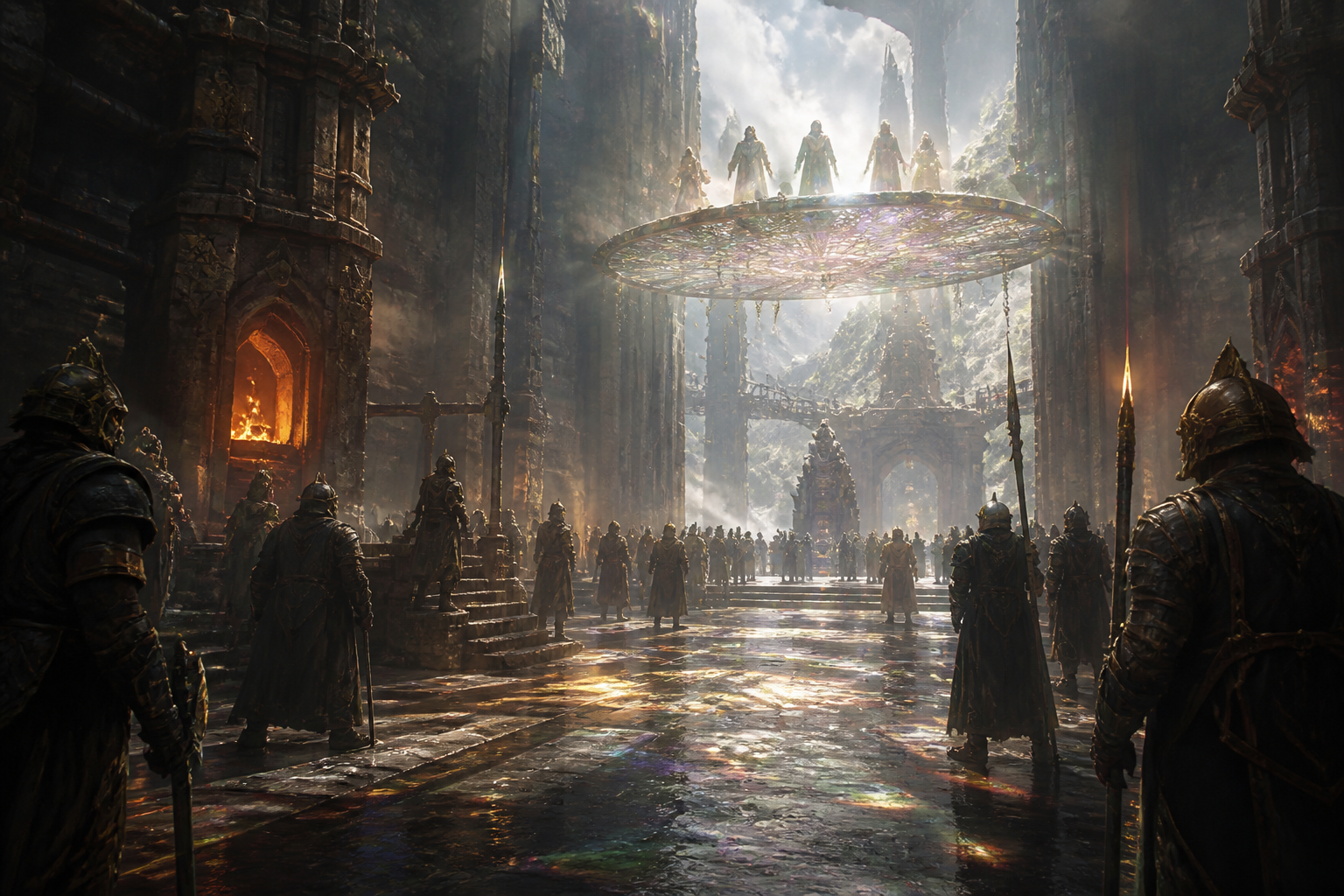
The first thing the gate-wardens of Heartforge saw was light, not the orange, coal-fed light they trusted, but something pale and refractive, scattered into a dozen ghost-colors across the stone plaza as though the air itself had decided to show off. Then they saw the platform.
It descended slowly, almost apologetically, a disc of woven air-lattice no wider than a merchant's wagon, its edges humming at a frequency that made the iron deposits in the surrounding rock wall resonate with a low, involuntary sigh. On the platform stood three figures robed in spun cirrus, cloth that moved even when the air was still, and each carried before them, braced in both hands like an offering to a god they were not entirely sure existed, a slab of wind-carved glass.
The glass was extraordinary. Quarried, if that was even the word, from the high pressure gradients above the Aero-Lattice itself, it had been shaped not by tool but by sustained, directed breath, generations of Zephyrian Archons exhaling their intention into raw atmospheric crystalline until the material complied. Each slab was slightly different: one the color of a clear winter noon, one faintly violet along its lower edge where a storm-memory was still trapped inside, and one perfectly, achingly transparent, so that when the senior gate-warden, Brossa Undenveil, looked through it, she saw not the plaza behind the Zephyrian delegation but some other version of the plaza, cleaner, quieter, shimmering with a light that did not yet exist.
"We've come about the knock," said the central Zephyrian, a woman whose name, rendered in the clipped airy syllables of her language, translated roughly into Landoryan common as She Who Reads the Pressure Before the Storm. Her voice carried the characteristic Zephyrian lilt, every vowel slightly elevated, as if speech itself were a thing that preferred altitude. "We believe your chamber heard it too."
Brossa had been a gate-warden for thirty-one years. She had turned away stone-thieves, sky-pirates, and once a delegation of Tidecallers who had arrived drunk on brine-mead and singing something deeply impolite about granite. She had not been trained for this.
She sent for the Forgemaster.
The negotiations lasted eleven days. They took place in the Chamber of Old Voices, which was either an insult or an honor depending on whether the Zephyrians understood that the walls remembered everything spoken inside them. By the third day, it was clear they understood perfectly, and had chosen it on purpose. Let the stone keep record, said She Who Reads the Pressure, when the Forgemaster raised an eyebrow. We have nothing to hide, and everything to preserve.
The wind-carved glass was offered in exchange for crystal tablets, resonance-cut slabs of heartstone whose internal geometry, when struck at the precise angle of three degrees off-vertical, sang a tone that corresponded to magnetic north with an accuracy no compass needle had yet achieved. The Zephyrian Archons had wanted them for decades; their aero-platforms were magnificent, but navigating the upper wind-currents without a fixed reference was, as one junior delegate confided to Brossa over a shared meal of spiced mineral broth, like trying to read a map that keeps deciding it's a different map.
The Granite Accord was inscribed on the seventh day. Not on paper, not on the wind-glass, on a slab of living granite that the Forgemaster drew up from the deep-seam with his bare hands and shaped while it was still warm, pressing the agreed terms into the surface with a stylus of compressed coal that left letters which glowed faintly for a hundred years afterward.
It was the first written agreement between two civilizations in the history of Landorya.
It would not be the last.
The Accord was barely cool when the Tidecallers arrived.
They came not through the gates but through the underground aquifer, a delegation of seven, riding a brine-current they had apparently threaded through three hundred feet of bedrock with the casual ease of people who considered water's presence in solid rock a suggestion rather than a contradiction. They surfaced in the lower cistern, wrung out their kelp-fiber coats, and presented themselves at the Chamber door with the particular dignity of those who are deeply aware they have made a dramatic entrance and are committed to not acknowledging it.
Their offer was different. Where the Zephyrians had brought art, the Tidecallers brought medicine, tidal almanacs encoding the healing cycles of deep brine, pressure-maps of the body's own internal currents, and three living specimens of the luminescent deep-urchin whose secretions, when properly distilled, could knit a fracture in bone the way water fills the shape of any vessel it enters. In return, they wanted what the Forgekind had always hoarded most jealously: heat-mapping. The precise knowledge of where, beneath the continental shelf, the thermal vents ran, the Tidecallers' greatest navigational mystery, and their ships' oldest enemy.
The Forgemaster sat with this request for two days. Then he gave it freely, asking only that the maps never be used to redirect the vents, for the vents were not his to redirect. They were, he said quietly, something borrowed.
The Tidecallers accepted. They understood borrowed things.
The Verdathi came next, and they came the way they did everything, slowly, irresistibly, from several directions at once.
Root-runners arrived first: thin vegetative tendrils that probed the gaps in Heartforge's outer wall over a period of weeks before anyone realized they were intentional rather than invasive. When the Forgemaster's apprentices traced them back to their source, they found a Verdathi Grove-Speaker sitting in patient silence three miles out on the eastern plateau, tending a small fire of aromatic bark and waiting to be invited in. She had been there for nineteen days.
We did not want to presume, she said, when they brought her inside, and there was no irony in it at all.
The Verdathi brought what nothing else could replace: deep time. Their root-memory archives, compressed biological records stored in the heartwood of ancient growth-nodes, contained ecological histories stretching back before even the Forgekind's oldest oral traditions. They knew which stone-seams ran true and which had been compromised by ancient cataclysm. They knew which winds had names before the Zephyrians named them. They knew the original shape of coastlines the Tidecallers no longer recognized.
In exchange they asked for one thing: fire. Not destructive fire, but forge-fire, the controlled, patient, generative kind that transforms rather than consumes. They wanted to learn the distinction. The Forgemaster spent three weeks teaching it. On the last day, the Grove-Speaker pressed her palm to a hearthstone and grew a flower from the residual heat. It was black-petaled, warm to the touch, and it lived for six months before it composted itself neatly in the corner of the chamber where it had bloomed.
The Forgekind kept the pot.
The Aetherans did not arrive so much as clarify.
There was a morning, perhaps three weeks after the Verdathi accord was signed, when the chamber felt subtly different, not changed, but completed, the way a sentence that has been waiting for its final word finally receives it. Several of those present later reported that they had the impression someone had been sitting quietly in the corner for quite some time, and had simply, at that moment, chosen to be visible.
The Aetheric representative had no name in any language. It communicated through a process the scholars later called resonant impression, not speech, not writing, but a quality of understanding that arrived in the mind fully formed, the way you know you are cold before you consciously notice the temperature. What it communicated, over the following days, was not an offer and not a request.
It was an observation.
Each of you, it conveyed, has been solving a partial equation. You have been brilliant and tireless and almost entirely correct. But you have each been solving for one variable while assuming the others are constants. They are not constants. They are the same equation, expressed differently.
It demonstrated. Not with diagrams but with the chamber itself: a shift in atmospheric pressure that caused the granite walls to vibrate at a tone that resonated with the wind-glass panels the Zephyrians had installed along the upper gallery, which in turn cast a refracted light that struck the surface of the Tidecallers' brine-chart at an angle that illuminated a previously invisible notation, which when read aloud in the old Verdathi root-tongue activated a dormant growth-memory in the living mortar the Grove-Speaker had seeded into the chamber walls three weeks prior, which bloomed briefly into a pattern that the Forgekind recognized, with a collective sharp intake of breath, as the thermal signature of the world's deepest vent.
The silence that followed lasted long enough for someone to realize that what they had just witnessed was not a trick.
It was a language. And they had all, unknowingly, been speaking it in fragments.
The century that followed was called the Coalescent Age by those who lived through it, and the Golden Era by those who came after, though the Forgekind, characteristically, rejected both names and referred to it simply as the Time of Proper Work. It was neither perfectly peaceful nor free from friction; the Zephyrians and the Tidecallers had a recurring argument about the ownership of coastal updrafts that flared into something close to hostility at least four times in the first fifty years. The Verdathi moved slowly enough that collaborative projects sometimes outlasted the lifespan of every other participant, requiring the elaborate negotiation of institutional memory that became the foundation of the first cross-civilizational academies. The Aetherans remained constitutionally difficult to schedule.
But work was done. Extraordinary, patient, foundational work.
The first resonance-lattice was built collaboratively in year twelve: a structure that used Forgekind hearthstone for its base, Zephyrian wind-glass for its transmission panels, Verdathi root-memory for its archival nodes, Tidecaller brine-pressure for its cooling channels, and an Aetheric harmonic principle, gifted quietly, without ceremony, for its organizing logic. It didn't do anything that any one civilization could immediately explain. But it worked. Things brought near it became slightly more themselves: metals refined faster, winds navigated more cleanly, roots grew straighter, waters ran truer, and on three separate occasions that first year, people standing within its range reported understanding something they had been trying to understand for a very long time.
They built more.
The invisible architecture went down first, deep axioms of cross-elemental interaction, the weight-bearing grammar of a magic system that would not be named as magic for another two hundred years, laid in the bedrock of shared knowledge the way the Forgekind laid their foundations: not for the present structure, but for the one that would come after, and the one after that.
The five civilizations did not love each other. Not yet, and perhaps not ever, the word itself translated differently in each language, carrying different weights and temperatures and assumed durations. But they worked together with the focused, unhurried attention of those who have come to understand that the cloth they are weaving is larger than any one of them, and that the thread they each carry, though it cannot make the whole alone, cannot be removed without unmaking something essential.
In the deepest chamber of Heartforge, the hundred-year-old conversation continued.
Now it had four new voices.
And the sentence they were building together was something none of them could have conceived alone.