Chapter 6
Chapter VI, The Aetheran Reckoning (The Invisible War)
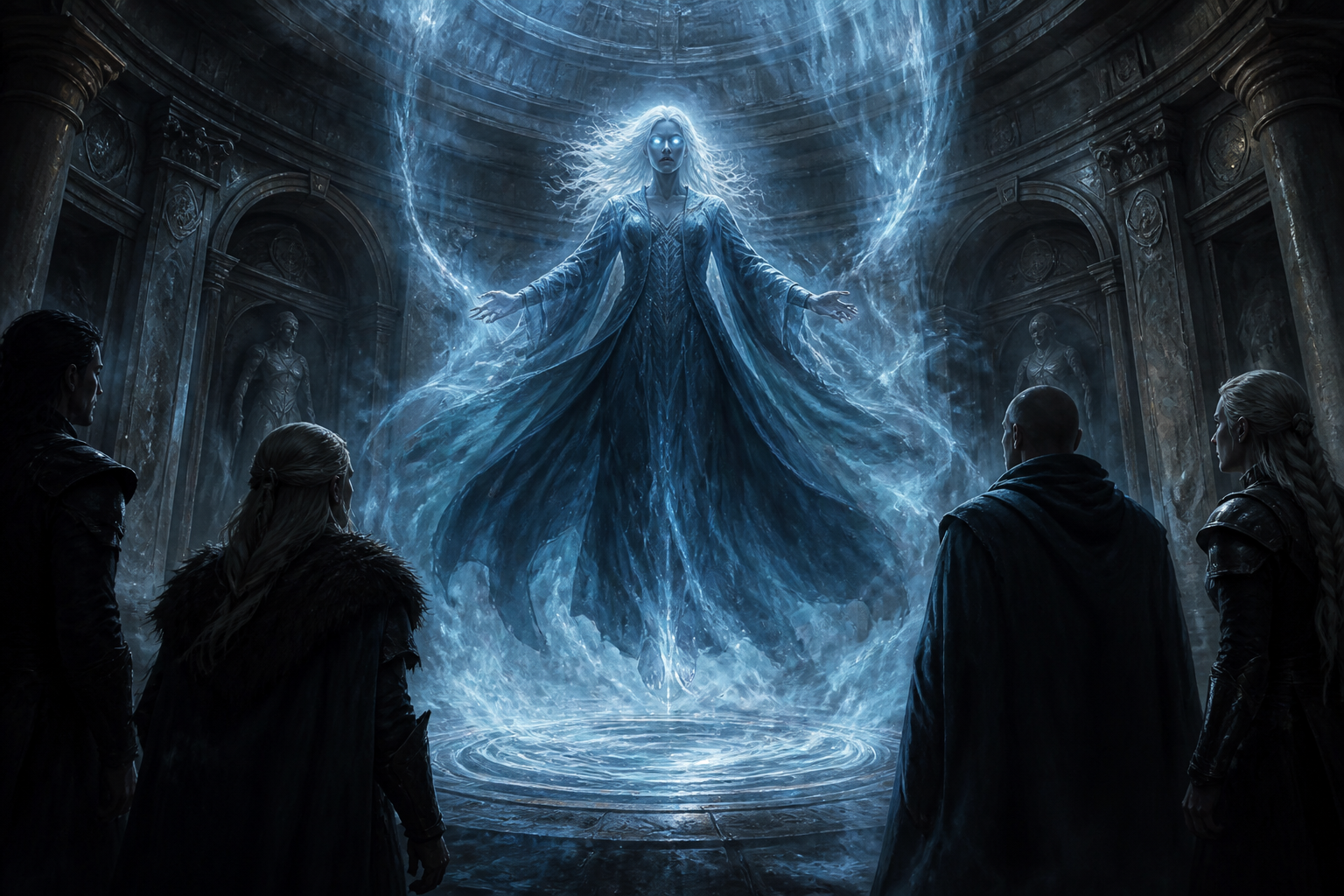
The Aetherans came at dawn, though they did not travel by road.
They arrived the way a held breath is finally released, all at once, and everywhere. In Stonehaven, one appeared in the Chamber of Resonance between one heartbeat and the next, her robes the colour of deep water under ice, her eyes doing that unsettling Aetheran thing of holding too much light for the hour. In the Tidecourt of Velmara, two more stepped from the salt-mist as though the fog had simply decided to take human shape. In the Ashfields, the Emberlords felt them before they saw them, a sudden stillness in the thermal currents, the fires guttering not in fear but in recognition.
They brought no weapons. They brought something worse.
They brought measurements.
The gathering was held in no single city, which was itself a statement. The Aetherans had proposed a place called the Median Ground, a high, wind-scraped plateau equidistant from all five territories, unmarked by any flag and claimed by no sovereign hand. It took three days for the delegations to arrive. Maella the Rememberer came with Stonehaven's party, her satchel heavy with blank tablets and her chisel worn to a fine, familiar edge. She had been etching Stonehaven's records since before the Stone-Wars began, and she had a sense, the way old stone-scribes develop senses the way walls develop cracks, slowly and then all at once, that what she was about to witness would require everything she had.
She was not wrong.
The Aetheran speaker called herself Sereveth, which was not a name so much as a title: the one who reads what is between things. She stood at the centre of the plateau and she did not raise her voice, yet every delegate heard her as though she spoke directly into the chambers of their skulls.
"The medium is torn," she said. "You need to understand what that means before you can understand what must be done."
She raised both hands, palms upward, and the air between them changed. It did not shimmer or spark, there was no theatre in it, no Emberlord pyrotechnics or Tideborn glamour. The air simply became legible, and what it said was terrible.
They could see the scars. Running through the invisible connective tissue that bound elemental force to form, that held the deep grammar of Landorya together, were fractures, long, lightless seams like cracks in river ice, branching and re-branching with a patience that was almost botanical. Around each fracture, the elemental coherence frayed. Stone lost its certainty. Water forgot the shapes it was meant to hold. Fire burned without direction, consuming itself.
"We name it the Null," Sereveth said. "It is not a creature. It is not a force. It is the absence that enters when structure fails. The way silence is not the absence of sound but its consumption."
Someone from the Tideborn delegation made a sound that was not quite a word.
"How long?" asked the High Geomancer's successor, a younger woman named Corrith whose left sleeve was still sewn flat in tribute to her predecessor's sacrifice.
"Since the first Stone-War. Growing since the Rift. The sealing slowed it." Sereveth lowered her hands. "It did not stop it."
The silence that followed lasted long enough for a cloud to cross the sun and release it again.
It was the Emberlord called Vashen, blunt, fire-scarred, constitutionally allergic to anything he could not burn through, who spoke first, and what he said surprised everyone, including himself.
"Tell us what you need from us."
Maella's chisel was already moving.
What followed over the next seven days was unlike anything the histories of Landorya had previously been required to describe, which is perhaps why Maella filled more tablets in that week than in any preceding year. She wrote with the urgency of someone who understood that the record was not merely documentation but preservation, that the knowledge of what had nearly been lost was itself the thing most necessary to keep.
The Aetherans redesigned the invisible frameworks from the ground up. It was architectural work, but the architecture was made of resonance and relationship rather than stone or timber, a vast, intricate reweaving of the medium's load-bearing structures, the kind of work that could only be seen by those trained to read what exists between things. Sereveth directed it like a conductor whose orchestra was the elemental infrastructure of the world.
But the Aetherans could not do it alone. The medium's repair required the active contribution of each elemental tradition, not as raw material to be processed, but as genuine co-authorship.
Stonehaven's geomancers anchored the new frameworks to the bedrock, giving them roots. Without that grounding, Sereveth explained, the repairs would drift, beautiful and purposeless as smoke. Corrith led them in a deep-work session that lasted thirty-six hours without pause, her remaining hand pressed flat against the plateau's stone until the rock beneath her palm had memorized the pattern she was asking it to hold.
The Tideborn contributed flow, the repaired framework needed channels through which elemental force could move without accumulating in dangerous concentrations. A Tideborn elder named Orvai waded into the conceptual current of the medium the way she might wade into a river, reading its pressures with her body, redirecting with gestures so subtle that Maella could barely record them accurately. She moved as though the invisible water trusted her, Maella wrote, and perhaps it did.
The Ashfield Emberlords provided ignition, the precise application of generative heat that sealed the reweaving as it was completed, fusing new structure to old in the way that a forge-weld fuses metal. Vashen did not speak much during this part. He worked with a focused silence that his people wore as their most serious expression.
And the fifth tradition, the Veilborn, those rare practitioners of shadow-craft who rarely declared themselves at all, offered something Maella had not expected: they contributed the negative space. The deliberate absences woven into the new framework, the designed silences between the notes, which Sereveth explained were not weakness but necessity. Even a perfect structure, she said, must have room to breathe. The Null teaches us that. Absence without design is destruction. Absence with design is the space that allows sound to exist.
On the seventh day, as the sun set in a sky that seemed fractionally more coherent than the one that had risen over the plateau a week before, Sereveth pressed both palms together and stood motionless for a long moment.
"It will hold," she said finally. "For now. Perhaps for a generation. Perhaps longer, if you are careful."
"And if we are not?" Corrith asked.
Sereveth looked at her with those light-holding eyes. "Then we do this again. But there will be less to work with."
Maella wrote through the night, alone, after the delegations had retreated to their fires. The plateau was cold and the stars were very bright and the stone beneath her was solid in a way that felt newly precious, not taken for granted, but recognized. Earned.
She etched with the careful economy of someone who knew that every tablet was finite and every word had to carry its weight. She recorded the names. The methods. The arguments that had erupted on the third day and been resolved, imperfectly, by the fourth. She recorded Vashen's unexpected question, what do we owe each other going forward? and Orvai's answer, which had not been a solution but had been, somehow, sufficient: We owe each other this. Showing up. Again. Next time.
When she reached the end of the last tablet, she turned it over and began on the reverse.
The knowledge of what was nearly lost, she understood, was not a warning to be filed and forgotten. It was an instruction. A door held open by the act of remembering.
She pressed her chisel to the stone and she did not stop.
What came next would have to be built on that, and now, at last, they had the language to build it with.