Chapter 3
Chapter 3: The Council Breaks on Cold Stone
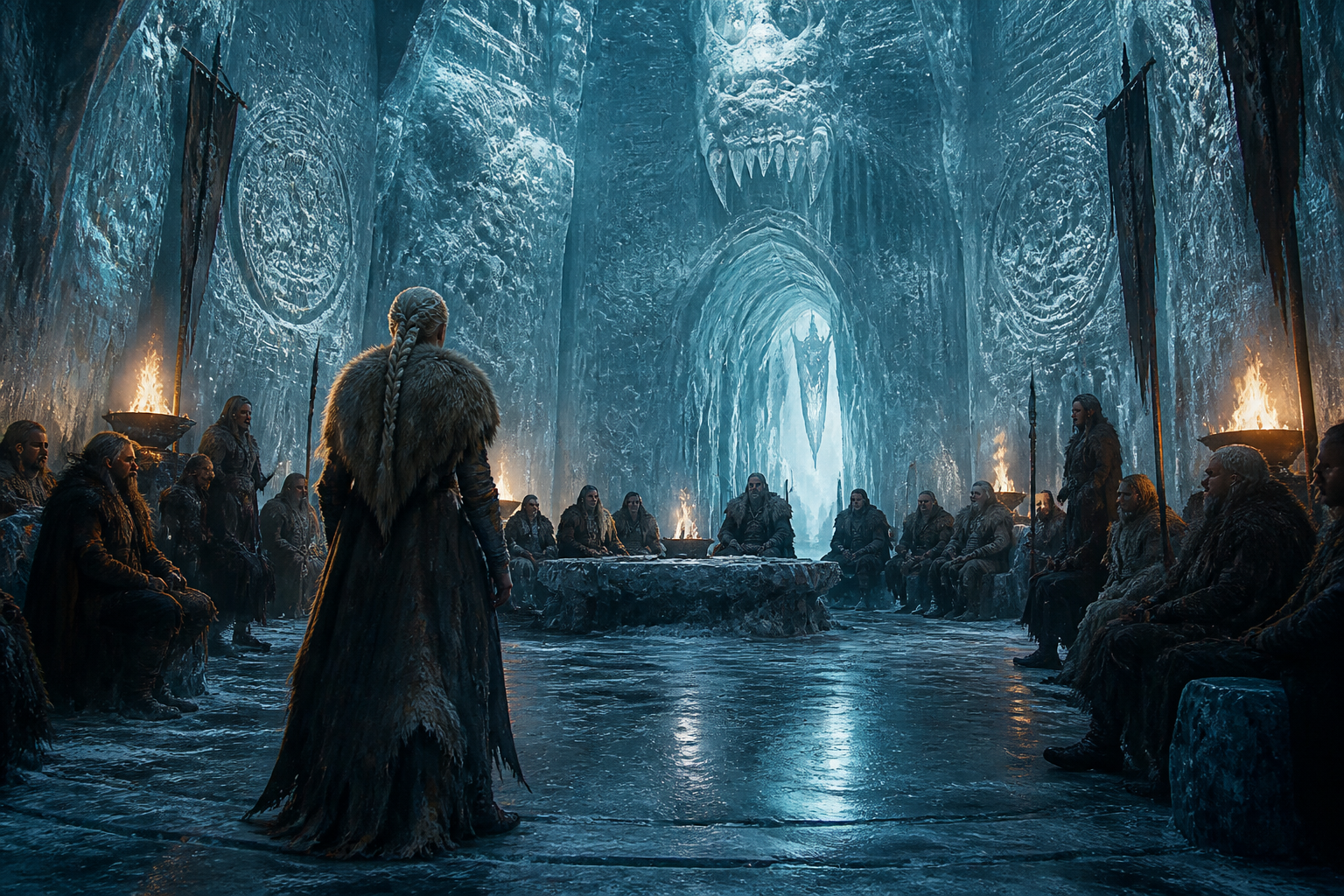
The Hall of Mouths had been carved from a single glacier, ten generations back, by hands that believed cold things lasted forever. The walls still held that old faith, blue-white and faintly luminous, etched with the jaw-sigils of every clan that had ever sworn into the northern compact. Tonight the torches along the ice made it look like the inside of a throat.
Solvei had not slept.
She stood at the Speaker's Stone, a flat disc of black granite at the hall's center, the only thing not made of ice, and felt the solidity of it against the soles of her boots. Halvard had wanted to come. She had told him no. The Council did not receive shamans' apprentices, and she needed them to receive her, which was already a difficult enough ask.
Bryndis stood at her left shoulder, arms folded, expression arranged into the particular blankness she wore when she was prepared to be furious.
The Chiefs arrived the way they always did: with ceremony designed to remind everyone else of their importance. Kettir of the Windrunners came in laughing, his red-streaked furs still damp from a hard ride, three of his outriders at his heels though custom permitted one. Maret of the Ashcallers sat near the eastern wall and immediately began speaking to the woman beside her in a voice too low to carry. Old Ysolde of the Ironshore came in leaning on her staff but with eyes that catalogued every face in the room before she'd taken three steps.
And Dunvir of the Deepglacier came last, as he always came last, not late, precisely, but delayed in a way that felt like a statement.
Solvei watched him settle. She had known Dunvir most of her life. He had always been a large man who worked to appear smaller than he was, the way truly dangerous things sometimes did. Tonight he looked hollowed. The creases beside his mouth were deeper, and he sat with his hands pressed flat against his thighs as though reminding them what they were for.
She began.
She gave them the Ur-Array as plainly as she could, its age, its function, the specific character of the decay she and Halvard had mapped across sixteen junction points. She described the cold that was not cold, the memory leaking out through fissures too subtle to see without the reading-hands. She set her notes on the Speaker's Stone where anyone might examine them.
Kettir of the Windrunners waited until she had finished and then said: "How long ago did your teacher die?"
Bryndis made a sound.
"Eight months," Solvei said.
"Mm." Kettir leaned back. "I ask because Renvar was a practical man. Good sense. Your findings are," he turned one hand over, lazy and deliberate ", ambitious."
"The array is failing," Solvei said. "Ambition has nothing to do with it."
"Shamans feel things," Kettir said, with the particular patience of a man explaining weather to a child. "It is your gift and your limitation. What you've described is a spiritual reading of stone. The Windrunner passes the eastern ridge daily. Our scouts have noticed nothing materially wrong."
"Your scouts aren't looking at the right layer."
"Then perhaps," Kettir said," the problem exists only in the layer you're looking at."
Laughter from his outriders. Not from everyone, Ysolde of the Ironshore was watching Solvei with an attention that felt like something other than dismissal. But laughter was its own kind of vote.
Solvei turned to Dunvir. He had not spoken. He was still pressing his palms to his thighs.
"The Deepglacier tunnels run within forty meters of the array's third junction," she said directly to him. "You've felt something. I think you've felt it for longer than you've told anyone."
The hall went quiet. Not the polite quiet of discomfort, but the particular silence of a room in which something true has been said out loud.
Dunvir looked up at her. His eyes were steady and very, very careful.
"The Deepglacier manages its own house," he said.
"Dunvir,"
"We manage our own house." Softer the second time, and worse for it. Soft in the way a door sounds when it is locked.
That was when Maret of the Ashcallers finally raised her voice, and what should have been a council of emergency became something else entirely, a relitigating of the border dispute over the Salthowl Pass, which Maret had been waiting three years to relitigate, and then Kettir was talking over her about the Windrunners' grazing rights, and Ysolde was on her feet speaking precise, devastating sentences that no one was listening to, and Dunvir had gone utterly still in the way Solvei associated with men who had already decided to act alone.
She waited. She gave them seven minutes by the torch-burn. She had promised herself seven minutes.
On the eighth, she drew the speaking-spike from her belt, an iron pin, palm-long, ancient, the kind of thing you were not supposed to carry into the Hall of Mouths because its use carried consequences that could not be walked back, and drove it point-first into the Speaker's Stone.
The sound it made was wrong for its size. Too final. Like a bone breaking in a very still room.
Every voice stopped.
"I invoke the Proving," Solvei said. Her own voice surprised her, not loud, but very clear, the way the air got clear right before a storm displaced it. "I invoke it now, under the old compact, in the sight of every jaw-sigil on these walls. The Wastes face a threat without a leader to face it. The Clans will elect a War Chief within nine days or answer to the ice for what they allowed to happen."
Kettir was staring at her. "You cannot,"
"I have. Witness or contest, Kettir. The compact does not offer a third option."
She looked at each of them in turn. Maret, arrested mid-sentence. Ysolde, who was almost, almost, smiling. Dunvir, who was looking at the spike in the stone with an expression that might have been recognition, or might have been dread, and was possibly both.
Bryndis, at her shoulder, had not moved. When Solvei glanced at her, Bryndis said, very quietly," Well. You've done it now."
"Yes," Solvei said.
Outside, the wind had picked up. She could hear it finding the gaps in the glacier-carved walls, note by low note, like something old reading the hall's acoustics and finding them adequate.
She left the spike in the stone. You always left the spike in the stone. That was the point.