Chapter 7
Chapter 7: The First Rune, Rewritten
Chapter 7: The First Rune, Rewritten
The glacier breathed.
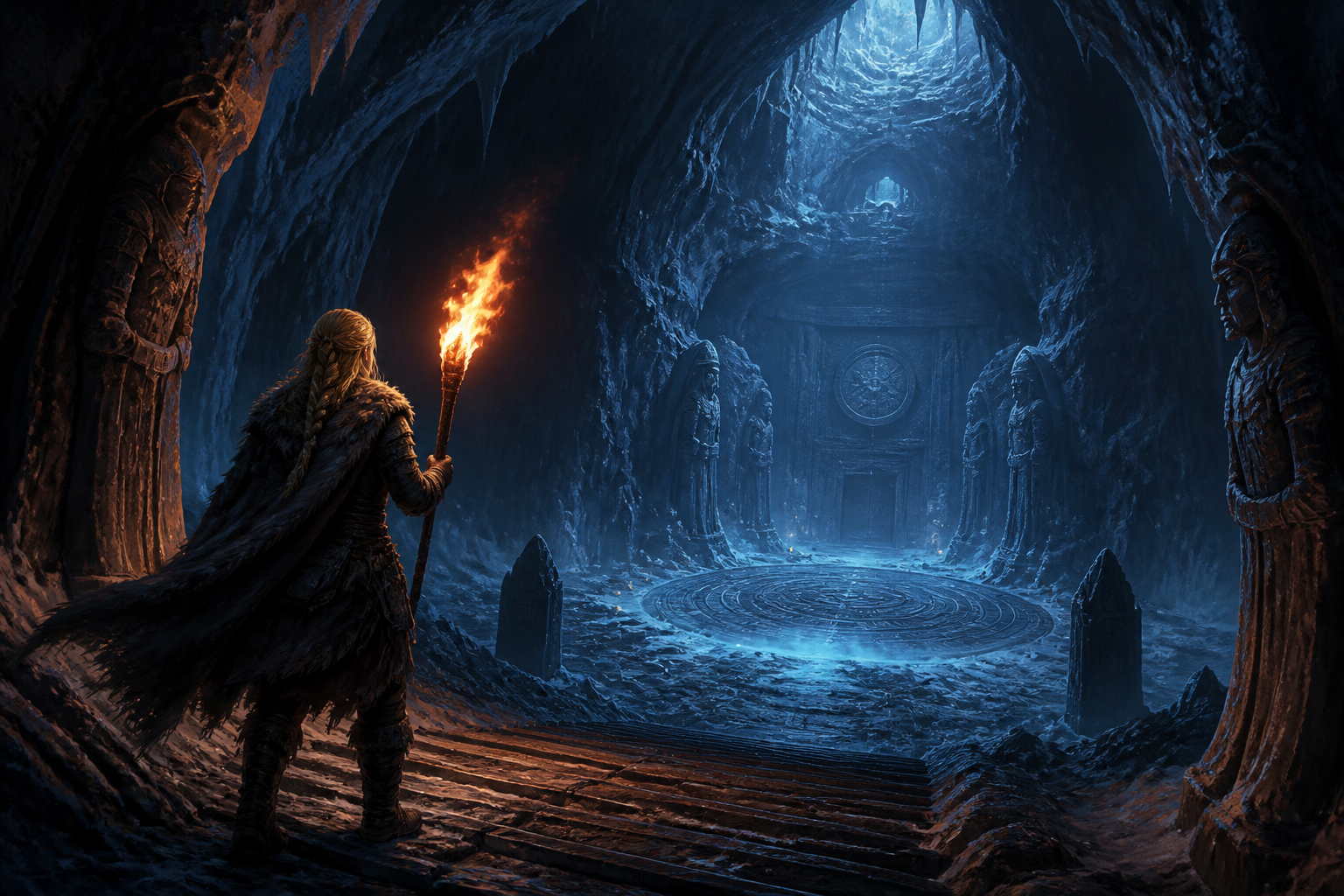
Solvei felt it before she saw it, a slow, pressurized exhalation rising through the soles of her boots, as though the ice beneath the Wastes were a living chest, vast and ancient and barely patient. She descended the carved throat of the access tunnel alone, her torch a small, defiant orange against walls that had been blue once and were now the colour of a bruise. The star-iron components clinked softly in the satchel at her hip: three pins, one anchor ring, the channelling wedge Caelindra had identified in the second scroll with ink-stained, trembling urgency. The wedge goes last, she had said. If you place it first, the inscription will read its own closure as its opening. The array will invert. Don't place it first. Solvei had memorised the sequence until it lived behind her eyes.
The tunnel narrowed. Her breath preceded her in small white clouds.
She had said goodbye to no one. There had not been time, and besides, she did not know the right words for it, for the particular shape of a departure that was not farewell and not certainty and not quite courage either. It was something older and quieter than courage. It was the thing Iskveld women did when the cold came for them: they went toward it. They let the cold find what it was looking for, and they stayed themselves in the finding.
The atrium chamber opened beneath her without warning, the tunnel simply ending, the floor dropping away, and she caught herself on the rim with both hands and breathed. Below: a cathedral of ice so ancient it had gone clear, like old glass, and in its heart the Ur-Array, a circle forty feet across, carved by the glaciomancers of the early age, fed by the deep-cold of Glacius himself. Or it had been. Now the runes were dark at their centres, scorched outward at their edges, and at the array's heart the void-thing moved.
It had no body that she could name. It displaced rather than occupied: a churning absence, a pressure behind the eyes, a sound at the exact threshold of hearing that her mind kept trying to resolve into language and could not. When she descended the last rope-length to the chamber floor and her boots struck ice, it turned toward her. She felt the turn in her marrow.
Frostblood, it said, without saying. Dilute. Mortal. Insufficient.
"I know," Solvei said, and opened the satchel.
She began at the array's edge, where the outer ring of anchor-runes was least corrupted. The first pin went in with a chisel-tap, ringing clear in the silence, and the void-thing flinched. Not much. Enough. She moved to the next anchor point and felt it press against her, not physically but inwardly, probing for the seam between what she knew and what she feared. It found her father's face easily enough. It found the hall, and the vote, and the moment she had taken the War Chief's chain from hands that had not wanted to give it. It found every night she had lain awake wondering if Iskveld blood was a fact of her or merely a story she had been permitted to borrow.
She kept carving.
You are temporary, the thing pressed. The cold was here before your line. It will be here after.
"Yes," she said. The second pin sang into place. "So carve something that lasts."
The anchor ring was the hardest. The ice at the array's midpoint was corrupted deep, the crystal structure itself disordered by decades of the void-thing's occupation, and when she knelt and pressed the ring to the surface it rejected the contact three times, sliding, refusing. Her hands shook. The rune-lines rose on her skin without her calling them, old reflex, Iskveld instinct, and she felt them pulled at, stretched, the void-thing feeding on the invocation like heat from an open palm. Her vision grayed at the edges. She thought of Caelindra hunched over the scrolls, cross-referencing glacier-dialects by lamplight, saying quietly: The First Rune isn't a command, Solvei. It's a declaration. Glacius isn't told to be cold. He's reminded of what he is.
She pressed the ring to the ice and stopped fighting it.
Instead she breathed. She let herself be what she was: not the War Chief, not the borrowed authority, not even the frostblood heir with all its weight of expectation. She was Iskveld. She was the daughter of a woman who had walked into a blizzard to pull a child out and had not hesitated. She was every cold morning, every test of will the Wastes had put to her and she had answered. She was shaped by endurance, not born to power, and that was not a lesser thing. That was the truest thing.
The ring accepted the ice.
The First Rune opened beneath her hands like a eye. Not carved, remembered. The array lit from its centre outward, blue-white, searing, and the void-thing screamed in every frequency she had, every nerve, every childhood fear laid bare and burned through in a single instant. She drove the channelling wedge home last, exactly as instructed, and said nothing, because the rune said everything: this cold is named, this place is held, this threshold is not yours.
The silence afterward was immense.
She became aware, slowly, that she was lying on her back on the ice and that the ice was warm against her skin in the way that ancient things are sometimes warm, with stored time, with patience. The array pulsed steadily around her. The void-thing was not gone; she understood that now, as she had not before. It was bound. Returned to its side of the inscription. The cold of Glacius moved through the chamber again, clean and directive, and she felt it settle into the Wastes above her like a body settling into familiar sleep.
She looked at her reflection in the polished ice overhead and did not recognise herself for a long moment.
Her hair had gone white. Fully, finally, root to end, not grey, not silvered, but the white of a crevasse interior, of snow beneath snow. And her eyes, when she made herself look at them: reflective, glacial, lit from somewhere behind the iris with a cold flat light. The rune-lines had faded from her skin. They had not needed to stay. Whatever the inscription had taken from her to seal itself, this was what remained.
She rose. She climbed.
Dawn was breaking by the time she emerged from the glacier's mouth, and the assembled clans were waiting.
They had gathered in the hours before light, word travelling the Wastes as it always did, fast and wordless, carried on wind and frostblood instinct. She saw the Vethrak standard beside the Iskveld banner, and beside both the iron-and-bone colours of the Kaldmere. Chiefs and bond-wardens and ordinary Wastes-people, all of them watching her come up out of the ice. She heard the change move through the crowd when they saw her face: not fear, precisely. Recognition.
Harva met her at the line. The old chieftain's eyes traveled from her hair to her eyes and back again, and something in his expression resolved into something she could not name, grief and satisfaction and relief, all pressed together.
She stopped at the centre of the gathered clans and reached up and unclasped the War Chief's chain.
"The Ur-Array holds," she said. Her voice was steady and carried without effort; the cold amplified it, or perhaps she simply had nothing left to spend on uncertainty. "The void-thing is bound. The elemental cold is restored to the Wastes. The north stands." She paused. "These were the conditions of the title's grant. They are met."
She held the chain out to the nearest Council elder, who took it with both hands.
"The authority returns to the Council," Solvei said. "As it should. As it always should."
No one spoke. The dawn came up pale and gold over the glacier, and the cold of it was clean and ordinary and right, the cold of a morning in a place that remembered what it was. Somewhere to the north, deep in the ice, the First Rune held its breath and held its line.
Solvei stood in the light with her white hair loose and her glacial eyes open and her hands, at last, empty.
She was Iskveld.
That had always been enough.