Chapter 2
Chapter II: The Cartography of Belief
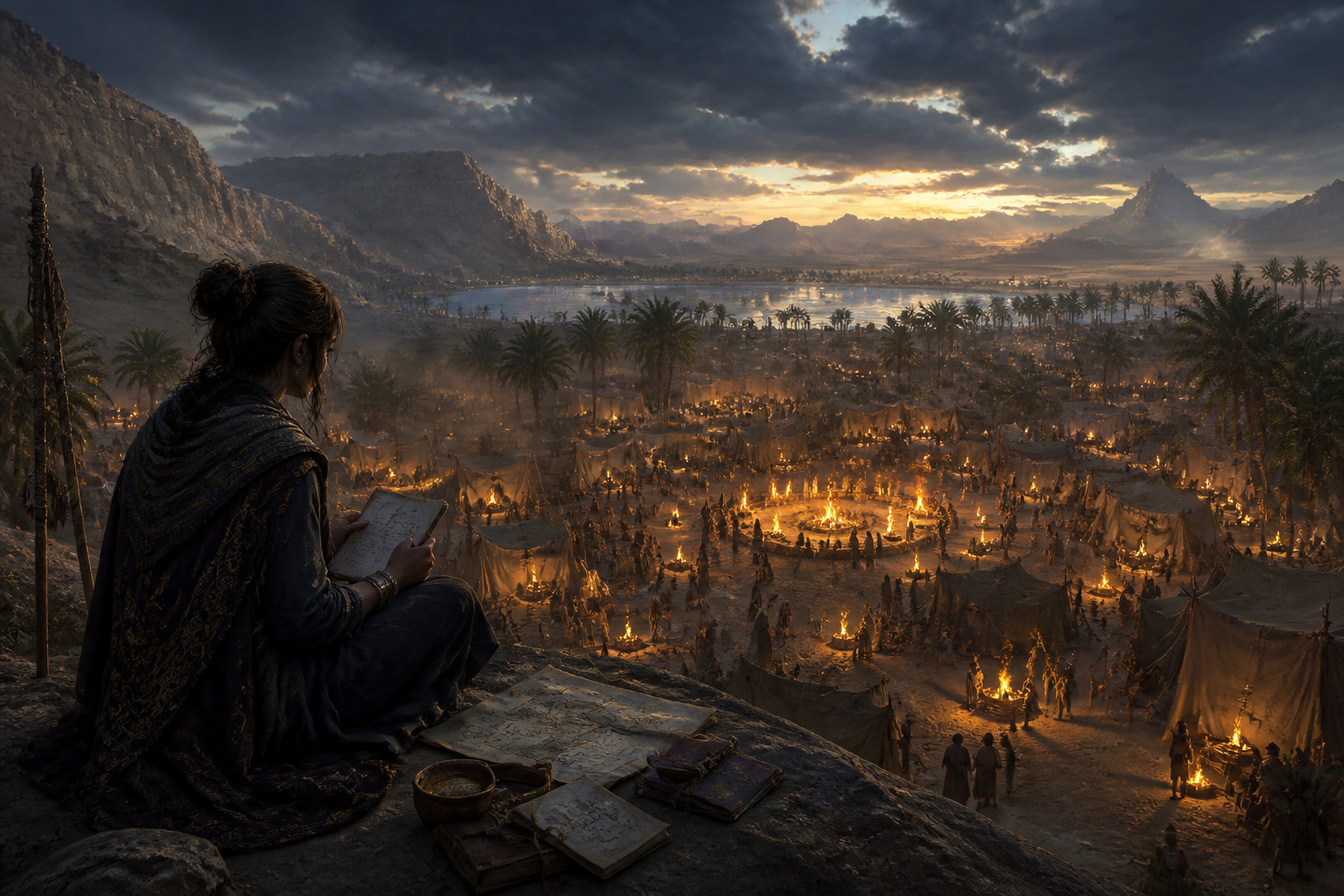
The oasis had grown a city.
Not of stone or timber, those would come later, if Sera's fears proved correct, but of canvas and intention. Lean-shelters staked against the wind. Cook-fires arranged in concentric rings, each ring feeding the one inside it. A hierarchy of warmth, she noted, and added the observation to the margin of her third wax tablet in as many days. She had filled two already. She had stopped thinking of the exercise as record-keeping and started thinking of it, despite herself, as archaeology.
It was the architecture that unsettled her most.
She had spent eleven years at the Scholarly Council's eastern annex cataloguing the divergent traditions of Landorya's interior, the sand-cults of the Hollow, the remembrance-rites of the Mireth tributaries, the bone-reading practices that the Mystaran Conclave officially dismissed and unofficially funded. She knew syncretism. She had written two monographs on it. Syncretism was desperate, improvisational, the spiritual equivalent of mending a sail with whatever cloth was at hand. What she was looking at now was not that.
She unrolled her third tablet on the flat rock she had claimed as a desk and drew a line between two doctrines she had transcribed the previous morning. The Hierophant had spoken, in the same breath, of the Mireth concept of shared burden, the idea that suffering distributed across a community loses none of its weight but becomes, somehow, more survivable, and the old Celestial principle of Collective Harmony, the axiom that undergirded every treaty the sky-realm had sent down in three centuries of distant, luminous governance. The congregation had received both ideas as a single thought. As though they had always been the same thought, and only the language had differed.
Sera drew another line. Then another. By the time the morning's second shadow reached her rock, she had a diagram that looked less like theology and more like load-bearing architecture. Every tradition the Hierophant borrowed had a structural function. The Mireth grief-rites softened the crowd's resistance to communal obligation. The Celestial harmonic principle gave that obligation a cosmological warrant. The desert asceticism of the Karath wanderers supplied the discipline that kept the framework from dissolving into sentiment. Each piece locked against the others. Remove any one of them and the whole would not collapse, it would simply redistribute the weight, like a vault.
She sat back. The stylus trembled slightly in her fingers.
Who built this? she wrote at the top of the tablet, and underlined it twice.
Word had apparently reached the capital before she had managed to send any of her own dispatches.
The Eldorian outriders arrived at midday on the sixth day, their white-and-copper livery absurd against the sand, their horses working too hard in the heat. Three delegates from the Scholarly Council rode behind them in a curtained wagon, which Sera privately noted was a choice that communicated both disdain and anxiety in equal measure, you did not curtain yourself from something you were not afraid to be seen ignoring. The Mystaran Conclave's representative was a woman named Isidor Fayne, who arrived alone, on foot, from the direction of the eastern escarpment as though she had been waiting there for some time, which she probably had.
Sir Aldric Vane dismounted without ceremony and handed his reins to no one, leaving his horse to stand where it would, which it did, too tired to wander.
Sera had heard the name. Vane of the Sundering Bridge. Decorated at twenty-three, the knight who had held the Mireth crossing against a Hollow-raider incursion while the Council debated jurisdiction. A man the institutions loved in the particular way they loved their best instruments, admiringly, possessively, and with the unexamined assumption that the instrument shared the hand's intention.
He was looking at the congregation.
Not with contempt. That was the first thing she noticed. The delegation's three scholars were already conferring in low, dismissive voices, their gestures indicating the whole scene was beneath the dignity of direct engagement. Isidor Fayne was watching the Hierophant with the focused, clinical attention of someone doing arithmetic. But Vane was looking at the people, the three hundred or so who had settled around the Hollow's edge in the honey-colored afternoon light, listening with an attention that Sera recognized now as the concentration of the genuinely fed.
She rose from her rock and approached him.
"Council dispatch?" she asked, though she knew.
"Eldorian chapter. Sir Aldric Vane." He did not turn. "You're the annex scholar. I read your paper on the Mireth rites."
"Everyone says that and no one means it."
He almost smiled. "The section on distributed grief. I meant that part." A pause. The Hierophant's voice moved through the crowd below, too low to decipher at this distance, but Sera watched Vane register the quality of the silence it produced, the specific, weighty quiet of people choosing to hold still. "We've been sent to assess the threat," he said.
"And suppress it."
"Those are the same word, in the Council's vocabulary." Now he did turn, and she saw something in his face she had not expected and would spend the next several nights trying to name precisely. Not doubt, not yet. Something earlier than doubt. The moment before a man looks down and notices the ground has been shifting beneath him for quite some time. "What have you found?"
Sera looked at the diagram on her tablet. The lines, the borrowed doctrines, the weight-bearing joints of a philosophy that had not been grown but designed.
"I've found a map," she said. "I'm still working out what it's mapping to."
Below them, the congregation stirred in a single, breathing movement, as though the Hollow itself had exhaled. Three hundred people adjusting, settling, leaning in, each one a point in a structure that Sera was increasingly certain had been drawn before any of them had arrived.
The afternoon held its heat. The institutions marshaled their responses. And in the silence between one word and the next, something that might have been faith, or might have been its more dangerous twin, continued, quietly, to spread.