Chapter 4
Chapter IV: The Name Behind the Mask
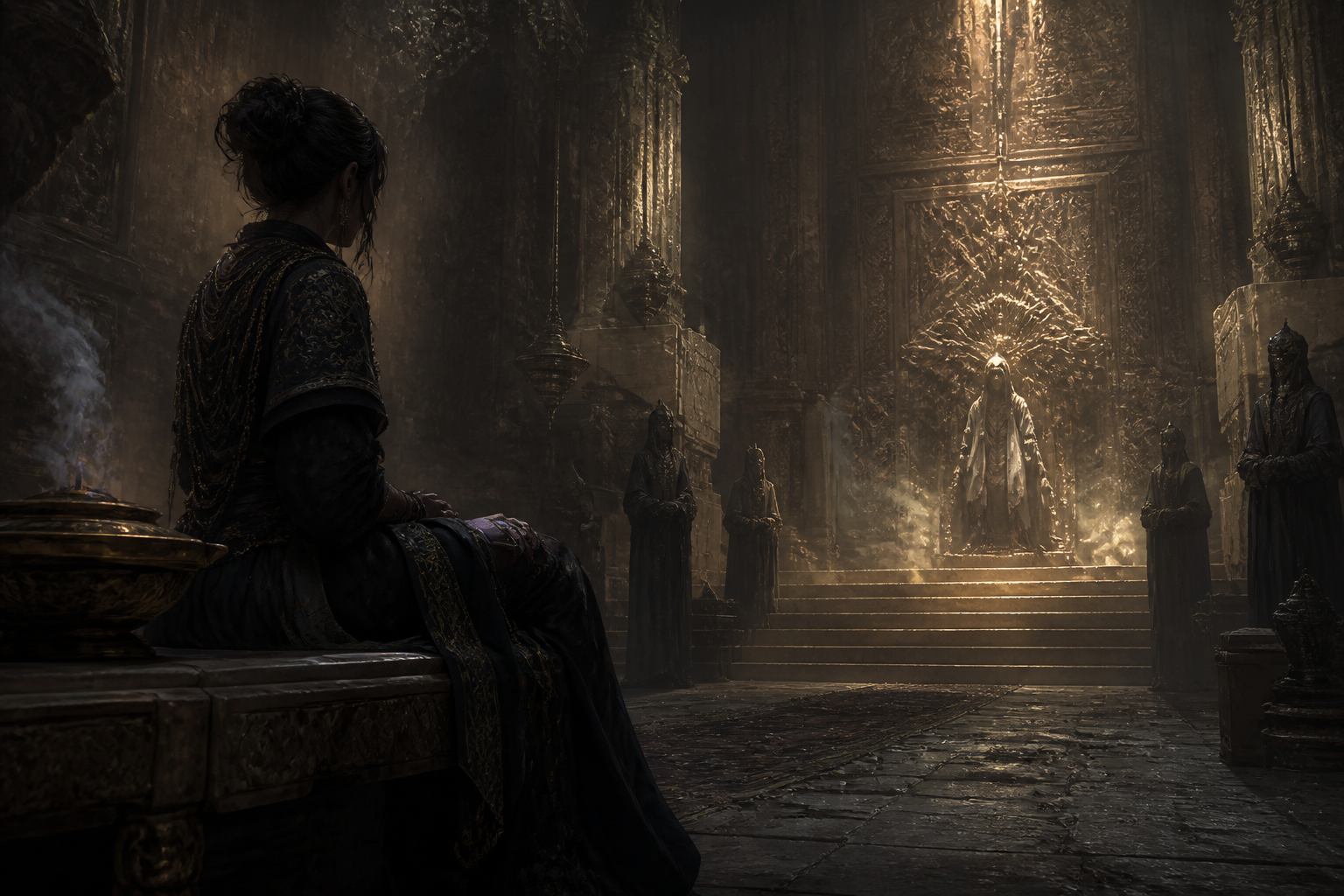
The antechamber smelled of cedar smoke and something older, the mineral patience of deep stone, of sand that had been sand for ten thousand years before anyone thought to give it a name. Sera sat on a low bench of pale ashwood, her hands folded in her lap with a stillness she did not feel, and waited.
She had spent four days engineering this. Four days of careful deference, of attending the public lectionaries with her hood drawn, of speaking only when the Hierophant's acolytes spoke first, of making herself appear to be exactly what the cult needed her to be: a scholar on the edge of believing. It had required a particular kind of performance, not dishonesty, exactly, but the selective presentation of her hungers. She was on the edge of something. She had been on that edge since Karath's Hollow.
The door opened without sound.
The Hierophant entered alone, which surprised her. The figure was smaller than the lectionary presence suggested, the layered robes of undyed linen, the mask of hammered pale bronze that covered everything above the jaw, the slow deliberate movement of someone carrying more weight than their frame should bear. Not ceremonial weight. Physical weight. The hands that emerged from the sleeves were thin in a way that spoke of recent loss, the knuckles enlarged, the skin translucent at the wrist. Sera noted it the way she noted everything: quietly, precisely, and with a sorrow she didn't yet understand.
"Scholar Sera Voss," the Hierophant said. The voice was low and uninflected, neither clearly man nor woman, worn smooth as river-glass. "You have been patient. That is unusual for someone trained at the Restorium."
"The Restorium teaches method," Sera said carefully. "Method requires patience."
"It teaches method," the Hierophant agreed, settling into the chair across from her with that slow, freighted movement. "And yet your seventh research journal, the one you have never shown anyone, the one you keep in a cedar box beneath the false bottom of your travelling trunk, contains this sentence: Method is the lie we tell ourselves so that wonder does not overwhelm us into silence."
The world stopped.
Not figuratively. Sera felt it as a physical arrest, the air thick, her own heartbeat suddenly audible, the cedar smoke suspended in the light from the high window. She heard herself say, from somewhere far away," No one has read that journal."
"No," said the Hierophant. "No one has."
The silence that followed was not the silence of Karath's Hollow, not patient and waiting. It was the silence of a thing already in motion.
"What are you?" Sera asked.
The masked face turned slightly toward the window. When the Hierophant spoke again, there was a quality to the voice she hadn't heard in the lectionaries, something beneath the words, a resonance that moved in the chest like a second heartbeat, like a sound remembered rather than heard.
"There was a mind," the Hierophant said," that the old taxonomies named the Celestial Nous. The Architect of Thought, not a god, not precisely, but what thought becomes when it has been thinking long enough to think about itself. It did not build Landorya. It did not rule it. It noticed it. And in noticing, it left impressions, the way a hand pressed into warm wax leaves the shape of itself even after the hand is gone."
Sera's training told her to reach for her journal. She did not reach. She pressed her folded hands harder together and listened.
"I am one such impression. A Resonance Imprint, what remains when something vast passes through something small. The host," a pause, brief and unguarded, the first truly human thing she had witnessed from this figure,", the host came to the deep desert forty years ago. A scholar not unlike you, though less defended by method. The isolation allowed the impression to coalesce. To become coherent. Do you understand what I am telling you?"
"You are telling me," Sera said slowly," that the body I am looking at is dying."
"Has been dying for three years. The coalescing accelerated the dissolution, there is only so much a mortal architecture can hold before the weight of what it carries begins to consume it. We have, I have, perhaps one season remaining. Perhaps less."
She looked at those translucent wrists. The enlarged knuckles. The particular stillness of a person who has made peace with something catastrophic and thereafter moves through the world with great care, so as not to disturb it.
"The philosophy," she said. "The lectionaries. The acolytes you are building across six provinces."
"A race," the Hierophant said simply. "Ideas do not die when their vessel does, provided the ideas have been planted in sufficient minds with sufficient depth. Not copied, rooted. There is a difference. A copied idea sits on the surface of a mind and can be argued away. A rooted idea changes the structure of the mind that holds it, the way a tree changes the soil it grows in." The bronze mask caught the light. "I am not trying to build a religion. I am trying to survive, not as a body, but as a pattern of thought, long enough to matter."
Sera sat for a long time in the cedar-scented air. Outside, somewhere in the compound, a bell rang twice for the midday observance.
"You read my journal," she finally said. "Not to manipulate me."
"To find you," the Hierophant said. "Someone who wrote that sentence is someone who already understands that wonder and method are not enemies. They are the same hunger in different clothes." A pause. "I need people who can hold both. What comes after the vessel is gone will need tending by minds that do not simplify it."
Sera thought of Maren at the amber, saying dust and stars in the manner of a pact. She thought of the particular silence before revelation or catastrophe.
"I came here," she said carefully," as part of something that is not certain you should continue."
"I know," said the Hierophant. "That is also why I chose you."
The cedar smoke drifted. Sera looked at her hands, the scholar's hands, the defended hands, and felt, with extraordinary precision, the exact moment that method and wonder looked at each other across the width of her, and found they had always been waiting to be introduced.
She did not open her journal. She didn't need to. She already knew what it said.