Chapter 1
Chapter I: The First Crack
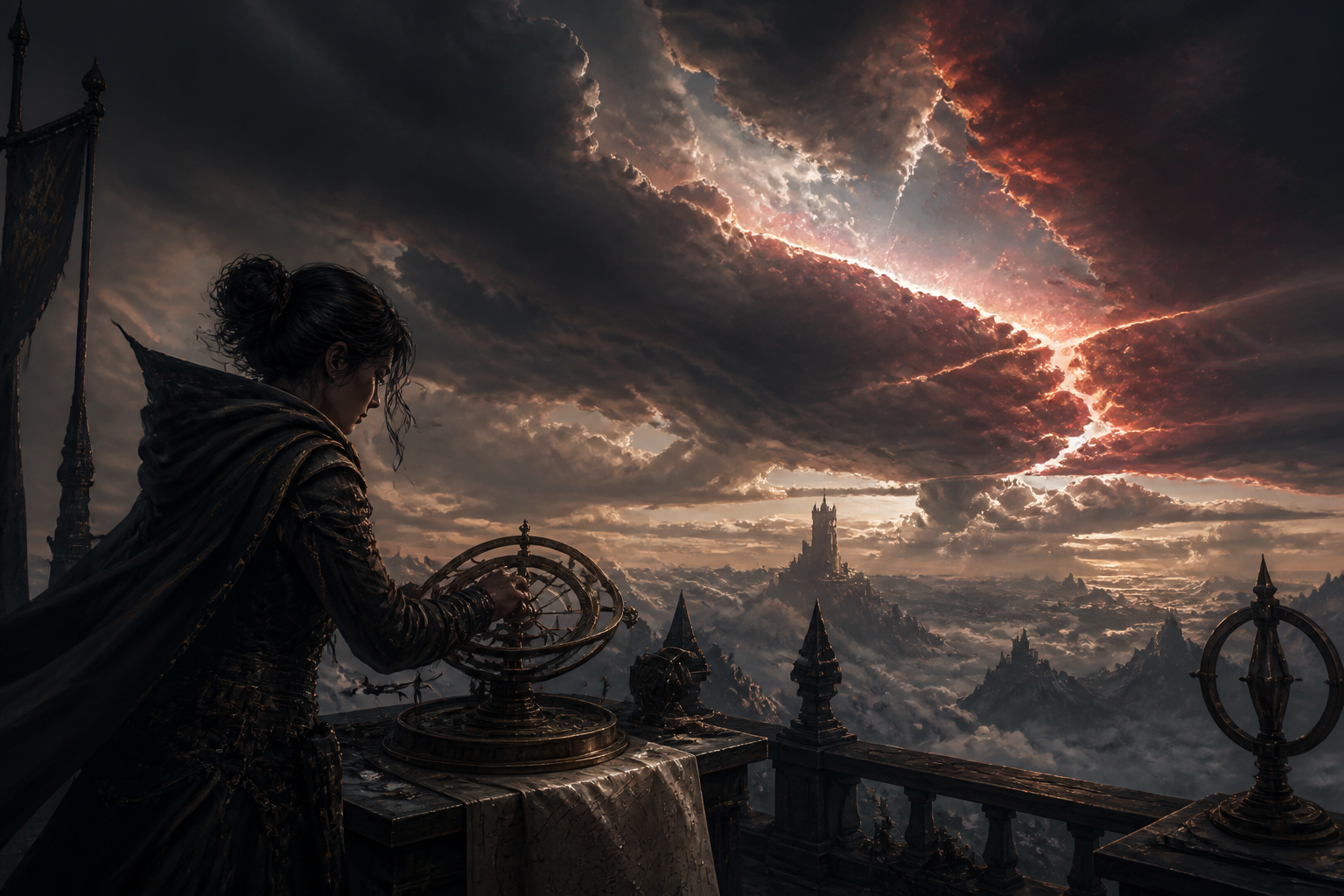
The sky had always been the one thing that did not lie.
Sael had grown up believing this, had repeated it like a creed through six years of Skywatcher training, through the cold predawn vigils and the ink-stained cartography examinations and the loneliness of the outermost post. The sky recorded. The sky endured. The sky did not break.
She was recalibrating her drift-compass when it happened.
The instrument shuddered first, a single tremor through the bronze casing, violent enough to knock the sighting lens off true. Sael frowned and pressed her eye back to the scope, half-expecting a thermal updraft, a rogue pressure current, the mundane explanation she could log and forget. Instead she saw the light.
It split the air above the eastern void like a seam torn in sailcloth: a ragged, widening wound that bled silver-white across the horizon. Not the silver of moonrise, not the pale wash of cloud-scatter, this light had mass to it, had weight, had the quality of something that had never been meant to be seen. It poured outward in slow, arterial pulses, each one expanding the crack another finger's width against the dark.
For three full seconds Sael stood motionless, her compass dangling forgotten from its lanyard.
Then the sound arrived.
It was less a sound than a rearrangement, a bass concussion that moved through stone and bone before it ever reached the ear, and when it did reach her ears it arrived as a fracture, a prolonged grinding tear, as though the architecture of the heavens had a foundation and something enormous had just shifted beneath it. The observation isle lurched. Sael grabbed the railing with both hands. Below her, the lower tier of the isle, the weather-reader's platform with its spinning vanes and glass barometers, simply fell away, its moorings sheared clean, the whole structure tumbling into the white below without so much as a groan of farewell.
She watched the platform shrink and disappear. Her knuckles went white on the rail.
Then gravity reversed.
It lasted only a moment, four heartbeats, perhaps five, but in those heartbeats the world turned traitor. Sael's feet left the grating. Her compass swung upward on its lanyard and struck her chin. Loose tools and logbooks and the tin cup she had left on the mapping table all rose in eerie unison, orbiting her like debris around a damaged moon, and she clung to the railing now from above it, her body horizontal, staring down at the clouds where up should have been.
Then it reversed again, and she fell hard to the grating and lay there gasping, pressing her palms flat against the cold metal as if she could hold the isle itself steady through sheer will.
She couldn't. No one could.
By the time the emergency bells of the Central Spire reached even the outermost post, a thin, frantic ringing that the wind kept swallowing, Sael had already filled half a logsheet with observations she suspected no one would believe. She described the wound's dimensions as best she could estimate them. She described the pulsing rhythm of the light. She wrote: The crack does not diminish. It widens. Bearing: east-northeast of the Vael Marker. Origin appears fixed. Effect on local gravity: catastrophic and intermittent. Then she stopped, ink hovering above the page, and added a final line that no Skywatcher training had prepared her to write: I do not believe this is atmospheric.
She rolled the report into a signal canister and sent it down the courier-line toward the inner islands, watching the small brass cylinder vanish into the haze with a sensation she would later recognise as grief.
The Aether Council convened before the hour was out, in the great crystalline chamber at Caelum's heart where the celestial maps hung suspended in slow rotation, vast, translucent charts of every current, every island-drift, every star-path the Aeriels had measured and named since the first Archon rose from the wind. The maps were wrong now. Sael could see it even from the junior Skywatchers' gallery, standing shoulder-to-shoulder with the others who had been summoned to witness: the configurations were impossible, islands charted in positions they could not reach in a season showing up already displaced, currents folding back on themselves in loops the mathematics of Caelum had no notation for.
Archon Vaethis stood at the chamber's centre beneath the largest map, silver-robed, his four wings half-furled in the formal posture of authority, and his voice when he spoke was precise and unhurried.
"We are experiencing a significant but contained atmospheric event," he said. "The Council will determine its parameters. There is no cause for disruption of civic function."
In the gallery, no one spoke. But Sael watched the face of Senior Cartographer Denne, who stood just below the Archon with her hands clasped at her back, staring up at the revolving maps with an expression that had nothing to do with calm, an expression Sael recognised because she had felt it herself on the observation platform, clinging to a railing above a falling sky.
It was the expression of someone watching something they had spent their whole life trusting quietly announce that it had been lying all along.
Outside the chamber's crystal walls, beyond the silver light that still bled from the east, the first of the outer islands slipped free of the archipelago's known bounds entirely, and drifted, slow and irrevocable, into unmapped sky.