Chapter 4
Chapter IV: The Forgotten Mandate
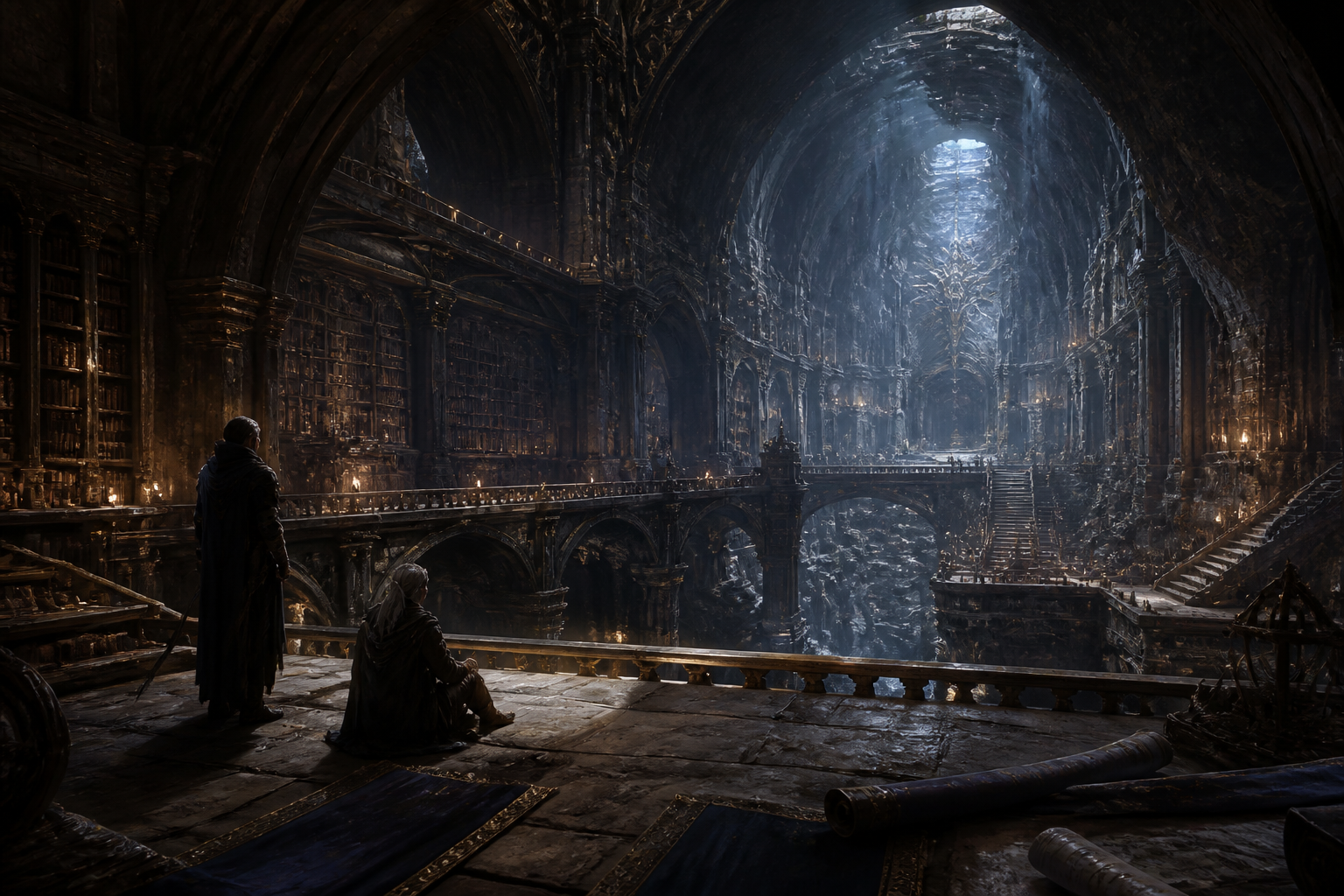
The archive smelled of altitude, of cold stone and the particular dryness that lived above the cloud line, where moisture surrendered and left only the mineral truth of the world beneath. Sael had not known, until now, that silence could have a texture. Here it did: dense, pressurised, old in a way that the Aureate Hall had only ever performed at.
Oryn called it the Underkeel. It occupied the hollowed belly of the smallest island in the Vethran drift, a fragment no larger than a modest courtyard, trailing the main chain like a thought not quite abandoned. No one mapped it. No cartographer's stylus had ever found reason to linger here, because the island grew nothing, hosted no thermal vent worth the name, and appeared, to any passing vessel, as simply another shard of ancient rootrock drifting on the high-wind current. That was, Sael was beginning to understand, entirely the point.
"How long have you been coming here?" she asked, setting the artifact on the reading table Oryn had built from salvaged Skywatcher struts. In the lamplight, it pulsed with a rhythm she could almost convince herself was breathing.
"Since before you were born," Oryn said, and did not elaborate.
He spread his tools beside it, no glass lenses or callipers, but something older: a set of copper listening-forks, the kind the pre-Conclave archivists had used before the clans decided that written record was sufficient and anything else was eccentricity bordering on heresy. He struck the smallest fork against the table's edge and held it near the artifact's surface. The hum that answered was not the fork's. It rose from somewhere inside the object, answering the vibration like a voice recognising its own name.
Sael felt it in her sternum before she heard it.
"Sit," Oryn said. "And try not to interpret what you see before you've finished seeing it. That is harder than it sounds."
She sat. He struck the fork again, and the visions came.
They were not images so much as impositions, scenes pressed directly against the inside of her thoughts, carrying the full sensory weight of moments she had never lived. She smelled smoke that tasted of burnt starlight. She felt the specific grief of an unnamed Aeriel standing at the edge of a sky that was coming apart, thread by thread, and knowing it was not accident but arithmetic: the inevitable sum of every year the weave had gone untended.
She saw the First Era not as the golden founding her schooling had described, the heroic ascent, the clans rising in noble purpose, but as something more complicated and more terrible. The Aeriels had not been given their gift of sky-reading and thermal-flight as distinction. They had been made, or had made themselves, the histories were unclear, and the visions were honest about that unclarity, into something structural. Living nodes in a lattice that held the sky's deeper architecture in coherent form. The weave was not metaphor. It was not poetry or theological comfort. It was a thing as real as rootrock, and the Aeriels had been its anchors: their practices, their rituals of synchronisation, the clan-gatherings that had once been not political theatre but genuine, necessary maintenance, all of it had kept the great lattice tensioned and whole.
Then the power struggle came.
Sael did not see its cause clearly, the visions blurred here, as though the artifact itself had inherited the shame of the era and could not bear to render it in full detail. What she saw was its aftermath: a fracturing of the old knowledge, deliberate and methodical. The clan that had won, and she recognised, with a nausea that had nothing to do with altitude, the ancient sigil of the Archon's own lineage among the victors, had excised the Mandate from the record. Not because they did not believe it. Because they believed it too well. If the other clans understood that their cooperation was structurally necessary, that no single clan could maintain the weave alone, then no single clan could claim dominion over the sky. The knowledge was too democratic. Too inconvenient.
So they had buried it. And the sky, slowly, over centuries of accumulated neglect, had begun to come apart.
When the visions released her, Sael found she was gripping the table's edge so hard that her fingers had gone white at the knuckles.
Oryn was watching her with the careful attention of someone who had navigated this revelation himself, years ago, and still remembered the particular quality of its landing.
"The Shattered Skies," she said. Her voice came out flat, scrubbed clean of inflection by what she'd seen. "They didn't just happen."
"No."
"We did this. The clans. The Archon's line,"
"Every line," Oryn said quietly. "Every clan that chose rivalry over remembrance. Every generation that let the old synchronisations lapse because the politics had become more pressing than the practice." He paused. "The Archon's ancestors lit the fire. But we all failed to put it out."
Sael looked at the artifact. It had gone still now, its pulse reduced to something barely perceptible, like a heart conserving itself for what came next. She thought about how it had felt in the Aureate Hall, how every faction had reached for it, each certain it was theirs, certain it was a weapon or a leverage point or a prize whose possession would settle the question of which clan deserved the sky's authority.
"It isn't a weapon," she said.
"No."
"It's a key."
Oryn nodded slowly. "A key, and a record, and perhaps a last instruction. Whoever made it, whoever hid it," He paused, choosing the next word carefully, as an old man chooses his footing on uncertain ground. "They understood what the clans would do if they found it without first finding the will to use it properly."
Sael turned the artifact over in her hands. Beneath its surface, in the deep material of it, she could feel the faint echo of whoever had last held it with intention, not greed, not ambition, but a specific and exhausted love. Someone who had carried the full weight of the Mandate alone for too long, and had finally, with no better option remaining, placed the burden inside this object and hidden it in the hope that some future moment might be different from all the moments they had lived through.
"Who were they?" she asked.
Oryn was quiet for a long time. The drifting island shifted in its current, and the lamp swayed, and outside the Underkeel's narrow porthole, the sky showed its fractures, those beautiful, terrible seams of wrong light that everyone in Landorya had learned to call weather.
"Someone who still believed the clans could remember what they were," he said finally. "Even after everything."
Sael set the artifact down with a care she hadn't known she possessed until that moment.
The lamp steadied. Above them, somewhere in the uncounted miles of failing sky, the weave continued its long, patient unravelling, waiting, as it had always waited, for someone to take hold of the thread.