Chapter 5
Chapter V: The Light and the Alliance
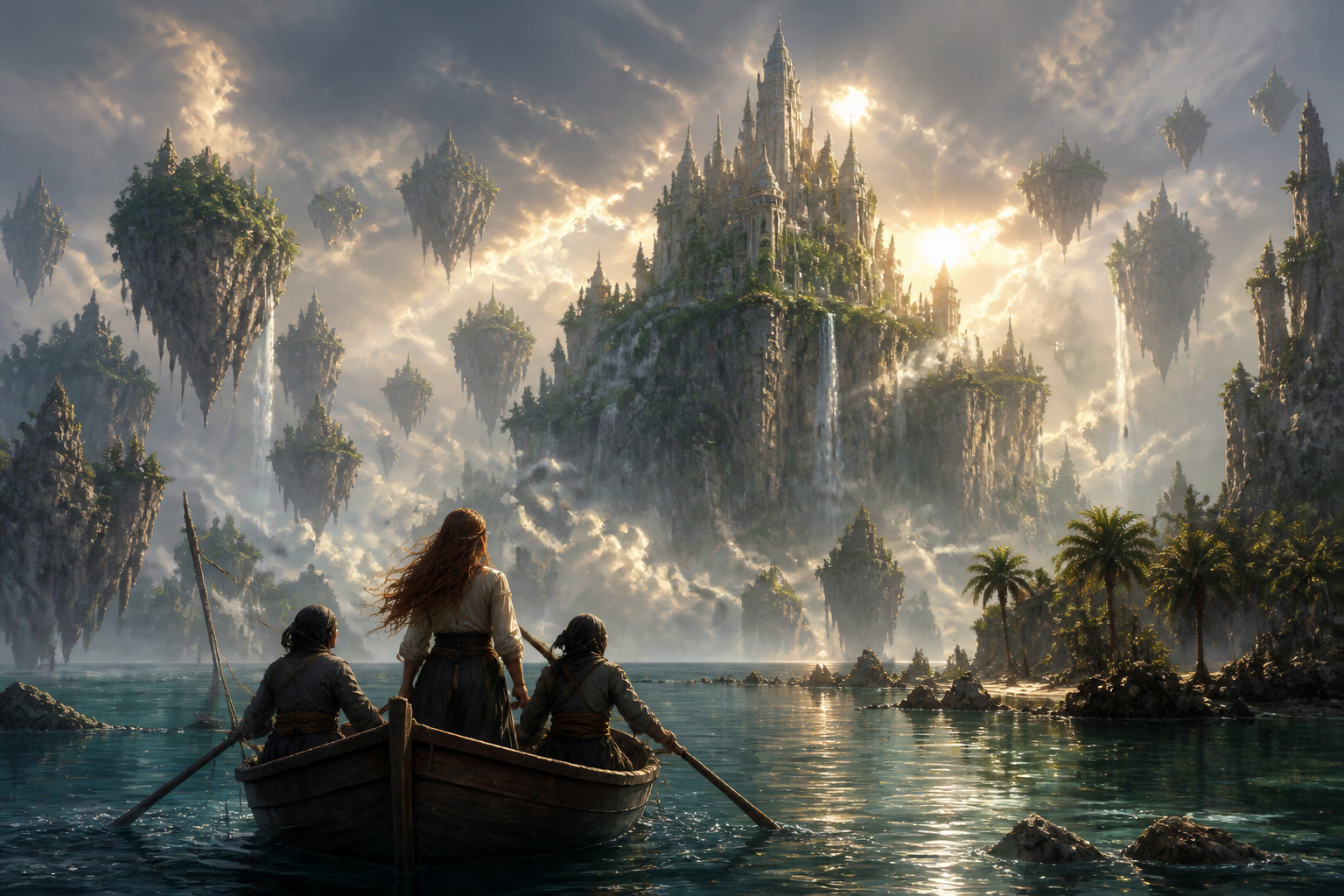
CHAPTER V: THE LIGHT AND THE ALLIANCE
The Shimmering Isles were named for what they did to the horizon, made it waver, made the eye doubt itself, made the traveler wonder if solid ground was a promise or a guess. Mary Starwind had crossed the strait at dawn in a flat-bottomed skiff crewed by two sisters from the Isles' westernmost atoll, neither of whom spoke to her the entire passage. She didn't mind. She spent the crossing reading faces the way other people read maps, and by the time the pier's salt-bleached wood was under her boots, she understood that these people had been disappointed by outsiders before, and recently.
She did not begin with words. That was her first divergence from every negotiator who had come before her.
The Elders of the Isles convened in an open-air hall where the sea-wind moved freely between the columns and the light bent through hanging panels of cut glass, throwing small rainbows across the stone floor. Three factions sat at three separate tables. They had refused to share one. Mary sat in the center of the open space between all of them, cross-legged on the bare floor, the Codex of Harmony open across her knees, and she waited.
An Elder from the Southern Atoll finally said, with barely concealed contempt: "This is your diplomacy?"
"This is my listening," Mary said. She looked at him directly. "I want to hear what was done to you before I say a single word about what I need."
The silence that followed had texture. She felt it shift.
It took the rest of that day and half of the next, but by the time the Shimmering Isles signed the Compact of Joined Waters, two of the Elders were openly weeping, not from grief, but from the particular exhaustion of people who have carried grievance so long they've forgotten what it weighs until someone finally helps them set it down.
She crossed back to the mainland and moved south to the Aurora Plains, where she found the horse-clans mid-argument over grazing boundaries that had already cost three lives. Here the Codex was secondary. She rode with them. She slept in their tents. She ate the food without comment, even the parts that were difficult. On the fifth night, around a fire that smelled of dried grass and something resinous and sweet, the clan-leader Veyra looked at her across the flames and said," You're not afraid of us."
"I'm afraid of losing you," Mary said, and meant it in the largest sense she knew.
The Plains compact took eleven days.
The Celestial Mountains were harder. The Aetheri clans of the high passes had a word for outsiders that translated, roughly, as "people who do not understand silence." Mary learned their word for it and used it to describe herself freely, which made them laugh in their reserved, breath-fogged way, and laughter was always the first thaw.
She was three weeks in the mountains when the messenger found her, a fire sprite no larger than her forearm, sent by James from the Aurora Plains camp, its small body guttering anxiously in the cold. It carried no written word. James never used written words with the elemental beings; they found the practice faintly absurd. The sprite simply showed her an image, the Verdant Rift, as James had seen it from the eastern approach, and the image was enough to make her close the Codex and stand very still for a long moment, alone on a ridge with the wind cutting hard off the glacier above.
She had known the Rift was worsening. She had not known it looked like that.
The Verdant Rift lay at the headwaters of three of Landorya's primary river systems, a cataclysm in slow motion: a fissure three miles long and deepening daily, its edges blackened not by fire but by something more fundamental, a corruption of the land's essential water, the kind of poisoning that worked backward through a watershed the way grief worked backward through memory, touching everything. The grasses for fifty miles were yellowing. The river-folk downstream were sick in ways that the healers could not name.
Mary arrived at the Rift's northern lip on a morning of flat, grey light. She stood at the edge and looked down for a long time.
The darkness at the bottom was not geological. She had known, somewhere below articulation, that it wouldn't be. But knowing a thing and seeing it were different countries, and she allowed herself to stand in the second country for a full minute before she began to work.
What she did next was not widely witnessed. The Aetheri elders who had followed her from the Celestial Mountains stood back at a respectful distance. The Plains-riders who had accompanied her kept the ridge behind her clear. Later, those who wrote of it would struggle with the language, the way she moved her hands in the old notation of the Codex, not as gesture but as structuring principle, as if she were arranging something invisible into an architecture that could bear weight. The way the light came, not from the sky but from her, from her chest, specifically, from whatever lived behind her sternum that she'd never had a name for but had always known was there.
The water was her second element, drawn up from the Rift's own depths, turned back on the corruption below. Light-water working of that magnitude had a sound: low and sustained, like a note held past the point where lungs should have failed.
She held it for forty minutes.
When the fissure sealed, not perfectly, not completely, but sealed enough that the corruption ceased and the slow knitting of the land could begin, she collapsed forward onto her hands on the blackened earth and stayed there, breathing, while the Aetheri elder closest to her made a sound she had never heard any of them make before: a high, sustained tone of formal acknowledgment that she would later learn was reserved for moments their tradition considered singular.
They called her The Light of Landorya before she had recovered enough to stand.
But it was what she found in the Rift's sealed depths, remnants of the working that had opened it, the deliberate geometries of Ancient Dark, the precise and patient architecture of something that had been planning, that she carried back to camp two days later, folded inside her like a stone.
Robert received her intelligence in the war tent at the edge of the Plains, and he read her written account without speaking. James sat across the camp table from him, quiet in the way he'd learned to be when information was settling. When Robert finally looked up, his face had the particular stillness of a person reorganizing everything they know.
"It's preparation," he said.
"Not metaphor," Mary confirmed. "The Rift was a wound opened deliberately. To weaken the lifeblood before a campaign."
Robert nodded once. He did not waste time with the fear. That was his particular discipline, not the absence of fear but its conversion, rapid and efficient, into motion. Within a day he had sent riders to every compact signatory. Within three, the war council convened for the first time in Landoryan history with representatives from the Shimmering Isles, the Aurora Plains, the Celestial Mountains, and the river-folk of the lowland valleys, all in a single tent, around a single table.
James, meanwhile, was not in the tent.
James was at the fire.
He sat alone at the camp's eastern edge as the sun went down, and he called in bonds the way other people called in debts, carefully, with full understanding of what they had cost. The fire sprites came first, three of them settling on the stones around him like small attentive presences. Then the sylphs, which were harder to see but unmistakably there in the way the air organized itself differently near his shoulders. The wind spirits came last and came large, a pressure and a sound and a quality of attention that made the horses shift nervously in their lines across the camp.
James spoke to all of them for a long time. Not in requests. In reminders, of what Landorya was, of what the Ancient Dark had already taken from the elemental world, of what the sealed Rift had revealed about the scale of what was coming. He spoke the way Mary spoke: making space before making argument. And when he was finished, the fire sprites burned higher and steadier, and the sylphs moved through the camp air with a new intentionality, and the wind spirits, the wind spirits sang something back to him in a register below hearing that he felt in his teeth and his sternum, and that he understood, and that meant yes.
He was still sitting there when the scout arrived at a dead run from the northern ridge.
The scout's name was Ora. She was seventeen and had been riding hard for two hours and when she found the three Starwinds together at the war tent's entrance she stopped and put her hands on her knees to breathe and then stood straight because the message deserved to be delivered standing.
"Northern ridge of Greenvale," she said. "They're there. The vanguard. The scouts counted," She stopped. "They stopped counting."
No one spoke.
Mary looked at Robert. Robert looked at James. James looked north, through the tent's open flap, through the dark that lay across the Aurora Plains in the direction of Greenvale, where the saga had begun, where the smell of something burning had first risen over a childhood horizon and set all of this in motion.
The Talisman in James's pocket was warm. The Codex under Mary's arm was warm. The war council behind Robert was assembled and waiting.
Outside, the fire sprites burned steady. The wind moved from the west, low and cool, the way it always did at dusk in Landorya.
The reckoning had arrived.
And the Starwinds stood at the threshold of it together, fractured, costly, absolutely ready, and did not look away.