Kapitel 1
Chapter I, The Stone-Heart Sings (The First Awakening)
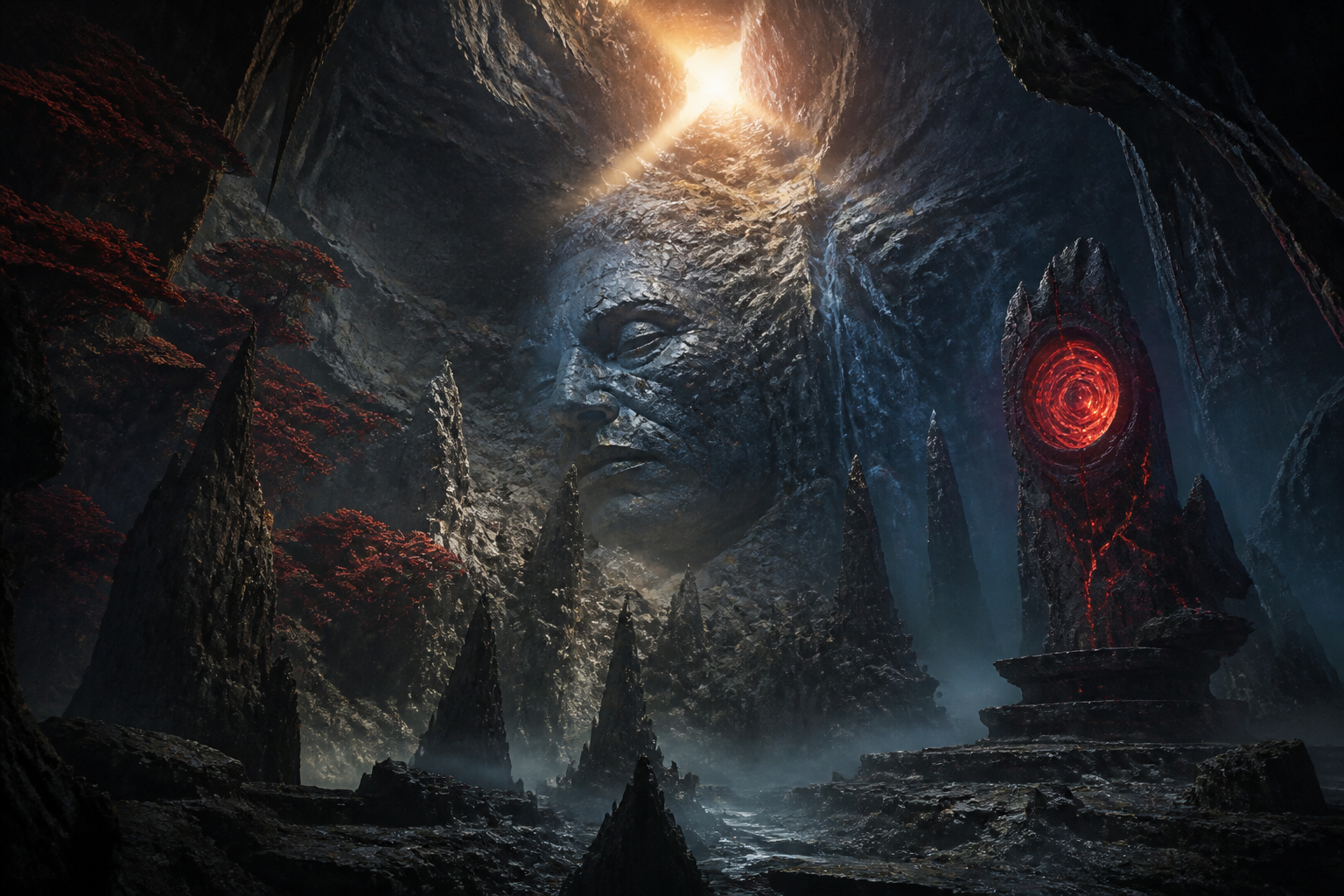
Before the first word was spoken in Landorya, there was pressure.
Not silence, silence implies an absence, and this was something older than absence. It was the weight of the world folded upon itself, granite grinding against granite in the long, slow conversation of mountains. Beneath the Granite Spine, where the roots of the range pushed so deep they touched the marrow of the world, that pressure had been thinking for an age beyond counting. It had been deciding.
Gara-Stone did not descend into the dark. She was the dark, the way a river is the valley it carves. She moved through bedrock the way breath moves through a sleeping chest, purposeful, unhurried, inevitable. Her fingers were fault lines. Her patience was tectonic. And on the night that the world finally cracked open its own heart to look inside, she reached into the fissure and cupped what she found there: a crystal no larger than a child's fist, pulsing with a soft carnelian light, warm as blood, steady as tides.
She pressed it into the chest of the first Talamhari, and the creature gasped.
The sound it made was not a cry. It was closer to the ring of a hammer finding true iron, clean, certain, resonant. The crystal heart answered the surrounding stone, and the stone answered back, and in that exchange of vibration the first Talamhari understood three things simultaneously: that it was alive, that it was not alone in the dark, and that the dark itself was a gift.
His name, when he chose one, was Durrak-Vor. He stood eight feet tall in the low passage where Gara-Stone had breathed him into being, and the ceiling fitted itself to him like a crown. His skin was the grey-brown of shale. His eyes, when they opened, held the carnelian light of his crystalline heart, not glowing precisely, but present, the way an ember is present in a banked fire.
He pressed one broad palm against the tunnel wall, and the wall pressed back.
"Thul marak," Gara-Stone said, and her voice came from everywhere at once, from the drip of groundwater and the settling of stone. Build inward. "The world above is not yet ready to know you. Go deeper. Go deeper, and make something worthy of what I have put inside you."
So he went deeper.
The city of Heartforge was not built so much as it was remembered into existence. The Talamhari, for Durrak-Vor was only the first of many, and Gara-Stone was generous with her crystal hearts in those first centuries, seemed to carry the knowledge of architecture in the marrow she had given them. They did not draft plans or argue over angles. They listened to the mountain, and the mountain told them where the great halls wanted to be, where the pillars longed to stand, where the underground rivers would consent to flow if asked politely and redirected with respect. Heartforge grew the way a geode grows: from the inside out, one luminous layer at a time, everything oriented toward the center.
At the center was the First Hearthstone, a chamber so deep and so perfectly spherical that sound circled it endlessly, whispering conversations that had happened a hundred years prior. The Talamhari would sit at its edges before sleep and listen to the voices of their earliest ancestors, still warm in the stone, still teaching.
Three centuries passed in the dark. Heartforge spread through six mountain ranges beneath the Spine, and its population had grown to ten thousand souls, each with their carnelian light beating soft and constant beneath grey skin. They had philosophy, metallurgy, a complex legal tradition rooted in the principle that all disputes were to be resolved before the First Hearthstone, where old voices could bear witness. They had grief, and joy, and the particular deep-bellied laughter that comes from a people who have never needed to be quiet.
They had not once looked up.
Above them, and entirely ignorant of all of it, the Azure Rift split the eastern sky like a wound that had healed proud.
The cliffs rose nine hundred feet from the valley floor, sheer and pale as bleached bone, and along their faces and between their fractured ledges, the wind had been doing its own long thinking. It did not require a deity to cup a crystal to a chest. The Zephyrians arrived differently, in the way that a note arrives when conditions finally permit the string to vibrate. They simply occurred, as mist occurs when cold air meets warm water, stepping out of the gales as though the gales had always been wearing them.
They were slight where the Talamhari were massive. Their bones were hollow. When they spread their arms, the membrane between wrist and hip caught the updrafts with a sound like a sail filling, a low, sustained note that each Zephyrian found uniquely their own, a voice within a voice. Their eyes were the grey-white of high cloud. They blinked horizontally.
The first among them was a woman who named herself Vaelindra-Crest, and she stood at the highest point of the Rift's edge on the morning of her arrival and looked not downward into the valley but outward, across the enormous, unpossessed sky, and laughed.
The wind took her laughter and scattered it across three hundred miles of open air, sowing it into weather systems, threading it through the cold streams above the clouds, and for a brief moment the whole sky rang with the sound of a new thing discovering itself.
"Build outward," she told her people, because she did not need a voice from the wind to tell her. It was simply obvious, the way truth is obvious when it lives in your body. "The stone is not for us. We take the sky."
And they built outward, towers with no foundations, platforms suspended from the cliff face on cable-work of braided lightning grass, bridges of crystallized air that hardened in the cold altitude and held weight with an ease that seemed to defy everything but faith. Their city had no name, at first. It was only called the Rift, or the Edge, or simply Out There, depending on whether you were standing inside it or dreaming of it from a distance.
Three more centuries Vaelindra-Crest's children grew, spreading across the thermals of the eastern range, constructing their impossible architecture between heaven and cliff, their hollow-boned laughter ringing through the spires.
They had not once looked down.
Landorya held them both in its body, the deep pulse of Heartforge's crystal hearts, the high ring of the Zephyrian wind-towers, and if the world was aware of the symmetry, it kept its own counsel. Two fires in the dark. Two songs in a throat not yet ready to form words.
But the stone and the sky, as any geologist or poet will tell you, are always in conversation.
The first tremor came not as a disaster but as a question, a faint harmonic shiver that ran from the Granite Spine's deepest root all the way up through nine hundred feet of cliff face, arriving at the Azure Rift on a morning when Vaelindra-Crest's great-granddaughter stood at the edge of the outermost platform, looking, as her ancestor always had, across the sky.
She felt it through the soles of her feet. She looked down.
Far below, in the valley that neither of her people had ever thought to name, a fissure had opened in the earth and from it poured a thin stream of carnelian light, warm and steady as a heartbeat, pooling against the valley floor like blood finding its level.
She had no word for what she was seeing. Her language had been built for wind and height and the names of thermals.
But her heart, which was not crystal, which was ordinary and soft and entirely mortal, her heart knew the rhythm.
It had heard that rhythm before, she realized. In the deepest register of every storm. In the frequency beneath sound that you felt in your sternum when lightning struck close.
She stood at the edge of the sky for a long time, one foot on nothing, listening to the world beneath her learn to breathe.
Landorya stirred.
And somewhere in the stone far below, in the chamber where old voices still whispered in circles, a hundred-year-old conversation paused, mid-sentence, mid-thought, as if something had interrupted it from outside.
As if something, at last, had knocked.