Kapitel 2
Chapter II, Fire, Water, and the Unseen Thread (The Rising of the Five)
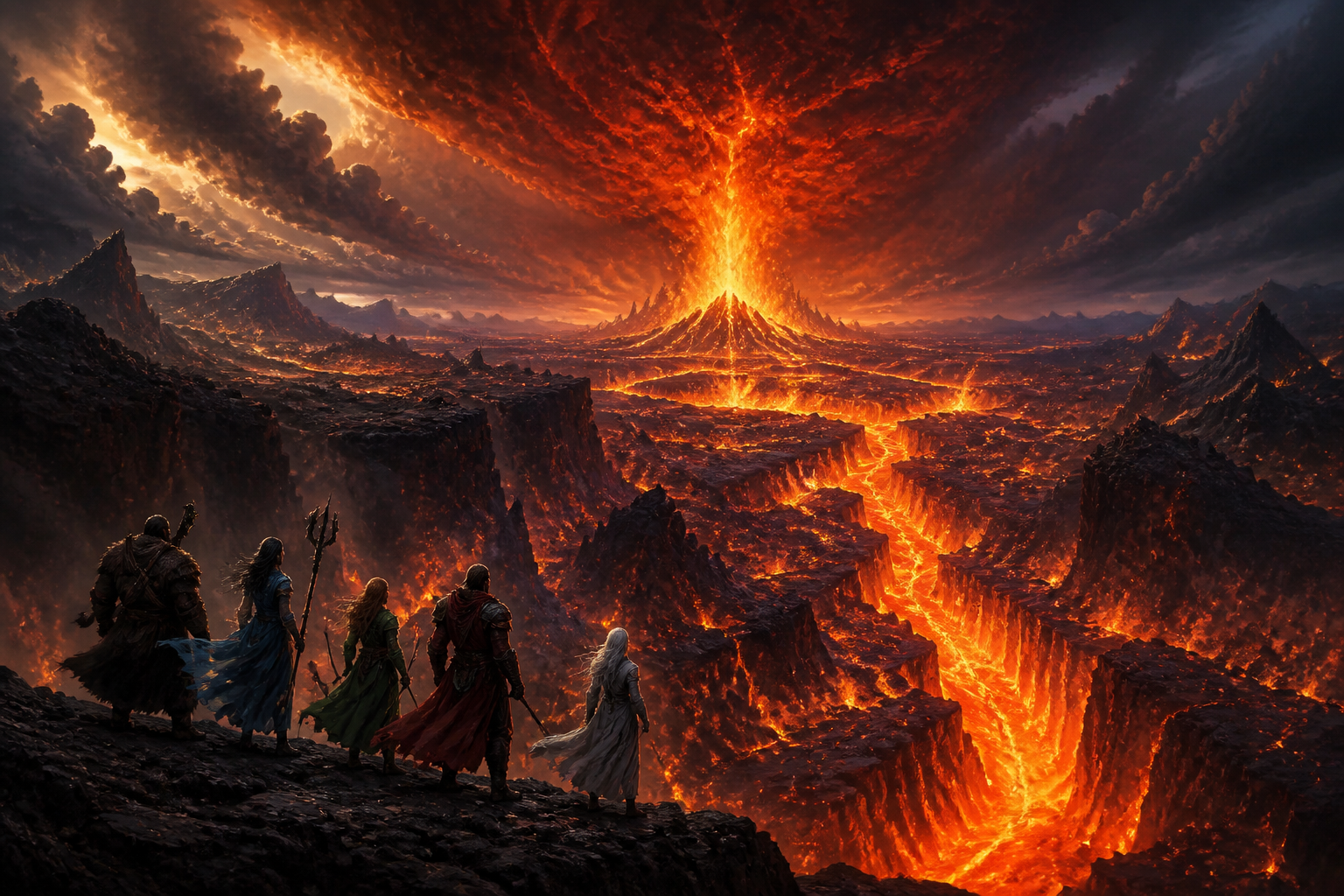
The caldera did not erupt so much as declare.
Three days after the knock that had silenced the old voices of Heartforge, the volcanic highlands of the Pyrakian Reach split along a seam that the stoneweavers had always called the Emberline, a fracture running forty leagues from the black mesa of Gorrath Sund to the obsidian flats of the Char Basin, as if the earth's own skin had grown too tight and simply opened. What poured out was not destruction. Or not only destruction. The magma moved with intention. It cooled where cooling served and burned where burning built, pooling into foundations, hardening into terraces, rising column by column into the first structures that were not shaped by hand but by will, and by a people climbing up out of the heat itself.
The Pyrakians emerged from the caldera-fields like ideas long held inside a mind finally given voice.
They were tall and narrow-shouldered, their skin carrying the deep undertone of cooling basalt, grey-brown at rest, faintly luminous at the cheekbones and knuckles when they were roused. Their eyes held no white. Only amber, and within the amber, the lazy drift of something ember-like, something that had not yet decided whether to flare. They moved with an unhurried precision that looked, to any observer, exactly like arrogance, though they would not have recognized the distinction.
Within a season they had raised Gorrath Sund into a city.
It was not beautiful in any way that softness understands. It was correct, every arch describing the precise load it carried, every corridor angled to move heat with the efficiency of breath through a bellows. Above the city's central spine, the great forge-towers drew magma upward through channels of volcanic glass, and the glow of the living rock lit the highland nights like a second sun gone horizontal. Travelers coming from the lowland passes, and there were some, already, the world growing curious of itself, would stop on the ridge road above the Char Basin and simply stand there, blinking, unable to look away.
The Pyrakians paid them little attention. They were busy with the seam.
The Emberline, they believed, was theirs, not by conquest but by nature, the way a river belongs to no one and yet belongs entirely to the valley it carved. They were the meeting point of earth and fire. They were the hinge. And when word reached them, in the way word travels in a young world, through merchants and rumor and the uneasy instinct that something elsewhere is growing, that the deep councils of Heartforge had begun debating the sovereignty of subterranean flows, the first council of Gorrath Sund convened around a table of living obsidian and lit the ceiling on fire simply to have adequate light to think by.
The tremors reached Heartforge three days later. The stoneweavers recorded them, quietly, in the margin of a document they had not finished writing.
Along the deltas, the Oceanans had been there longer.
This was not something they announced, it was simply true, the way tides are true, the way patience is true. They had gathered in the coastal basins and river mouths where fresh water meets salt and neither wins, and they had built nothing that could not be dismantled and rebuilt, because permanence, to an Oceanan, was a kind of failure of imagination. Their councils floated. Their libraries were oral, carried in the braided-rhythm speech of their tide-singers, each verse locked to a particular current's cadence so that the knowledge would not survive separation from the living voice that held it.
They were broad-framed and low-centered, their skin carrying the blue-grey of deep water at midday, their eyes the pale green-gold of shallows. They read weather from water and wisdom from weather, and on the morning after the Pyrakian caldera declared itself, an elder tide-singer named Sohaveth stood knee-deep in the delta mouth of the Var and watched the river's surface behavior shift, a pressure wave moving upstream, subtle as a held breath, the seismic signature of something massive hardening forty leagues inland, and said to no one in particular: "The highlands have found their voice. We should find ours before it finds us."
Her council agreed, in the slow circular way that Oceanan councils agreed, which looked to outsiders like disagreement until, without announcement, everyone was moving the same direction.
They sent no messengers to Gorrath Sund. Not yet. But they began recording the Emberline's tidal effects in their singers' verses, and they began counting.
The Aetherans left no record of their emergence because they had no emergence.
This was the difficulty that all subsequent scholars would face: the Aetherans did not rise from a place. They did not build. They did not gather and decide and name themselves. They simply, at some point between one moment and the next, became aware, and with awareness came the retrospective understanding that they had always been present, distributed through the invisible medium between all things, the connective tissue of Landorya's body that was neither earth nor sky nor fire nor tide but the thread that ran beneath all four, stitching the world's pieces into something capable of holding together.
They perceived the Pyrakian declaration as a vibration in the thread.
They perceived the Oceanan counting as a tension in it.
They perceived the old voices of Heartforge, still paused mid-sentence, mid-thought, as a knot.
And though they had no mouths yet in any form others could easily agree upon, they turned their collective awareness toward the knot in the way a hand turns toward a snagged weaving, not urgently, but with the focused, unhurried attention of something that understands that one loose thread, if ignored long enough, can undo the whole cloth.
In Heartforge, deep in the chamber of old voices, the hundred-year-old conversation resumed.
But the sentence it completed was not the one it had been trying to finish.
Something had changed the subject.
Something had answered the knock.