Kapitel 4
Chapter IV, The Stone-Wars and the Seam of Ruin (The Fracture)
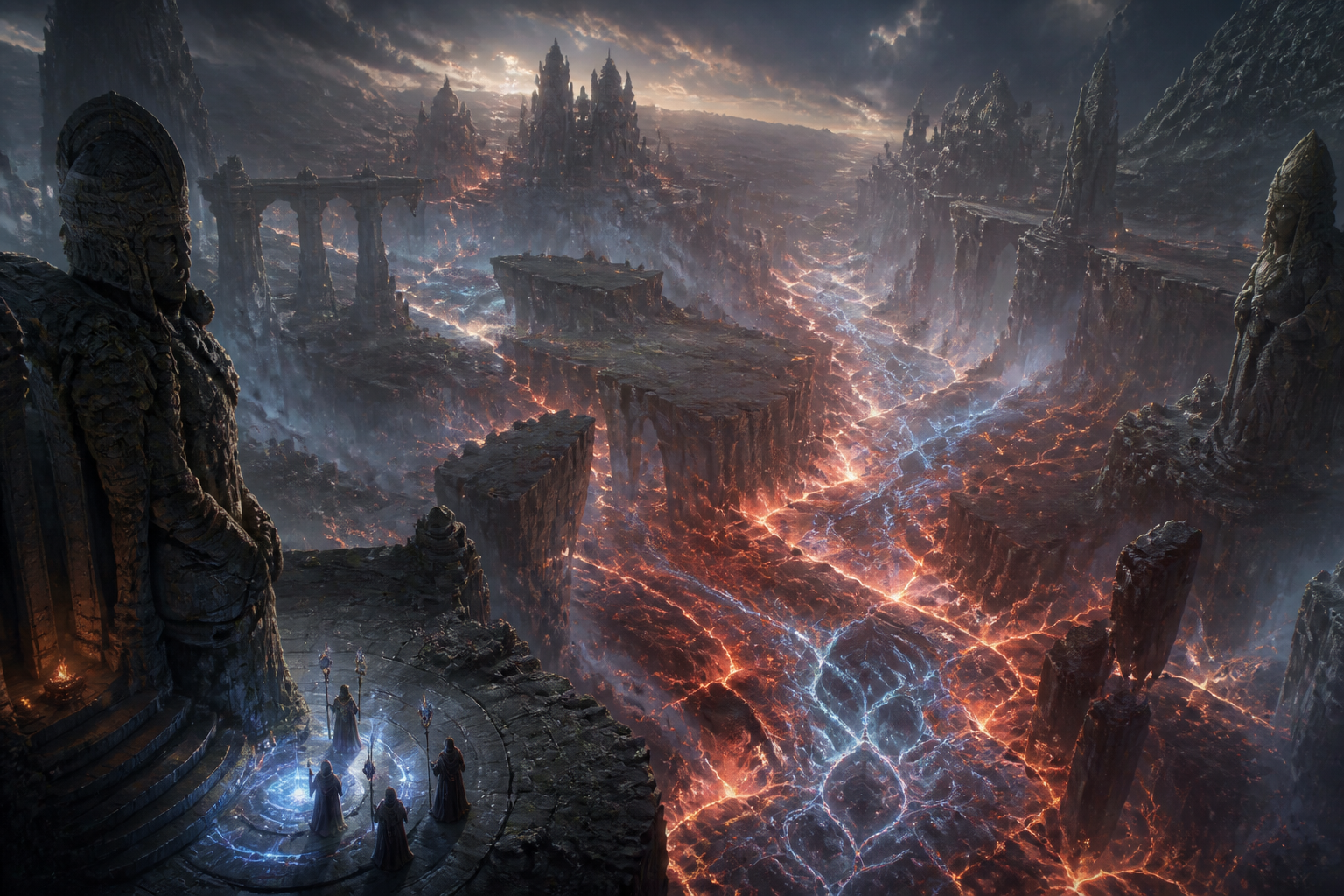
No one declared war. That was the cruelty of it.
The seam had no name on any official chart, it was too deep, too unstable, too intertwined with forces that resisted cartography. The Talamhari called it the Veinroot, because that was what it resembled when their earth-seers pressed their palms to the stone and looked: a branching, luminous network of mineral and magma threading through the roots of the eastern range like the circulatory system of something immeasurably old. The Pyrakians called it the Bloodline, because of course they did, because to a pyromancer-engineer every vein of heat was personal.
Both names were correct. That was also part of the problem.
Forge-Master Keldor received the collapse report at dawn, while the light above Heartforge was still the color of hammered bronze. The runner, a young Crystal-Core technician whose left arm was powdered with stone dust to the elbow, delivered it in fragments, the way people deliver news they cannot fully believe.
"The seventh lateral tunnel," the boy said. "The bracing held until the third shift. Then the," He stopped. Started again. "The Pyrakian bore-teams, Forge-Master. They were working the parallel shaft. The heat differential, no one calculated for simultaneous extraction at that depth. The pressure,"
"How many?" Keldor asked.
"Forty-one Talamhari. We don't have a count for the Pyrakian side."
Keldor was a broad woman, iron-grey at the temples, with the kind of stillness that came not from calm but from having learned, over decades, to keep her grief below the surface where it could not interfere with the work. She stood at the window of the Forge's upper command room and looked east toward the mountains, and for a long moment she said nothing.
Then the mountain answered for her.
The sound arrived before the tremor, a low, structural groan that seemed to come from inside the listener's own chest rather than from any external source. Then the floor moved. Not violently, not at first. A long, slow heave, like the earth drawing a breath it could not quite finish.
Then the caldera destabilized.
They would argue afterward, in testimony chambers, in written histories, in the kind of exhausted conversations that follow catastrophe, about whether it was the Talamhari bore-heads or the Pyrakian heat-lances that triggered the chain event. The honest answer was that it was both, and neither, and that the seam itself had been under centuries of accumulating strain that neither side had bothered to measure, because both sides had assumed the other was managing it.
The Rift opened along a forty-mile stretch of the eastern range in under two hours.
It did not open dramatically. It opened the way old injuries reveal themselves: a crack at first, hairline-thin, running northeast from the collapsed tunnel site. Then a widening. Then a sound, not an explosion but an exhalation, vast and geological and obscenely patient, as the accumulated pressure of deep stone and deep fire found the path of least resistance and took it.
By midday, the eastern face of the Karthenmount range had a wound in it you could see from the Zephyrian skyways.
Windcaller Sael saw it first from the back of her gale-hawk, banking high above the dust plume that had turned the eastern horizon the color of ground bone. She was the youngest member of the Zephyrian mediation wing and had been dispatched before the full scope was understood, which meant she arrived before anyone knew what to tell her.
She descended through the ash cloud with her silk-compass spinning and her throat covered against the particulate, and when she broke through the lower layer and saw the Rift, the sheer, black-lipped gash splitting the range like a poorly healed scar torn open again, she reached for her signal mirror before she'd consciously decided to.
Three long flashes. Crisis-scale. All wings.
She did not have language yet for what she was looking at, but her hands knew the code for this is larger than I am.
The Oceanan tidal-priests arrived by evening, traveling the underground aquifer channels that threaded beneath the eastern territories like a second circulatory system, cooler and quieter than the one above. Their high-priestess, a spare woman named Voreth-an-Sel, emerged from the access spring at the base of the Karthenmount foothills with seven subordinates, each carrying vessels of deep-sea brine blessed, if that was the right word, with tidal resonance.
"We can cool the rupture margins," she said, when Keldor met her at the perimeter. "Slow the magma migration. Buy you weeks, perhaps."
"Weeks," Keldor repeated.
"The stone is in grief," Voreth-an-Sel said, which was not a metaphor but a technical assessment, in the Oceanan framework. "Grief generates heat. We can address the heat. We cannot address the grief."
Keldor looked at her for a long moment. "What addresses the grief?"
The tidal-priestess looked east toward the Rift. "Acknowledgment," she said. "And then, if you are very careful, repair."
The Aetherans did not come.
This was noted, and misread. The Talamhari assumed offense, some diplomatic slight in the chaos of emergency coordination. The Pyrakians assumed calculation, the Aetherans positioning themselves as neutral arbiters for the negotiations they expected to follow. The Zephyrians, who knew the Aetherans best, felt something closer to unease.
Aetheric-Seer Lirien had not withdrawn out of politics. She had withdrawn because the moment the Rift opened, she had seen what no geological instrument would measure and no earth-sense would detect: the Rift was not only tearing stone.
She stood in the high observatory of the Aetheran enclave, three hundred miles from the eastern range, and she watched the aetheric lattice, the connective medium that threaded through and between all five elemental orders, the invisible grammar that made the world a system rather than a collection of competing forces, and she watched it fray.
The Rift had edges in the physical world. In the aetheric layer, it had no edges. It had spread.
Thin lines of dissolution, like cracks in old glass, radiated outward from the event site in patterns that corresponded to no geological model because geology was not the operative framework here. They moved along the seams between orders, the interface between earth and fire, yes, but also the interface between fire and air, between air and water, between water and the deep mineral dark.
If they reached the confluence points, the places where all five orders touched and sustained one another, the orders would not merely conflict. They would begin to forget the grammar of their coexistence.
Lirien pressed two fingers to the observation glass and held very still, and thought about the conversation that had been building in the deepest chamber of Heartforge, the careful sentence none of them could have conceived alone.
She thought about what happened to a sentence when you removed its connective tissue.
Not the meaning. Not the argument.
The and.
She sent no diplomatic message. She sent no representatives.
She sent a single unmarked stone, Aetheran grey, perfectly smooth, carrying a resonance frequency that anyone trained in aetheric reading would recognize as: come quietly, come quickly, this is not what you think it is.
The stone arrived at Heartforge three days after the Rift opened.
Keldor turned it over in her hand and felt the frequency move through her palm and into the bones of her wrist, and the word that surfaced in her mind was not geological.
The word was unraveling.
She closed her fingers around the stone.
Outside, the dust from the east had not yet settled. The tidal-priests were working the rupture margins with their brine and their careful grief-theory. The Zephyrian mediation wings were flying triangulation patterns, trying to map something that kept changing shape.
And in the eastern range, the Rift lay open under the sky, patient as all wounds are patient, waiting to see whether the hands that had torn it apart were capable of becoming the hands that learned to close it.
The sentence they had been building together, so carefully, for so long, it was still there.
But it had developed a silence in the middle of it.
And silences, in the grammar of elemental order, were never simply pauses.
They were the places where everything that followed depended on what came next.