Kapitel 5
Chapter V, Varrik the Unshaken and the Weight of Three Cities (The Sacrifice at the Rift)
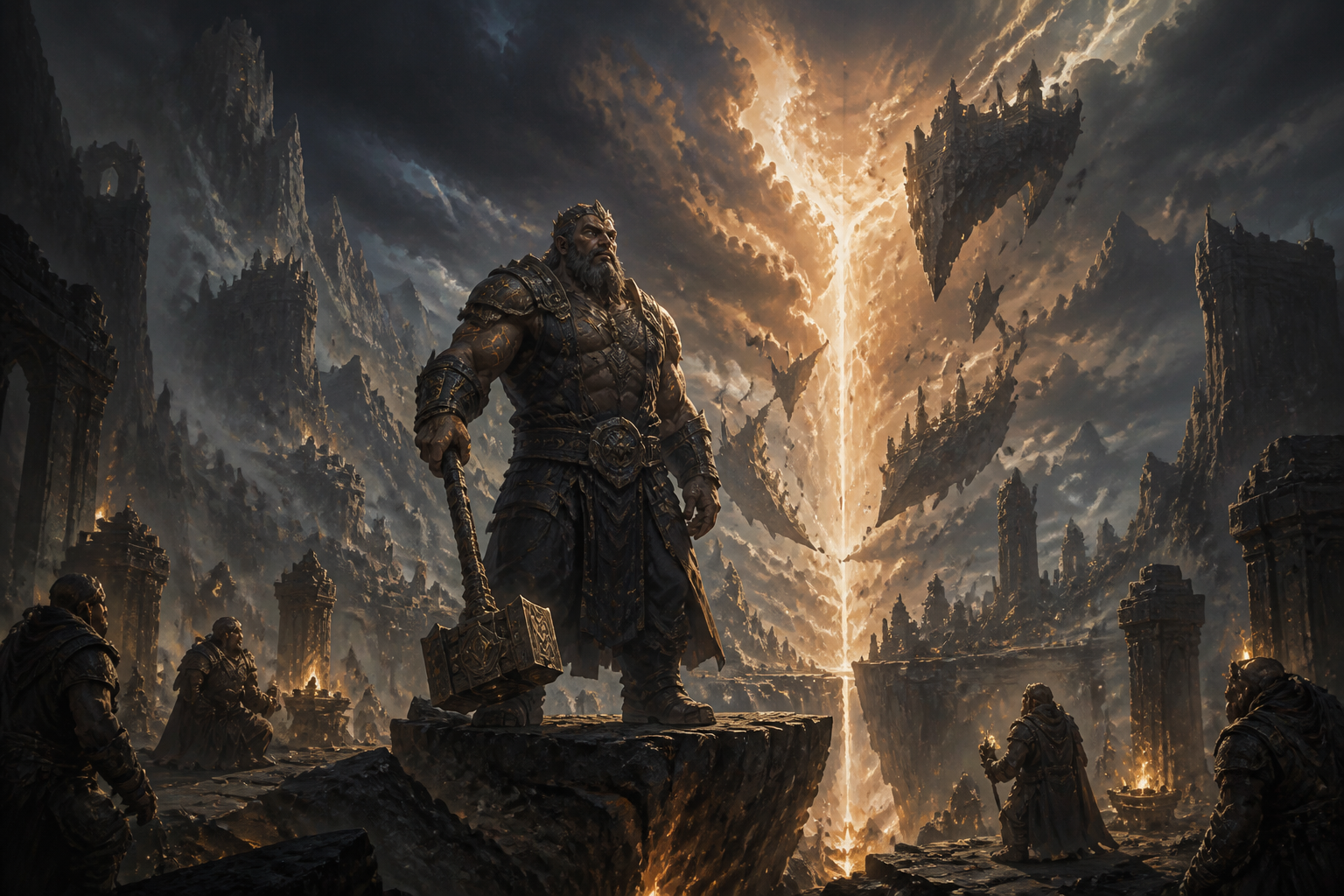
Chapter V, Varrik the Unshaken and the Weight of Three Cities (The Sacrifice at the Rift)
The Rift did not announce itself. It simply grew.
Varrik felt it the way all Talamhari felt the deep earth, not through his feet, not through the trembling of the stone corridors around him, but through the place behind his sternum where geomancers kept their second heart. A pulling, a stretching, as though something immense far below had turned over in its sleep and every tunnel, every buttressed shaft, every carved gallery of the Heartforge network had shifted a fraction of an inch in consequence. A fraction that, compounded across three hundred miles of rock, became catastrophic.
He was standing on the ridge-spine of the central peak when the second tremor came. Around him, the wind carried grit that tasted of iron and something older, mineral, ancient, the breath of the deep places. His delegation from Stonehaven stood behind him in rigid silence. The envoys from Durn-Karath and the deep-cut city of Thelvara were already there, having climbed from the eastern face in the grey light before dawn, their robes caked with the pale dust of evacuated tunnels. Between the three groups lay no formal ceasefire. Only the mountain's urgency, which required no signatures.
The Rift itself was perhaps forty strides across at its widest, a wound in the granite plateau that pulsed with a deep, bruised luminescence, orange and amber and the occasional cold white flash, like something trying to think. Varrik crouched at its edge and pressed both palms to the stone. He closed his eyes.
Lithara.
He had never spoken her name aloud in ceremony without a circle of twelve around him. Here there was only wind and witness. But he felt her, unmistakably, terribly, in the agitation of the bedrock below. The Ever-Coiled, First Serpent of the deep mantle, dreaming her geological dream, was not awake. That was the mercy of it. But she was dreaming badly, her massive coils shifting against the foundations of the eastern range, and each shift cracked another Heartforge passage like a dried reed. Miners were already dead. More were trapped.
He stood. He turned to face the three groups on the ridge.
"I need your Heartlines," he said. Not a request. His voice was quiet in the way that large stones are quiet, not absent of sound but too solid for it.
The Thelvaran geomancer, a woman named Ostre whose contempt for Stonehaven's council was well-documented and irrelevant now, went still. "You mean to channel all three."
"Yes."
"Varrik." That was Aldun, his own second, stepping forward. "The capacity of a single,"
"I know the capacity."
"You will not survive it whole."
Varrik looked at him for a long moment. The wind moved between them. "I know that too," he said. "Set the formations."
What followed was not beautiful. Let no telling of it make it beautiful. The three geomantic circles arranged themselves on the ridge in the old collaborative pattern, a configuration so rarely used that two of the Durn-Karath practitioners had to be talked through the anchor-positions by Ostre, who knew it from texts but had never stood inside one. They worked quickly because the mountain did not pause for precision. Another tremor. A sound from the Rift, low, resonant, like a chord played in a register below hearing, that made several of the youngest practitioners buckle at the knees.
Varrik stood at the Rift's edge. He planted his feet. He let the Heartlines come to him.
The first line, from Stonehaven, struck him like a current of cold river water, familiar, manageable, his own city's deep-channel energy running up through his legs and settling in his core. He breathed. The second line, Thelvara's, older, slower, heavy with the gravity of passages cut five generations deeper than Stonehaven's, pressed against his ribs like a second skeleton trying to grow inside the first. He breathed through that too.
The third line was Durn-Karath's.
He had known, intellectually, that Durn-Karath's geomantic stores ran hot, closer to the mantle boundary, drawn from formations of compressed volcanic basalt rather than granite. Knowing it as fact and receiving it through his spine were different experiences entirely. It hit him like an open furnace. He heard someone on the ridge shout his name. He did not look back.
He pushed it all, all three streams, all three cities' worth of gathered elemental force, down through himself, through the soles of his feet, through the skin of the plateau, and into the Rift.
The silence in the grammar of elemental order.
He filled it.
The Rift resisted. Of course it resisted, wounds do not want to close, not really, not when they have grown accustomed to being open. He felt the stone around it shuddering, grinding, the deep earth protesting his imposition. He leaned into it. He thought, with startling clarity, of every passage below. Of the miners in the dark. Of the three cities whose disagreement over those same passages had widened the silence in the first place. He thought: we made this. And then, calmly, without drama: we can unmake it.
The Rift began to close.
It took a long time. Or perhaps no time at all. He would not afterward be able to say. What he would remember was the moment the stone came for his arm, not as pain, exactly, but as a certainty, a weight that moved from his fingertips upward in a slow, deliberate tide, the energy choosing its price the way water chooses the lowest path. He watched his left hand go first: the skin graying, the knuckles smoothing, the fingers locking into a half-curl that would never open again. The stone reached his wrist, his forearm, and stopped just below the elbow, as if satisfied.
When he opened his eyes, the Rift was sealed.
The plateau was scarred but solid. The bruised luminescence was gone. Beneath them, in the deep places, Lithara's breathing slowed to its old geologic rhythm, slow as continental drift, steady as the planet's own pulse.
Varrik raised his right hand and pressed it to the stone surface of his left arm. Cold. Dense. Perfectly, irrevocably granite.
He turned around.
On the ridge, no one spoke. The three groups stood intermingled now in ways that the morning's geography of resentment had not permitted, people who had climbed here as enemies of record, standing shoulder to shoulder, staring at the sealed wound in the earth and at the man before it whose arm had become the monument to its closing.
It was Ostre who moved first. The Thelvaran geomancer crossed the ridge and stood beside him and looked at the petrified arm for a long moment. Then she looked at his face.
"The Stone-Wars are over," she said. Not a declaration. An acknowledgment of what had already become true, sometime in the last several minutes, without anyone having decided it.
Varrik nodded. He felt extraordinarily tired and extraordinarily light in the same breath. "They were never really wars," he said. "They were an argument we had decided to have with our bodies instead of our mouths."
"And now?"
He looked out over the eastern range, at the Granite Spine running away in both directions under a sky going pale gold at its edges. Below them, three city-states' worth of tunnels breathed in the dark, intact, connected, saved.
"Now we use our mouths," he said. "Carefully."
The Pyrakians, who had massed at the western trailhead in combat formation since the previous night, received word of the Rift's sealing by mid-morning. They stood down by noon. No battle was announced. No victory was claimed. The scouts who returned to each respective city carried with them no trophies, no prisoners, no terms.
Only the news that the High Geomancer of Stonehaven had sealed the Rift of Ruin at the cost of his left arm, and that the mountain had accepted the price, and that the eastern tunnels held.
And that something, somewhere in the long difficult sentence the Five had been building, had finally been spoken into the silence.
What came next would have to be built on that.